
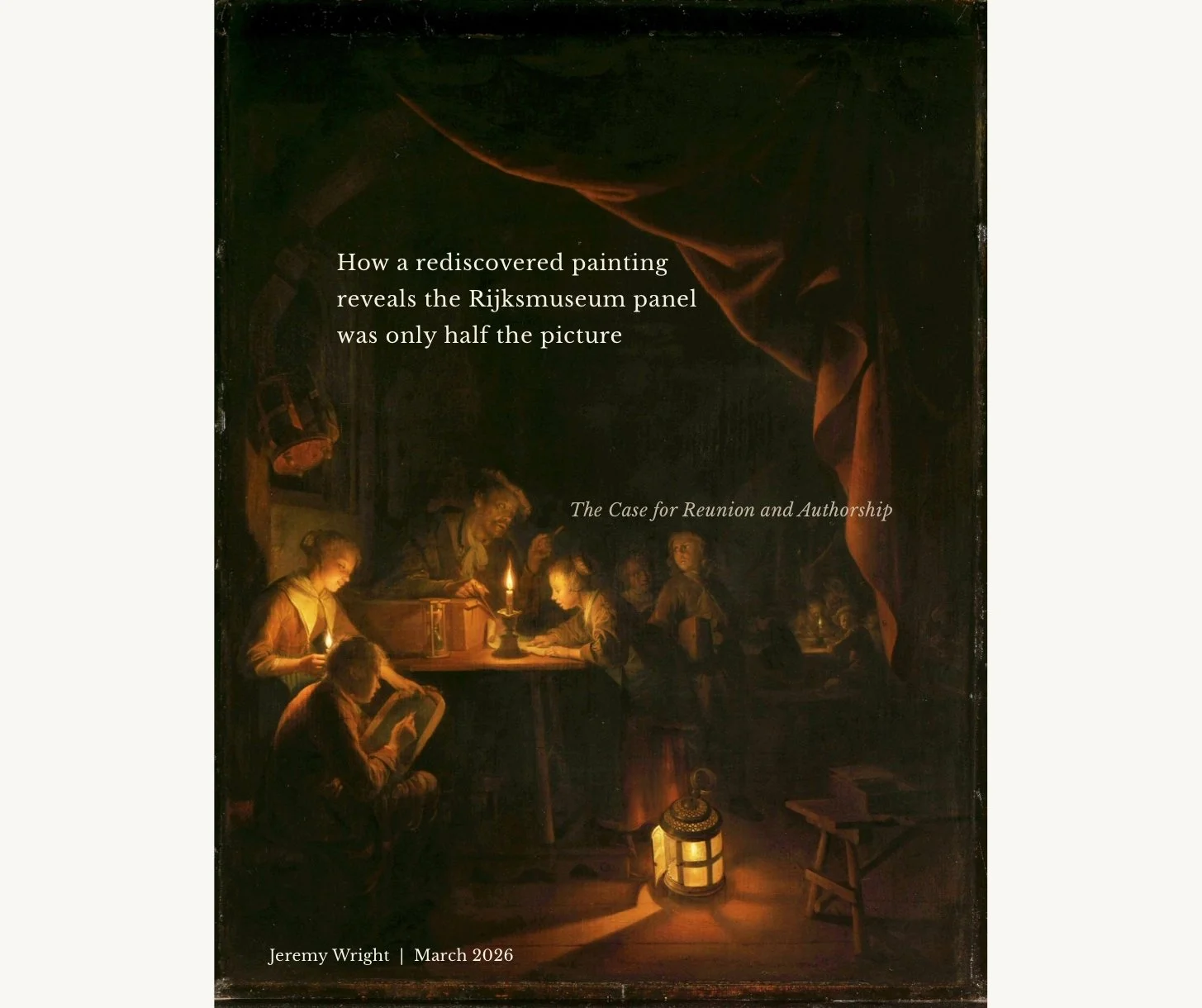
The Night School: The Case for Reunion and Authorship
How a rediscovered painting reveals the Rijksmuseum panel by Gerrit Dou was only half the picture.
Jeremy Wright | Updated May 2026
Preface
In November 2021 I came across an unusual candlelit painting of children on eBay. By chance that same week, during a visit to the Rijksmuseum in Amsterdam, I stood before Gerrit Dou’s The Night School and was struck by an unexpected connection between the two works. As I looked more closely and then read the gallery caption, I realised that its explanation did not match what I could see: there was an unresolved gesture in The Night School that the description did not adequately explain. That moment marked the beginning of a four-year investigation into how the painting I subsequently acquired might relate to Dou’s panel.
This research dossier examines whether the painting originated in Dou’s Leiden studio as the companion panel to The Night School. The study draws upon compositional analysis, technical examination, stylistic comparison, and documentary evidence to assess this possibility.
If the relationship proposed here is correct, the rediscovered painting substantially alters how The Night School can be understood: no longer as a self-contained image of instruction, but as one half of a larger diptych structured through contrast, relation, and time. Much of the discussion that follows therefore concerns not attribution alone, but the system of meaning that emerges once the two panels are reunited — revealing a far richer treatment of learning, behaviour, and attention than has previously been recognised in Dou’s painting alone.
The evidence is presented as a framework that others may examine, question, refine, and build upon in their own research, or use for teaching. The dossier has been shared with the Rijksmuseum, which has added its findings to its files on The Night School.
Whatever the eventual outcome of the arguments advanced here, the possible reunion of a diptych not seen complete since Dou’s panel left his Leiden studio in 1665 is itself a noteworthy moment. The fuller significance of the work will naturally emerge as the painting becomes better known and finds its place within the history of Dutch Golden Age painting.
How to Cite this Dossier
Jeremy Wright, The Night School: The Case for Reunion and Authorship, thenightschool.org, Updated May 2026.
When citing a specific section, add the section number and title. For example:
§5.8, “The Flame as Signature.”
Comments or suggestions regarding the arguments presented here are welcome and may be sent via the contact form provided on this site.
© Jeremy Wright, 2021–2026. All rights reserved.
All images remain the copyright of their respective owners and are reproduced here for scholarly purposes.
Contents
1 THE TWO PAINTINGS
1.1 Puzzling Anomaly
1.2 The Teacher’s Assistant
1.3 A Temporal Diptych
1.4 Two Paintings to Scale
1.5 A Different Force
1.6 Connections
1.7 Moment of Collapse
1.8 The Measure of Time
2 STRUCTURED UNITY
2.1 Pair on the Wall
2.2 Folly Adrift
2.3 Five Lights of Learning
2.4 Balance of People and Tables
2.5 Numerical Structure
2.6 Unified by Time
2.7. Iconic Role Models
2.8 The Teacher’s Identity
2.9 Youthful Joy
2.10 The Rhythm of Learning
2.11 A Lesson in Authority
2.12 The Triangular Lock
2.13 Scale and Hierarchy
2.14 Colour and Structure
3 AUTHORSHIP
3.1 A Radical Step
The Case for Godfried Schalcken
3.2 Process of Elimination
3.3 Grounding in Candlelit Drama
3.4 Courtauld Technical Evidence
3.5 Early Comparative Analysis
3.6 Interim Authorship Summary
4 PRODUCT OF ITS TIME
4.1 Leiden Influence
4.2 Leiden Rivalry
4.3 A Captured Moment
4.4 Career Progression
4.5 Social Evolution
4.6 The Artist as Conductor
4.7 Spiritual Register
4.8 Fine Bookends
5 THE STUDIO EXPERIMENT
5.1 A Special Relationship
5.2 Evolution of Learning
5.3 Compositional Precedent
5.4 A Master’s Instruction
5.5. Choreography of Consequence
5.6 Time Made Visible
5.7 Reading Time in Paint
5.8 The Flame as Signature
5.9 Children with Life
5.10 Physiognomy as Argument
6 A SINGULAR CREATION
6.1 A Living Tension
6.2 A Black Swan Moment
6.3 Folly Alone
6.4 The Diptych in Dou’s Oeuvre
6.5 Dou’s Creative Leap
6.6 Learning and Human Potential
6.7 Reassessing Dou’s Legacy
6.8 Dou and Schalcken
6.9 A Lesson in Teaching and in Life
6.10 Market Reality
6.11 Schalcken Reconsidered
6.12 Lost Silver as Tribute
6.13 An Enduring Enquiry
6.14. A Fine Mechanism
6.15 Completing the Picture
6.16 Wider Perspectives
7 PROVENANCE
7.1 The Night School
7.2 Folly at the Night School
7.3 Comparative Technical Notes
8 POSTSCRIPT
APPENDICES
1. The Process of Discovery
2. Courtauld Technical Report
3. The Rijksmuseum Description
6. Some Thoughts on Display
BIBLIOGRAPHY
1. Primary Sources
2. Secondary Sources
3. Digital/Technical Sources
1 THE TWO PAINTINGS
1.1 Puzzling Anomaly
Since its acquisition in 1808, The Night School by Gerrit Dou has been exhibited in the Rijksmuseum as one of the cornerstones of seventeenth-century Dutch genre painting. One of the most meticulously constructed paintings of the period, it exemplifies the care with which learning is ordered and maintained.
Yet, unusually for an artist known for precise compositional control, the work contains a puzzling anomaly. The teacher, the central figure, raises an emphatic finger toward something not visible. No behaviour within the painting appears to justify the gesture, and none of the surrounding figures acknowledge it or react. At the same time, a large curtain establishes a strong visual axis to the right, in the very direction toward which the teacher points. The gesture is therefore the key action in the composition, yet its intended recipient appears absent.
Attempts have therefore been made to supply a recipient for the gesture. The Rijksmuseum gallery text suggests that the "schoolmaster admonishes a boy standing in shadow"; 1 while the art historian Arthur K. Wheelock Jr. interprets the gesture as directed toward "the boy in the shadowed middle ground." 2
But no such figure appears in the direction of the gesture. The assistant visible beyond the teacher sits further back in space, his smaller scale confirming his position in the middle ground. He neither meets the teacher's gaze nor reacts to the gesture, and performs no action that might provoke rebuke. The admonished boy is therefore not a figure within the composition but an interpretative addition introduced to account for a gesture whose intended recipient is absent from the panel. X-radiographic examination of the Rijksmuseum panel confirms that no such figure was ever present at any stage of the painting's development (see §7.3 and the Rijksmuseum technical notes, inv. no. SK-A-87).
1.2 The Teacher’s Assistant
As I realised in the gallery, the person toward whom the teacher appears to raise his finger is his assistant, who responds with outstretched arms as if to say, “What can I do?”
Why? Because he is failing to control a whole table of unruly pupils in a second panel — the painting I have identified as its counterpart. [Fig. 1]
This work is referred to here as Folly at the Night School, a separate title intended simply for clarity of discussion rather than to imply independence, since the picture is best understood as the second half of a single visual conception.
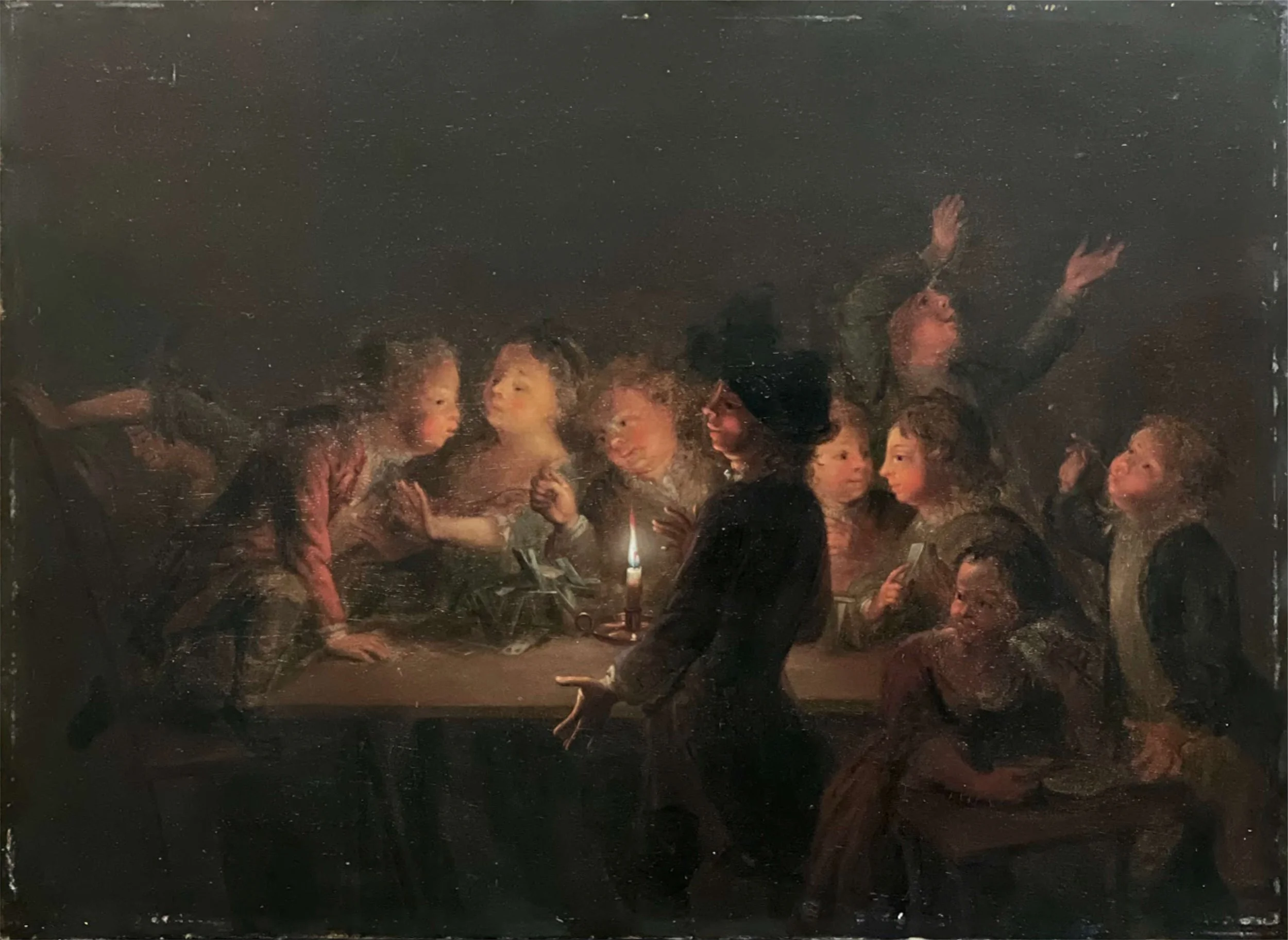
Fig. 1. Folly at the Night School, oil on panel, 22.5 x 30.6cm. Click to open in new window for viewing as you read the dossier.
1.3 A Temporal Diptych
The evidence presented here supports the view that The Night School was conceived as the master scene in a single, structured narrative — a composition whose discipline and stillness gain their full force only when set against a contrasting scene, showing how easily that order can unravel. Folly is smaller and horizontal in format, focused on a single table in the same schoolroom — the one that has caught the teacher's eye. Its scale follows naturally from its subject. This is no decorative pairing but a dramatic structure, designed to show how the behaviour of a few children can unsettle an entire classroom. The asymmetry is well suited to that purpose.
Folly at the Night School earns its name because, on first impression, the diptych stages a familiar opposition: diligence and folly. Look closer, however, and the opposition is not moralising in the usual way. It is more precisely temporal. The paintings do not contrast virtue and vice as fixed states, but the wise and unwise use of the same measured time. The underlying structure is therefore more layered — and more open — than a simple binary would suggest.
1.4 Two Panels to Scale
When the Rijksmuseum's dimensions of The Night School panel (53.8 × 42 cm) are applied, the figures within it correspond closely in size to those in Folly at the Night School.1 Seen together, the two compositions operate at the same human scale, allowing gestures, glances, and spatial relations to align naturally across the divide. The correspondence is not approximate but structural: the figures inhabit a shared pictorial world. [Fig. 2]
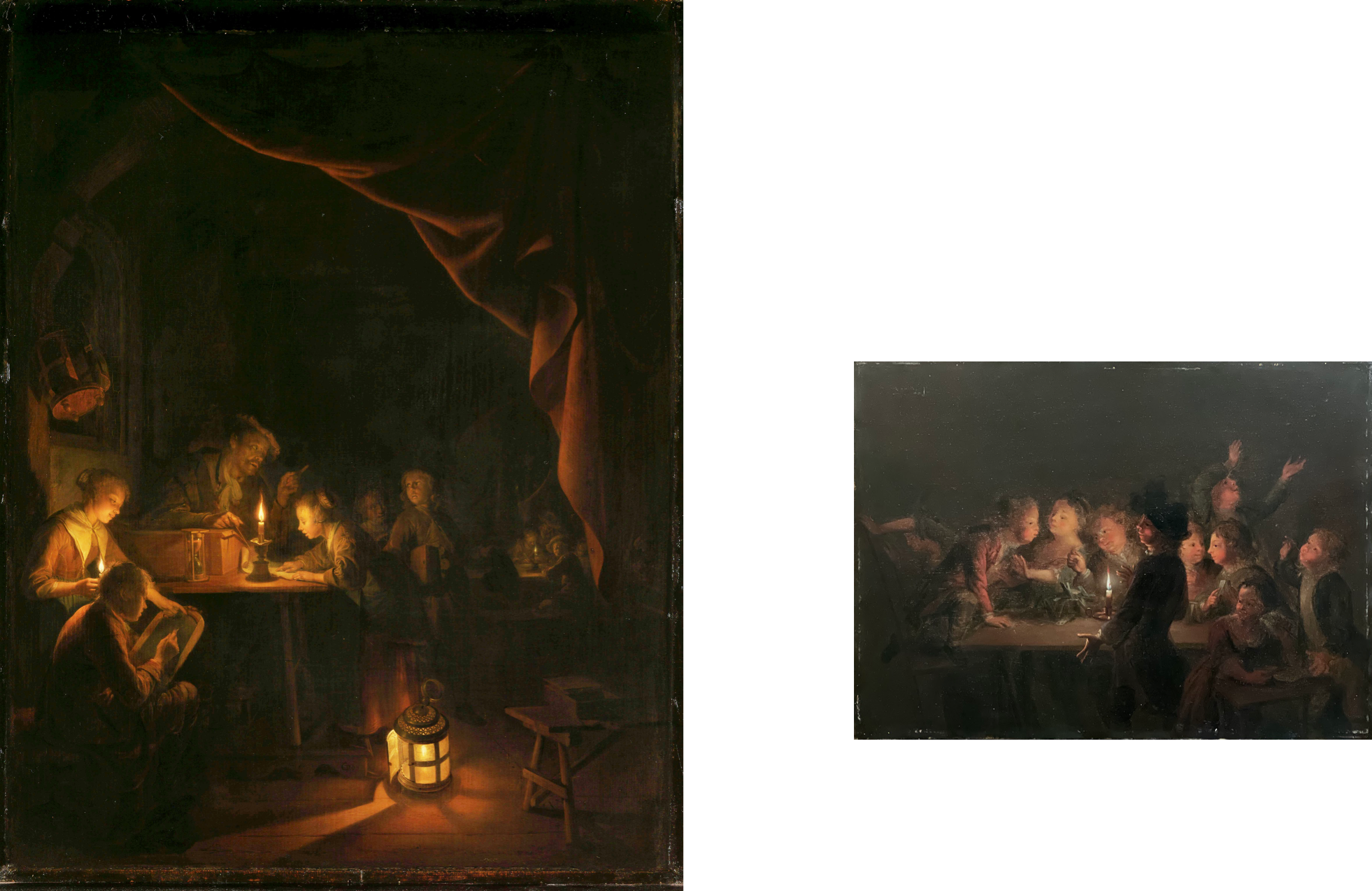
Fig. 2. The two panels to scale: The Night School 53.8 x 42cm (Rijksmuseum); Folly at the Night School 22.5 x 30.6cm (private collection). Click to open in new window for viewing as you read the dossier.
1.5 A Different Force
While the two paintings share lighting, scale, and pictorial architecture, Folly carries a different force. It reads as the work of another hand — a difference that sharpens rather than weakens the dissonance between the scenes. Had both panels been painted by Dou alone, the pairing would not deliver the same effect. It is not merely two views of a classroom, but a structured contrast: between restraint and exuberance, order and disruption, education and its potential undoing.
Unusually for a painting of the Dutch Golden Age, the pairing appears to involve two authorial voices. Folly introduces the disruptive energy on which the structure depends. It shows what the teacher in The Night School responds to, and what threatens the concentration of the classroom as a whole. The conception implies a division of pictorial roles: order on one side, volatility on the other.
This is not the kind of task typically assigned to a studio assistant under the usual terms of studio training. Rather than imitation or replication, Folly suggests the deliberate introduction of a contrasting pictorial temperament — one capable of animation, instability, and expressive candlelit movement. Whether this reflects a conscious delegation by Dou, or a more collaborative studio dynamic, is a question taken up later.
Yet despite the difference of hand, the two panels read as parts of a single conception. Their coherence in scale, lighting, and narrative function points to an overarching structure, even as their stylistic contrasts invite closer examination. How that balance between unity and difference was achieved — and what it reveals about design, authorship and learning — forms a central thread of the sections that follow.
1.6 Connections
If the two paintings, by different artists, were conceived as a single narrative, what are the connections that give the composition its coherence?
Both paintings draw the viewer into a moment in time in a dimly candlelit interior. A pupil from the children's table has come forward to read to the teacher. Her bench, with books upon it, now sits in the foreground of The Night School, leaving a visible gap at the children's table in Folly. She is also unmistakably one of them: she shares the same impish features and is noticeably younger than the other students in The Night School panel. She reads, and the children are misbehaving — blowing over a house of cards, pushing over a chair, blowing bubbles, eating some bread.
The key focus of the works is the teacher in The Night School and his assistant in Folly, and their response to the disruption. Their eyes lock and their exasperated gestures — the stern finger and the open-palmed helpless shrug — answer each other across the divide. They are the only two hatted figures in the diptych — visual signposts across the panels, signalling their authority, shared responsibility, and the central structural axis of the work.
Both hats are consistent with mid-seventeenth-century Dutch dress. The teacher’s hat is a wide-brimmed, flat-crowned felt hat of a type frequently associated with sober, respectable dress. It is practical but restrained, contributing to an impression of authority without ostentation. The assistant’s hat is more informal — soft felt, somewhat slouched and more expressive in character. It suggests a looser, less settled mode of dress, consistent with his position within the scene. 3
1.7 Moment of Collapse
While all is orderly in The Night School, Folly is on the point of collapse.
A boy has climbed on a chair to blow over a house of cards, which is already tumbling. Beyond it is the lit candle, which will be next if he is not stopped — a single flame whose extinction would plunge the scene into darkness. A girl and a boy try to restrain him, but seemingly to no avail, while another girl pushes at the chair itself, increasing the likelihood that he will crash to the table.
Elsewhere in the composition, two boys are engaged in playing cards; two boys have left the table to blow and chase bubbles; and a girl has turned away from it to eat food on her bench.
There is no work being done and no books to be seen.
1.8 The Measure of Time
In The Night School, the teacher has just turned the hourglass for the girl to begin reading — an act that marks the measured, diligent use of time. Seen alone, it simply starts the lesson. But when reunited with its companion panel, its meaning deepens: the turning of the glass sets the ordered rhythm of one scene against the disorder unfolding in the other.
In Folly, in that same moment, the house of cards collapses, the chair tips, the bubble is about to burst. Mischief runs like sand through the glass. The teacher's raised finger in The Night School and the assistant's outstretched arms in Folly meet across the two panels in the same arrested instant — a bridge of cause and consequence.
The hourglass thus binds the diptych in a single temporal and behavioural frame. In The Night School it measures diligence; in Folly it reveals how the same measure of time can be wasted. Seen together, the two panels bring to life the wise and unwise use of time — how swiftly order can give way to disorder, and how precarious the attention on which learning depends.
Footnotes to Section 1
Rijksmuseum, The Night School, Gerrit Dou, collection database entry and technical notes (G. Tauber, 2021), inv. no. SK-A-87, https://www.rijksmuseum.nl/en/collection/object/The-Night-School--206d24dbca2f35d9d6a296bdb2e00193 (accessed March 2026).
Baer and Arthur K. Wheelock Jr., ed., Gerrit Dou, 1613–1675: Master Painter in the Age of Rembrandt (exh. cat., National Gallery of Art, Washington; Dulwich Picture Gallery, London; Mauritshuis, The Hague, 2000–2001), p. 120, where Wheelock states “The schoolmaster raises an admonitory finger at the boy in the shadowed middle ground”.
Marieke de Winkel, Fashion and Fancy: Dress and Meaning in Rembrandt’s Paintings (Amsterdam: AUP, 2006), esp. 102–107 on headware and its meanings.
2 STRUCTURED UNITY
If The Night School and Folly together form a single narrative conception, the structure that binds them is equally deliberate. Scale, perspective, light, gesture, number, time, and human behaviour operate together within a unified compositional system through which the diptych’s drama unfolds.
2.1 Pair on a Wall
When placed side by side, the two panels behave not as an incidental pairing but as a single, engineered ensemble. Their scales, internal proportions, and visual correspondences are such that the scenes begin to fuse when viewed together, suggesting that they were conceived to operate physically as well as conceptually on the wall.
This becomes evident first in their basic proportions. The combined height and width of Folly closely match the height of The Night School — a structural equivalence unlikely to be accidental and consistent with deliberate planning. With Folly to the right of The Night School (from the viewer's standpoint), the call-and-response of gestures and glances forms a single split-second storyline. The children in Folly do not look back to the teacher they disturb — they are too absorbed — but the assistant's outstretched arms before them act as a conduit, reflecting their misbehaviour across the divide to the teacher and closing the narrative circuit between the two panels.
Perspective plays its part with quiet elegance. The teacher’s desk in The Night School is level and authoritative, anchoring a space that unfolds clearly into depth. By contrast, the table in Folly is set within a markedly compressed field, with little indication of recession beyond the immediate group. When the panels are viewed together, this asymmetry becomes productive: the shallower space of Folly is read against the deeper interior established in The Night School, encouraging the viewer to perceive the two scenes as occupying a continuous environment. Depth is thus not constructed equally in both panels, but emerges through their conjunction.
Even when the paintings are viewed in their separate frames, with a natural gap between them, the connection remains legible. It is the interlocking of the teacher’s and assistant’s eye lines and gestures — supported by broader spatial correspondences — that draws the two scenes into a shared narrative field, encouraging them to be read in relation to one another.
A scale mock-up illustrates how the works might have appeared if framed and hung on an oak-panelled wall together in the seventeenth century. [Fig. 3]
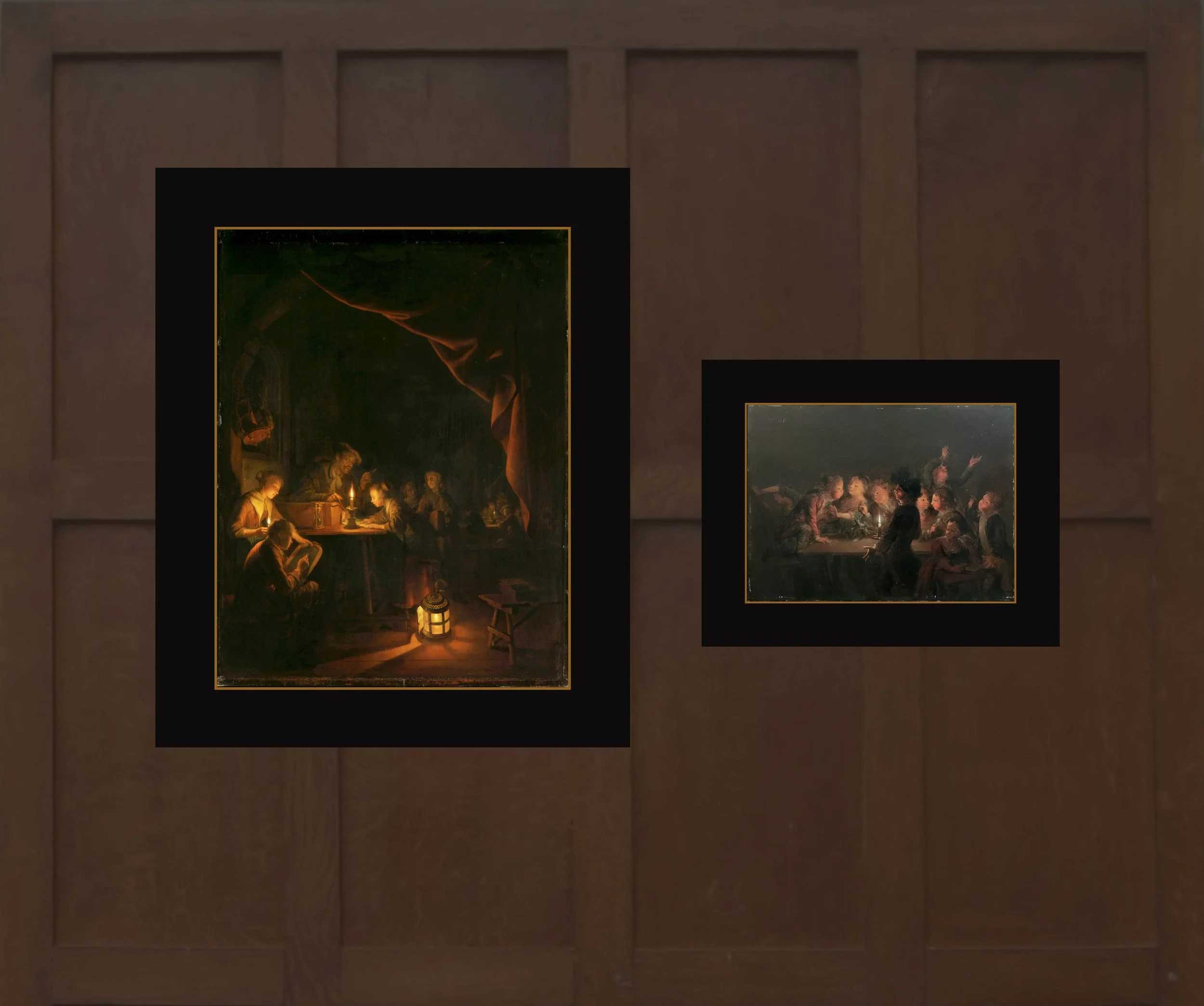
Fig. 3. The Night School and Folly at the Night School as they might have appeared, if framed, on an oak-panelled wall in a seventeenth-century Leiden interior.
2.2 Folly Adrift
If The Night School is incomplete as a standalone panel, Folly makes no sense at all. Who, after all, would design a candlelit scene in which a large foreground figure is shown on the shadow side of the flame, gesturing emphatically out of the side of the picture? All the illuminated action is set beyond and behind him, his arm cutting across the candlelight. None of the children respond to his gesture. The only logic is that it is directed toward the teacher in The Night School. Without its partner panel, the gesture has no recipient. With it, the two panels click together: the teacher admonishes, the assistant reacts, and the schoolroom becomes one flowing narrative. Only one figure in the diptych appears to witness the exchange: the small girl at the lower right, who, turned toward us, glances past the assistant toward the teacher beyond. Nonchalantly eating her bread, she treats the unfolding reprimand as entertainment.
2.3 Five Lights of Learning
Across the reunited diptych, five lights structure the entire sequence: four steady flames in The Night School — the desk candle, the girl’s candle at left, the back-table candle, and the floor lantern — balanced by a single, more lifelike flame in Folly, examined later. Seen together, they act as fixed points of illumination that guide the eye around the schoolroom and bind the two panels into a continuous visual system.
In The Night School, the four lights anchor the architecture of order: each illuminates a distinct pocket of teaching and learning. Earlier scholarship has rightly emphasised the symbolic significance of these flames. Franits observed that candles in seventeenth-century Dutch literature and emblematic imagery were closely associated with reason, understanding, vigilance, and disciplined study. 1 Wheelock likewise noted the similarity of the standing girl in the left foreground, holding a candle to supervise the pupil writing on slate, to the figure of Cognitione (Kennisse, or Understanding) in Cesare Ripa’s Iconologia (1644), where illumination functions as an emblem of knowledge attained through attentive learning. Wheelock further connected the large floor lantern with contemporary metaphors of learning and cognition, interpreting the darker hanging object at left as an unlit counterpart signifying ignorance overcome through study— though this latter reading is considered further in §2.6. 2
Yet the reunion of Folly reveals that these lights do more than symbolise learning: they organise it pictorially. In The Night School, the flames sustain a carefully ordered environment of concentration and discipline. In Folly, by contrast, the lone candle becomes the vulnerable centre of a scene already slipping from control — the single point of illumination around which distraction, movement, and consequence gather. Read together, the lights operate almost like stepping-stones for the viewer: a quiet visual path carrying the eye from one flame to the next across both panels, allowing the diptych to unfold not as two separate scenes but as a single pedagogical drama.
This five-point arrangement reveals the sophistication of the diptych’s design. The lights are not merely emblematic attributes distributed through the composition, but part of a larger luminous architecture through which Dou and Schalcken choreograph attention, sequence, and behavioural contrast across the two panels. Candlelight remains symbolic, but its symbolism is activated through structure, timing, and relation.
Within this system, the large curtain drawn from the right introduces a further vector of light. Its lower edge catches the candlelight, forming a long diagonal of light that leads the eye toward the right-hand side of the composition. Drawn back like a stage curtain, it lends the schoolroom a theatrical quality in which the principal scene extends laterally beyond its architectural frame, allowing the disorder of Folly to unfold in the right foreground as part of the same drama — a mode of spatial extension already familiar in the design of seventeenth-century Dutch theatres. 3
2.4 Balance of People and Tables
Although The Night School and Folly differ markedly in size and spatial character, each presents a comparably populated scene. Read together, the panels balance one another through human presence: one expansive and ordered, the other compressed and volatile, yet each containing the same number of figures.
In this way, the two panels establish a carefully structured balance of age and behaviour across the schoolroom. In The Night School, several figures quietly model correct behaviour: the assistant supervising a pupil writing at the lower left; the slightly older, more responsible pupils or assistants moving purposefully behind the teacher, books in hand. These figures function as living templates of diligence and attentiveness — visual standards against which the conduct in Folly is set. The contrast requires no explanation: order is shown, not asserted.
Another balancing factor lies in the tables. In The Night School, a small, dimly lit table sits in the background, barely registering in the scene. Seen on its own, it can feel a weak signal of a schoolroom setting. When the table in Folly mirrors it in the foreground, however, it transforms from an isolated detail into one of several, indicating a busy, multi-table classroom. In turn, the background table in The Night School lends coherence to Folly, anchoring its scene of disorder as part of a larger institutional space rather than an isolated subject.
Without the riotous second panel, Dou's title The Night School can feel oddly overstated — a scene with a surprisingly high proportion of teachers or assistants to pupils. With Folly, by contrast, the title comes fully alive. Together, the diptych depicts a complete schoolroom ecosystem, balanced between order and disorder, example and lapse, study and mischief.
2.5 Numerical Structure
The diptych's architecture rests on numbers as much as on figures. With each panel containing ten figures, a deliberate equilibrium of diligence and distraction is established across the two scenes. The effect is like a narrative seesaw: when the diligent girl rises from the Folly table to read in The Night School, her move tilts the balance. The scene tips into disorder. Her departure removes a stabilising presence, and mischief spirals.
Such numerical structuring, once recognised, would likely have carried resonance within a culture familiar with scriptural narrative and moralised imagery. The division of ten into two contrasting groups recalls familiar biblical patterns, most notably the parable of the Wise and Foolish Virgins (Matthew 25:1–13), in which five are prepared and five unprepared — a moral contrast centred on vigilance, time, and readiness. While no direct reference can be assumed (though the parable is associated with Folly in later evidence; see §4.7), the underlying logic of balanced opposition would likely have been readily intelligible.
More broadly, Dutch moral and emblematic traditions — as seen in the writings of Jacob Cats — habitually frame ethical experience through paired contrasts: diligence and idleness, order and disorder, restraint and impulse.⁴ In this context, the diptych’s numerical symmetry is less a fixed symbolic code than part of a wider visual language in which number, balance, and contrast serve to organise meaning and satisfy through their use.
Before the girl’s move across to The Night School, ten children sit at the Folly table: some attentive, others inclined toward distraction. With the oldest-looking pupil removed, the balance shifts. Now the unruly outnumber the attentive, and a chain of small collapses follows: cards fall, chairs topple, bubbles scatter, and the candle of learning is threatened. [Fig. 4]
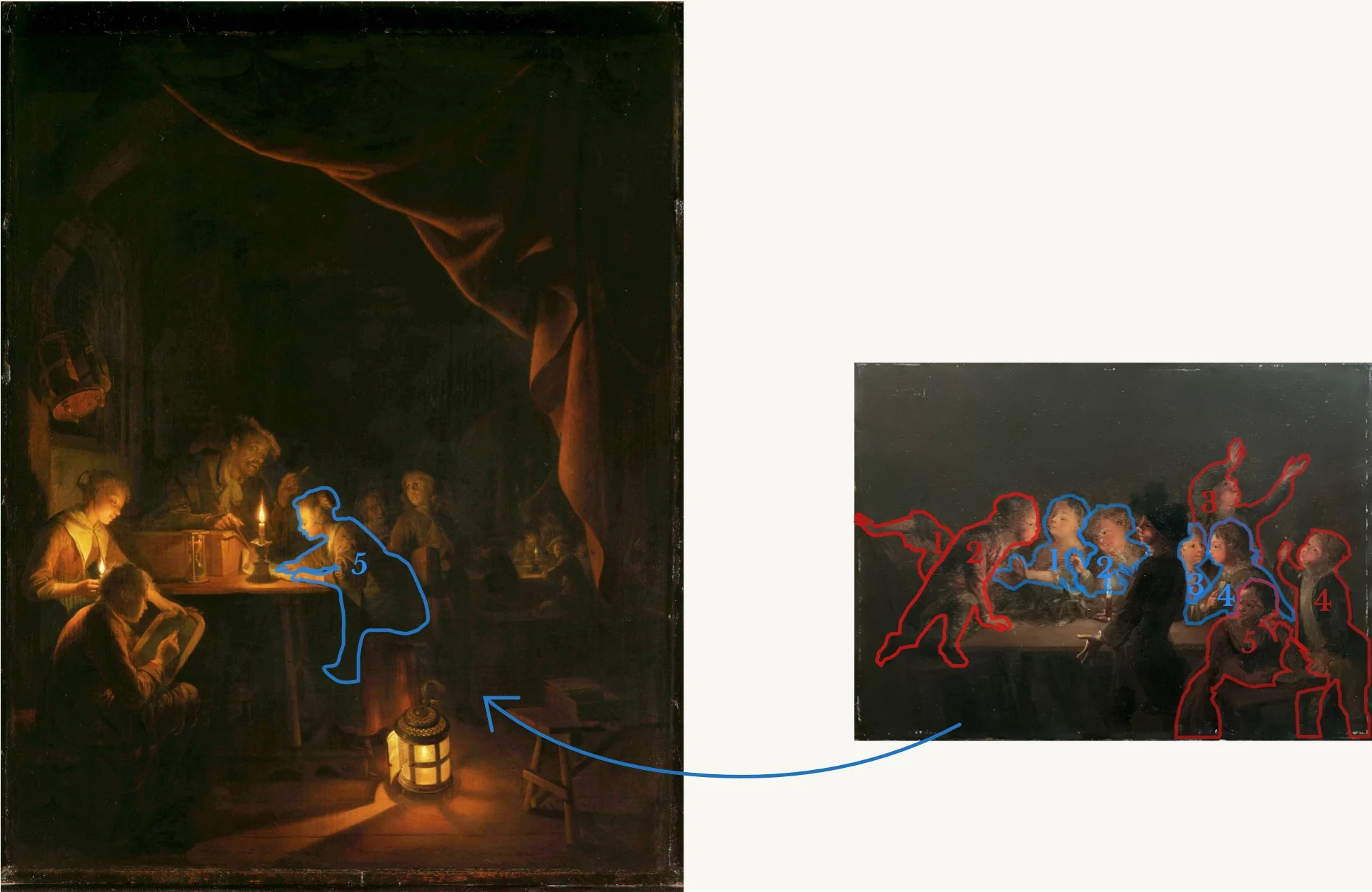
Fig. 4. The balanced parity of five more diligent and more unruly pupils. When one of the diligent pupils crosses to read, the Folly table loses its stabilising presence: the remaining four are outnumbered, and disorder follows.
The five-point lighting scheme described above participates in the same logic. The four steady lights in The Night School and the single exposed flame in Folly translate the balance of diligence and folly into visual form: stability distributed across many points versus risk concentrated in one. Comparable five-part structures recur elsewhere across the diptych: in the five adult and supervisory figures, where one destabilising assistant unsettles an otherwise ordered framework; in the five figure groupings across the two panels, where the one in Folly threatens to unsettle the others; and in the five female figures spanning distraction to disciplined learning, culminating in the standing girl associated with Cognitione.
This recurring numerical balance, by virtue of both its precision and repetition, is unlikely to be accidental. Rather, it establishes the framework within which the diptych’s deeper articulation of learning operates — in time, measured and placed under pressure across the two scenes, and in human development, expressed most fully through the physiognomic contrasts traced across the figures (see §5.10).
2.6 Unified by Time
At the centre of this ordered structure, beside the teacher, Dou grouped a drum, an hourglass, and a candle in close proximity. The darker hanging object at left, previously interpreted by Wheelock as an unlit lantern, lacks the glazed panes visible in the illuminated floor lantern and more closely resembles a suspended drum. Seen alongside the adjacent hourglass and candle, this identification also clarifies the object’s compositional role within the schoolroom. Read together, these objects would likely have signalled discipline, time, and study: the drum marking the rhythms through which collective activity was regulated, the hourglass measuring the duration of the lesson, and the candle providing the light by which learning could proceed. Their placement is deliberate. The drum hangs high on the wall, out of reach of the children; the hourglass sits close to the teacher’s authority. Together they announce a governed pedagogical space, structured through time.
The hourglass, however, does more than identify a schoolroom. It activates the diptych's deepest logic. The sand has just been set running for the girl's candlelit reading in The Night School — a timed act of attention and discipline. Yet that same movement across the room coincides with a loss of order in Folly, where play has overrun its allotted time and the assistant has failed to restart the class. Time is therefore not merely measured; it is used well in one panel and mishandled in the other. The diptych's counterpoint is not simply diligence versus folly in the abstract, but the wise and unwise use of time made visible in action.
This is why Folly feels so precarious. It is a painting of mis-timing: cards caught mid-fall, a chair tipping, bubbles rising, a candle threatened at the very moment the scene begins to unravel. The viewer registers the before — the children's break of play and food, and the assistant's failure to restore order; the now — the instant when disorder tips into collapse; and the after — the imminent fall and the disruption that will follow, all compressed into a single arrested moment.
Read together, the two panels therefore operate like a parable of temporal wisdom. The Night School shows time structured and invested — attention gathered, learning sustained, dignity formed. Folly shows how easily time can be squandered — and how swiftly consequence follows when the moment to restore order is missed. The hourglass is the quiet link between them: a small instrument that unifies the entire diptych and shows how the authority who turns it determines what the measured time is for.
2.7 Iconic Role Models
Earlier readings of The Night School understandably turned to the visual language of emblematic tradition to interpret its distinctive figures and gestures. Before the recovery of Folly, the painting appeared to function as a self-contained image of instruction, inviting comparison with the allegorical figures and personifications that populated seventeenth-century moral and pedagogical imagery. Several of these parallels remain illuminating, though the reunion of the diptych changes the weight they can bear.
The most persuasive comparison concerns the standing girl at the left of the composition. Holding a candle while directing attention toward the pupil at the desk, she closely recalls the figure of Cognitione (Kennisse, or Understanding) in Cesare Ripa’s Iconologia (1644), where illumination signifies knowledge acquired through attentive study. Her role within the composition similarly combines light, guidance, and intellectual focus. She mediates attention itself, her outstretched hand guiding the pupil — and the viewer — toward the act of learning. The resemblance is unlikely to be coincidental. Dou, whose work was known to engage with the visual traditions of emblematic culture, appears deliberately to invoke the established association between light and understanding.
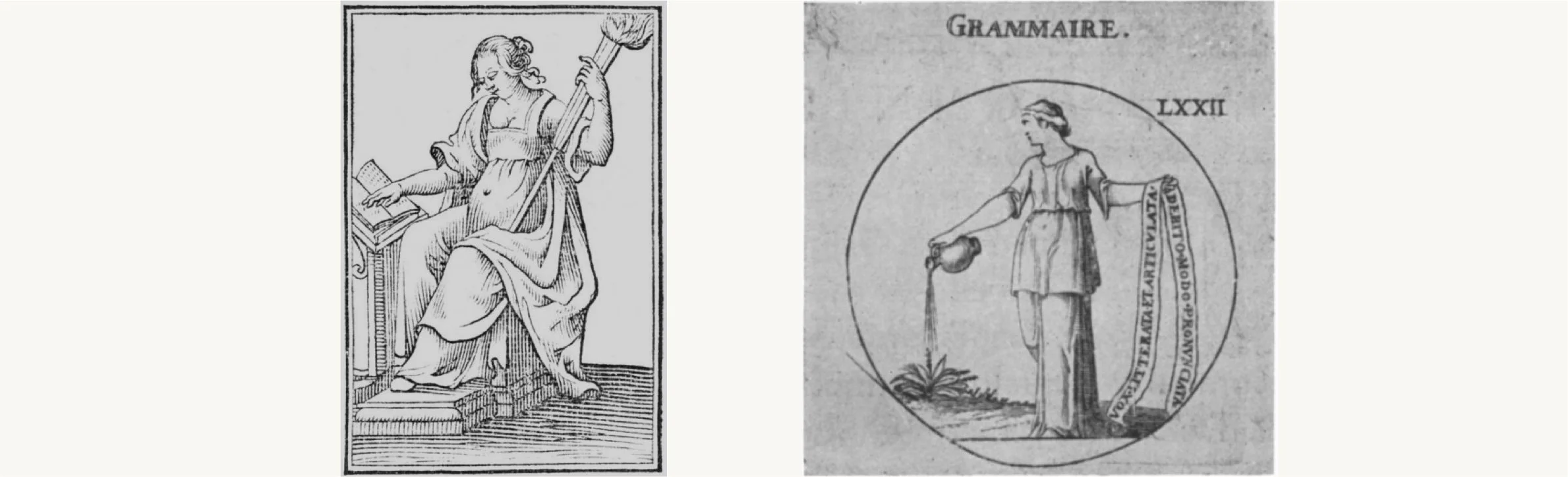
Fig. 5: Cesare Ripa’s Cognitione (left) and Grammatica (right), from the 1644 editions of the Iconologia. The candle-bearing girl in The Night School recalls the visual language of Cognitione, while Dou’s teacher differs fundamentally from the gentle, nurturing figure of Grammatica: his raised finger does not cultivate learning, but intervenes to restore discipline.
Less convincing is the long-standing attempt to associate the teacher with Ripa’s Grammatica. Wheelock noted certain broad similarities between the teacher’s raised gesture and the outstretched arm of the allegorical figure, whose nurturing action symbolises the cultivation of learning. Yet the differences are more striking than the resemblance. Grammatica is conventionally represented as female, gentle, and maternal, often watering plants as a metaphor for intellectual nurture and gradual cultivation. Dou’s teacher, by contrast, is male, upright, and admonitory. His raised finger does not nourish or encourage; it intervenes. The emotional register is entirely different: not allegorical serenity, but disciplinary immediacy. [Fig. 5] 5
The weakness of the Grammatica comparison reveals a larger problem. Interpreted in isolation, the teacher’s gesture appears unresolved and iconic, encouraging scholars to search for symbolic prototypes capable of explaining it. Once Folly is reunited with The Night School, however, the gesture no longer points into abstraction. Its object becomes immediate and concrete: the assistant whose failure of vigilance has allowed the schoolroom to lapse into disorder. What previously seemed a generalised emblem of instruction now reads as a specific act of teacher correction unfolding within the diptych’s continuous dramatic structure.
Dou’s use of visual reference was not limited to learned allegorical traditions. Smaller details within Folly suggest the same willingness to utilise familiar vernacular imagery. The two boys playing cards, for example, are arranged in semi-profile and profile views that subtly mirror the profile variation of court cards themselves. The visual rhyme is slight but precise: in a scene where play increasingly governs behaviour, the players embody the game in which they are engaged. Such details suggest that Dou took a flexible and imaginative approach to the use of iconic figures, absorbing them into the diptych’s larger system of meaning. [Fig. 6]

Fig. 6: The opposing semi-profile and profile views of the two boys playing cards in Folly subtly mirror the contrasting profiles of court cards, a rewarding connection once noticed.
The reunion of the diptych therefore does not invalidate earlier iconographic readings, but places them within the drama of the schoolroom. Dou still draws upon the visual language of emblematic tradition — particularly in the association between illumination and understanding — yet these references no longer function as closed symbolic keys. Instead, they are integrated into a more complex pictorial system governed by time, behaviour, attention, and consequence. The figures are not static personifications but participants in a living pedagogical drama.
This shift changes the question posed by the teacher himself. Rather than asking which allegorical prototype he may or may not resemble, the reunited diptych directs attention toward why Dou chose to embody authority in this particular figure, with this particular gesture, at the centre of the schoolroom. The important question becomes how specifically Dou chose to render him in paint and to what end.
2.8 The Teacher’s Identity
Despite his proximity to the desk candle — positioned close to the flame, like the girl reading before him — the teacher’s complexion appears markedly darker than hers, an anomaly that cannot be attributed to the way he is lit. [Fig. 7] His features — darker skin tone, broader nose, short dark hair — differ from those of the surrounding figures in ways that go beyond the effects of candlelight. The X-radiograph of the panel confirms no later alteration to this passage, establishing that the rendering is original and intentional. 6
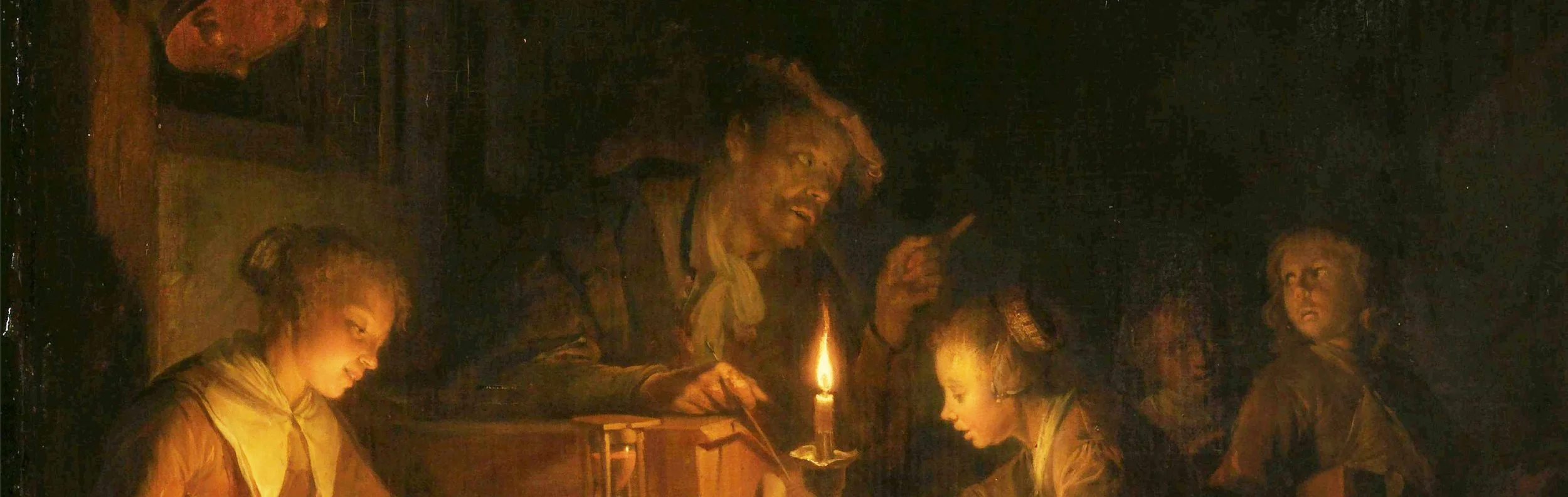
Fig. 7. Detail of The Night School: the teacher’s features differ visibly from those of the surrounding pupils — darker skin tone, broader nose, and short dark hair — while his elevated placement above the candle, forward-leaning posture, and raised directing hand establish him as the principal authority in the room.
In seventeenth-century Dutch painting this is unusual. Darker-skinned figures do appear in the period, but most often in subordinate roles — attendants, servants, or decorative presences. It is rare to see such a figure placed at the apex of a conventionally moralised scene, and rarer still to find one presented as the authoritative centre of a contemporary genre interior such as this.
In The Night School, Dou positions the teacher with unmistakable deliberation: elevated above the pupils and the instruments of learning, bearing the composition's strongest directing gesture, standing above the symbolic flame as its interpreter and guide. His central, heightened presence and the authority of his gesture place him apart from every other figure in the composition — not as an observer but as its governing intelligence.
Within a culture shaped by Calvinist theology and civic humanist ideals — both of which affirmed the equality of souls and the duty to cultivate one's gifts — such a figure could embody these principles with particular clarity. His placement is consistent with the view that discipline and learning, rather than birth, confer authority and respect. For a painter as intentional as Dou, the teacher's distinctive appearance and compositional prominence carry interpretive weight that the painting's reception history has not yet fully addressed.
This reading resonates with Dou’s own practice as a painter and teacher. Having trained under Rembrandt and led a studio of pupils in Leiden for over two decades, he was deeply invested in the transmission of skill through disciplined instruction. The teacher may thus be understood as embodying a broader human premise: that learning is a universal capacity, capable of elevating those who devote themselves to it. In this context, the decision to present a figure of darker complexion at the apex of the scene acquires particular force — a visible assertion, in paint, that authority and respect are conferred not by origin but by education and self-mastery. This important theme is returned to in §5.10 and §6.6.
2.9 Youthful Joy
The diptych pairs the youngest children with the youngest classroom assistant. In The Night School, the older pupils and older assistants sustain a calm order: the former read, copy, and listen; the latter instruct and supervise. In Folly, by contrast, every figure is at the youngest stage of learning — and the assistant, with his flamboyant hat and softer features, is visibly less mature than his counterparts in the companion panel. Dou has deliberately grouped youth with youth.
Seen in this light, the disorder in Folly reads not as delinquency but developmental truth: the natural exuberance of the young, who require closer guidance and steadier example. Their high spirits are not condemned; they are understood. Given the task of creating a counterpoint to Dou's painting of diligence in The Night School, one might have expected a sterner view of its disruption. Yet the Folly table is anything but menacing: it overflows with life — an expression of childhood exuberance. The upstretched arms of the boy watching his bubble rise, the laughter and glances that ripple around the table, infuse the scene with natural energy. The moment captures not vice but vitality — a quality unusual in Leiden fijnschilder art. 5 What we witness is not degeneration but the untamed energy of the young that schooling must learn to channel.
In Calvinist teaching, diligence and folly were never simple opposites but partners in moral education. This balance is reinforced by the diptych’s use of familiar objects — instruments of work and play — that also carry recognised vanitas associations of time, transience, and human distraction. In The Night School, the steady candle is supported by the hourglass and drum — tools of measured time and discipline — while in Folly the more fragile candle is amplified by the falling house of cards and the boy blowing bubbles, images of instability and transience. 7 Arranged in a counterpoint of threes across the two panels, these elements do not impose a fixed meaning, but reinforce the behavioural contrast at the heart of the work.
Yet the children who imperil the class are portrayed with warmth and sympathy. Their exuberance is not condemned but understood as requiring guidance: their joyful energy is the raw material of learning itself. Such balance accords with a broader Calvinist understanding of education as the tempering of impulse through grace. The diptych therefore proposes that the exuberance of youth should be steadied, not extinguished — and that through discipline learning takes hold.
2.10 The Rhythm of Learning
Seen in this way, the disorder in Folly is not a condemnation of childish behaviour but a vivid moment when play has overrun its allotted time and begun to get out of hand. The children have been on break: they play with cards, eat, chase bubbles. But the lesson has begun again, and the assistant has failed to restore order. What The Night School captures is the precarious rhythm of any classroom where mischief can so easily escalate and disrupt others who are working.
Beneath this small schoolroom drama lies a delicate equilibrium. In The Night School, decorum depends on two stabilising forces: enough children setting a good example, and the assistant’s active supervision to steer the class. When the girl steps forward to read, the balance tips to five against four; when the assistant fails to restart the lesson, disruption takes hold. The double lapse sets the disorder in motion. The implication is that distraction is not moral failure but natural energy — energy that must continually be rebalanced through example and diligence, the very rhythm by which learning sustains itself.
Were the narrative to continue, the next instant would see the boy tumble, the candle snuff out, and the concentration of the whole room broken. The folly lies less in the children's high spirits than in the assistant's lapse — his failure to bring them back to task, to put the cards away, sit down, and fetch more books. The insight is not punitive but wise: in a well-ordered classroom, as in life more broadly, there is a time to work and a time to play, and wisdom lies in knowing when one must yield to the other.
2.11 A Lesson in Authority
This reading also sharpens our understanding of the figures who frame the scene. The assistant, with his foppish hat and dismayed yet half-defensive posture, is no neutral observer but a young man out of his depth — overconfident and inattentive, struggling to reassert control. His failure has allowed the break for play to spill into the time for study. The teacher’s raised finger, long read as an admonition directed at an unseen boy in the shadows, now reveals a more specific force: it is directed at the assistant himself, a reprimand for having allowed order to lapse.
Looked at this way, the diptych's balance subtly shifts. On the surface, the two panels appear to contrast diligence and folly; yet the real folly is not in the children — whose exuberance is rendered with palpable joy — but in the assistant's lack of diligence in restarting the class. What had seemed emblematic becomes dramatically human — a moment of teaching within the teaching.
The hierarchy of the schoolroom is re-enacted before our eyes: the teacher corrects his subordinate, the subordinate fails to correct his pupils, and the ripple of disorder travels outward until it reaches us, the spectators. In this small drama of authority, the paintings shine a light on misbehaving schoolchildren and hapless staff in a way that resonates down the centuries.
Were the sequence to continue, the next turn of order would be restoration: the girl returning to her place, the assistant regaining control, the balance of diligence restored. For what the diptych shows is not failure, but the perpetual motion of learning itself — order, lapse, and renewal — the beating heart of the process.
2.12 The Triangular Lock
Seen as a single narrative, the two panels form a compositional triangle that guides both the viewer’s eye and the unfolding story.
A. The ideal: In The Night School, the sand runs in the hourglass, the girl reads, and a steady candle burns. This is the apex of order — learning aligned with time and light. Yet the teacher's raised finger and gaze already point across to its lapse.
B. The lapse: In Folly, authority is lost: the children misbehave, and a more real candle wavers. The assistant gestures back in dismay, his dereliction of duty clear. The books required for the lesson are absent from the table — the volumes now resting on the bench in The Night School suggest the very tools the lesson requires.
C. The renewal: The bench that has shifted across the panels, with its closed books, is both the key to learning and the lesson’s resumption — the very tools the assistant in Folly should be using to restart the class. The bench also marks the absence of the diligent girl who has crossed to read before the teacher. Together, the books and the girl embody what the Folly table requires: the means and the discipline for the class to resume.
The two paintings form a closed triangle with a triple narrative lock [Fig. 8]:
A → B: the teacher's pointing gesture and sightline, to which the assistant responds. B → C: the bench gap to the bench, like a bolt pushed across, linking the narrative in both directions. C → A: the bench signalling that the girl has moved across from Folly to read to the teacher.
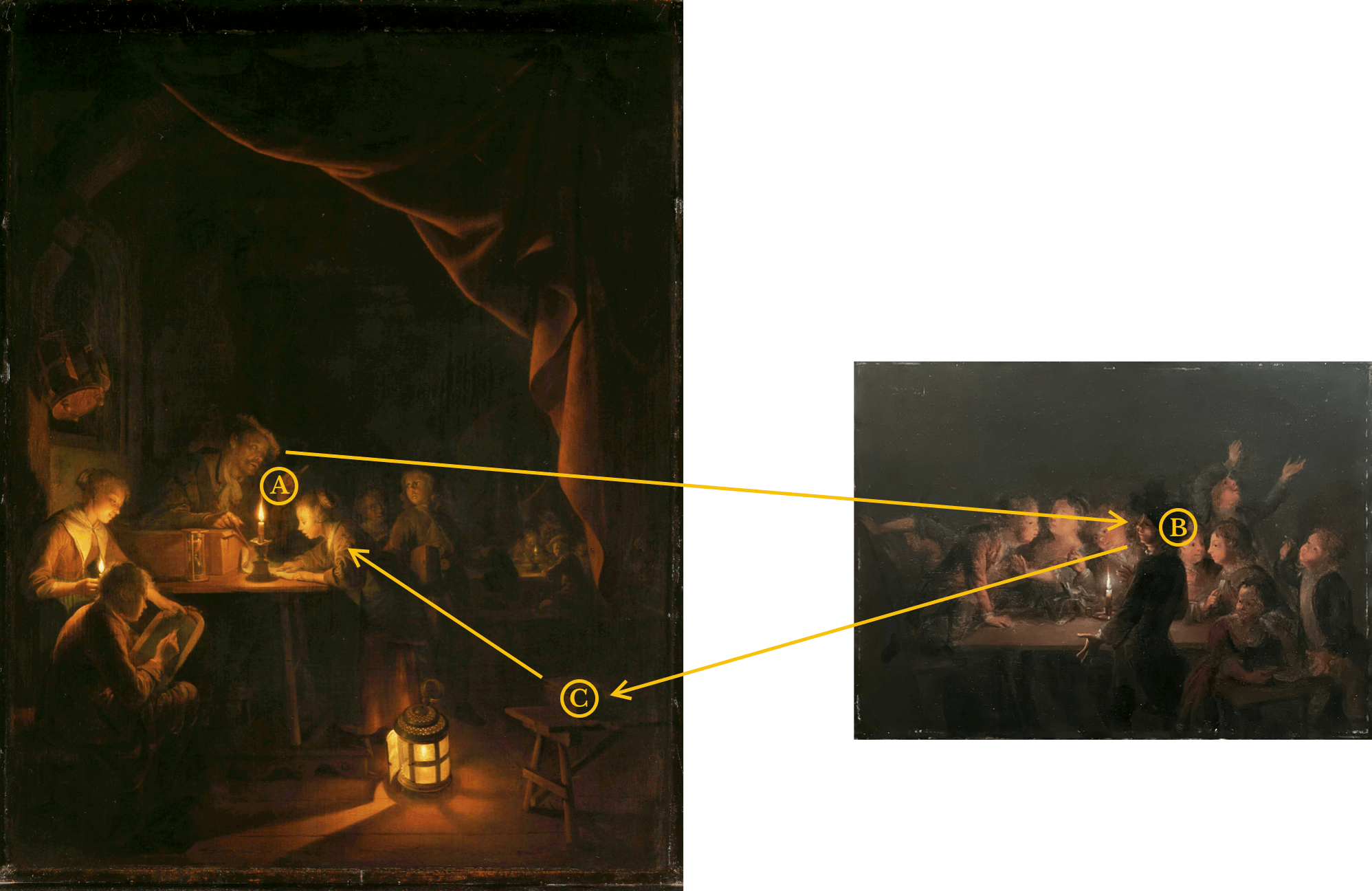
Fig. 8. The triangular circuit of gestures, sight lines, and the bench with books locks the narrative across the panels in a geometry of movement, response, and meaning.
Even the teacher’s and assistant’s outstretched arms, and the aligned angles of the bench and reading girl, reinforce this geometry. The foreground bench works almost like a signpost: one edge directs the eye to the girl’s diligence; the other points back to the unfolding folly at the table from which it came. The triangle becomes the structural lock uniting the two scenes — at once diagram and drama, the compositional proof of the diptych’s unity.
Pivotal in this triangular circuit is the girl sitting reading, who functions as the human bridge between the two scenes. Her features retain something of the unruly children's vitality — she is one of them — yet that energy is quietened into the absorption of reading. Her focus, like the candle in Folly, still holds. In compositional terms, she acts as a locking element: a figure whose posture, bench, and books bind the two panels together, binding the diptych into a single conception.
Taken together, the triple lock does not enforce a single moral; it points instead to a living rhythm. The Night School is not a fixed lesson but a cycle in motion: order achieved, order lost, order to be regained. Its unity lies not in prescribing a verdict but in showing how learning continually rebalances itself — a process in every schoolroom that here makes two paintings one.
2.13 Scale and Hierarchy
The strength of this triple lock allowed Dou to deploy an unusually inventive diptych format for its time. Folly focuses on a single table in the same schoolroom — the one that has caught the teacher's eye — and its smaller, horizontal format follows naturally from that concentrated subject. Yet the scale difference between the panels is more than a consequence of subject matter; it is itself a structural and pedagogical statement.
The panels balance numerically, with ten figures in each, yet they diverge markedly in scale and pressure. One is expansive and ordered; the other compressed and volatile.
The Night School is conceived as the governing upright frame: more spacious, calm, and architecturally stable. It establishes the diligent use of time — time measured, invested, and sustained. Its scale and depth reinforce its role as the normative scene, the place where balance is meant to hold.
Folly, by contrast, is smaller, denser, and more charged — a space in which mischief fractures the viewer's sense of time. Focused tightly around a single table, its compressed horizontal format intensifies proximity, movement, and instability. This is the space of lapse rather than order, of consequence rather than principle. By containing disorder within a reduced field, the composition prevents it from overwhelming the system as a whole. The imbalance is deliberate: disruption is potent, but bounded.
Seen this way, the asymmetry between the panels is structural. The larger panel does not mirror the smaller because it is not its equal; it governs it. The smaller panel does not overthrow that authority, but puts it to the test. Scale becomes a visual analogue for hierarchy: order sets the terms; misrule reacts within them.
This choice is consistent with Dou's meticulous intelligence. Rather than producing a decorative pendant of matching dimensions, he designed a narrative system in which size, weight, and visual pressure correspond to pedagogical function. The result is not a pair of equivalent scenes, but a calibrated structure — one that allows disruption to exist without displacing the authority that contains it.
The difference in scale between the panels also aligns with the hierarchy of the artists who painted them — the master and his apprentice. The larger panel establishes the system; the smaller enriches it.
2.14 Colour and Structure
When the panels are viewed together, further correspondences appear in the alignment of colour and structure across their join. In The Night School, the illuminated lower edge of the large curtain forms a strong descending diagonal. This line echoes both the teacher's raised finger and the direction of his gaze, projecting visually toward the space beyond the frame.
In Folly, that directional movement finds a clear continuation. The angle of the overturned chair appears to continue the curtain's diagonal, carrying the viewer's eye forward into the companion scene. The boy leaning across the table then establishes a counter-axis to this diagonal, stabilising the composition around the central candle — the narrative and visual heart of the second panel.
Colour appears to reinforce this structural linkage. The warm red of the curtain appears to find an echo in the red jacket of the boy at the table, while the dark garments of the teacher and assistant echo one another across the divide. The pupils and students in both scenes are painted within the same range of reds, blues, and browns, unified by the warm tonal spectrum of candlelight.
Taken together, these correspondences create a continuous visual rhythm that carries both line and colour across the boundary between the panels. The effect is subtle but consistent with deliberate planning: structure and palette operate together to bind the two scenes into a single pictorial system — a diptych whose unity operates simultaneously through narrative, geometry, number, light, and colour.
Footnotes to Section 2
Wayne Franits, Dutch Seventeenth-Century Genre Painting: Its Stylistic and Thematic Evolution (New Haven: Yale University Press, 2004), p. 122 on how studying by candlelight in Dutch literature and emblematic imagery were metaphors of viligence and studiousness.
Baer and Arthur K. Wheelock Jr., ed., Gerrit Dou, 1613–1675: Master Painter in the Age of Rembrandt (exh. cat., National Gallery of Art, Washington; Dulwich Picture Gallery, London; Mauritshuis, The Hague, 2000–2001), p. 120, where Wheelock highlights the similarity of the girl holding a candle in the left foreground to the figure of Cognitione (Kennisse, or Understanding) in Cesare Ripa’s Iconologia (1644); and goes on to compare the lit floor lantern with the unlit hanging lantern, embodying the ignorance teaching must combat.
W. M. H. Hummelen, “Types and Methods of the Dutch Rhetoricians’ Theatre,” in The Third Globe: Symposium for the Reconstruction of the Globe Playhouse (Detroit, 1981), 164–89. The theatrical analogy accords with developments in Dutch rhetoricians’ theatre and early Schouwburg staging, in which curtains and compartmental stage design allowed dramatic action to unfold across connected playing spaces.
Jacob Cats, Sinn- en Minnebeelden (Middelburg, 1618) and Houwelick (Middelburg, 1625), widely circulated emblem books in which moral instruction is frequently structured through paired contrasts such as diligence and idleness, restraint and excess, and order and disorder.
Rudolf Wittkower, “‘Grammatica’: From Martianus Capella to Hogarth,” Journal of the Warburg Institute 2, no. 1 (1938): 82–84, on the iconographic tradition of Grammatica and its development from late antique personification to early modern allegorical imagery, including Cesare Ripa’s 1644 Iconologia and related visual examples. Wittkower reproduces several representative variants of the figure, all of which emphasise feminine personification and nurture rather than admonitory authority.
Rijksmuseum, The Night School, Gerrit Dou, collection database entry and technical notes (G. Tauber, 2021), inv. no. SK-A-87, https://www.rijksmuseum.nl/en/collection/object/The-Night-School--206d24dbca2f35d9d6a296bdb2e00193 (accessed March 2026).
Simon Schama, The Embarrassment of Riches: An Interpretation of Dutch Culture in the Golden Age (New York, 1987), on the broader cultural context of moral instruction, discipline, and the structuring of everyday life in the Dutch Republic.
J. A. Emmens, “Gerrit Dou’s ‘Nursery’ and the Problem of Genre Painting,” Nederlands Kunsthistorisch Jaarboek 11 (1960), on Dou’s use of everyday objects and interior settings as carriers of moral or emblematic meaning.
Eric Jan Sluijter, Marlies Enklaar, and Paul Nieuwenhuizen, Leidse fijnschilders: van Gerrit Dou tot Frans van Mieris de Jonge, 1630–1760 (exh. cat., Museum De Lakenhal, Leiden; Zwolle: Waanders, 1988), on the practice and stylistic character of Leiden fijnschilder painting.
De Jongh, Tot lering en vermaak (1976), on vanitas motifs in domestic and educational interiors, including candles and hourglasses.
H. Perry Chapman, Art and Reform in the Early Dutch Republic (Cambridge, 2012), on the relationship between art, moral instruction, and religious culture in the Dutch Republic.
3 AUTHORSHIP
3.1 A Radical Step
Folly at the Night School marks an unusual moment in seventeenth-century art — a candlelit genre painting that breaks from the refined stillness of the studio that gave it life.
In a single panel it orchestrates ten figures in vivid, kinetic interaction, capturing the fragility of order and the instant of its unravelling. Yet once reunited with The Night School, the full ambition of the conception becomes apparent. The more closely the diptych is examined, the more intricately calibrated its structure appears. Light, gesture, time, behaviour, and symbolic reference operate not independently but in concert across the two panels.
Vanitas motifs, emblematic associations, and the rhythms of schoolroom life are woven into a scene where the studied calm of the schoolroom teeters on the brink of disruption. Its psychological insight, structural coherence, and narrative sophistication make it an object of exceptional ambition within the fijnschilder tradition — one that steps beyond serene control into something more theatrical, dynamic, and expressively human.
And it is Dou, the very apotheosis of stillness, who integrates this experiment with Folly into one of his most important works. With his direction and trust, the master sets the stage, allowing another artist to develop the counterpart panel in a freer style. It was someone who worked under him: it could not have been conceived later, or outside his own studio, for the diptych's multi-layered geometry is too intricately unified. The question is who he chose — and why — for this unusual step.
The Case for Godfried Schalcken
3.2 Process of elimination
If Folly at the Night School was conceived as a counterpart panel to The Night School, and both were painted around 1665 in Leiden, it follows that the artist behind Folly must have been working under Gerrit Dou's direction at precisely that moment.
To date, only one apprentice is securely documented as active in Dou's studio in the mid-1660s: Godfried Schalcken, who according to Houbraken studied with Dou in Leiden following his earlier training under Van Hoogstraten in Dordrecht — most likely from around 1662–63 until approximately 1665. 1 Schalcken is the only artist for whom a compelling case can be made both in terms of documented presence and painterly capacity to create a panel of Folly's skill, scale, and imagination. 2
Other candidates fall away quickly. Dominicus van Tol, Dou's nephew and a painter in his manner, joined the Leiden Guild of Saint Luke in 1664 and worked primarily in daylit domestic interiors. Although occasional candlelit works appear in his output, none approaches Folly's compositional dynamism, theatrical energy, or technical ambition in candlelight. Pieter van Slingelandt had been a member of the Leiden Guild of Saint Luke since 1661 and was by 1665 an independent painter of four years' standing. Houbraken describes him as extraordinarily methodical, spending months on individual works in pursuit of surface perfection — a temperament and working method the opposite of what Folly's kinetic invention required. 3 No other name satisfies both historical plausibility and artistic credibility.
This process of elimination is consistent with what the paintings themselves suggest. Schalcken’s documented presence in Dou’s studio, his previous training, the qualities evident in his early works, and his later mastery of complex candlelit scenes all support this conclusion. Folly is not a derivative piece: it shows invention, structure, and a distinct theatricality. In its handling, the painstaking rendering of detail alongside a freer touch and gentler transitions — which Jansen associates with Schalcken’s emerging style — already distinguish his method from Dou’s more enamelled finish. 4
Of Dou's known pupils in the mid-1660s, only Schalcken would go on to master candlelit painting as a defining practice. Van Slingelandt pursued a meticulous daylit manner entirely his own; Van Tol produced occasional candlelit works but nothing of comparable ambition or invention. If Folly was a skilful candlelit work conceived in Dou's studio alongside The Night School, Schalcken alone was demonstrably there to deliver it, with the capacity to execute it and the passion to pursue its technical breakthroughs thereafter. As Hofstede de Groot recorded, it was from Dou that Schalcken gained his taste for painting scenes by candlelight, and he attained remarkable success in this genre "especially in his earliest pictures" — an observation that aligns precisely with the evidence of Folly. 5
3.2 Grounding in Candlelit Drama
In light of the technical evidence, Folly at the Night School may represent one of Schalcken’s earliest sustained experiments with candlelight. Its ambition is striking: ten figures orchestrated around a single flame, their gestures, expressions, and interactions bound together within a tightly controlled field of illumination.
Such complexity is not only a technical achievement but also the product of training. Before entering Dou’s studio, Schalcken had been apprenticed for several years (c.1658–62) to Samuel van Hoogstraten in Dordrecht, where the depiction of the passions formed a central component of artistic practice. As Van Hoogstraten’s theoretical writings make clear, painters were encouraged to conceive of figures in rhetorical and theatrical terms — studying emotional expression through performance, gesture, and observation. As Arnold Houbraken later recalled, this training could involve the active performance of roles, the study of gesture through enactment, and even the staging of light effects, with pupils encouraged to understand expression as something embodied and observed rather than merely described. 6
Schalcken’s prior training under Van Hoogstraten would have equipped him with precisely the expressive resources required for such a counterpoint scene. This training provides a crucial context for the expressive intensity of Folly, in which each figure is defined not merely by appearance but by a heightened state of action or reaction. The challenge posed by candlelight in this context is both technical and expressive. Light must not simply illuminate, but model form, define texture, and articulate gesture within a restricted visual field. In Folly, Schalcken meets this challenge with remarkable assurance. The candle burns clearly without overwhelming the scene; instead, it organises the composition, drawing together faces caught in fleeting expression and binding them into a dynamic choreography of disorder. Gesture, physiognomy, and light operate as a single system.
This compositional use of candlelight also has clear precedents in earlier Dutch gaming scenes such as Gerrit van Honthorst’s Card Players (1624) and Jan Lievens’s Leiden adaptation of the subject (1625). In these, figures cluster tightly around a candlelit table, with a large foreground figure in shadow on the viewer’s side of the candle — like the assistant in Folly — to heighten immediacy and dramatic interaction. [Fig. 9] 7 Yet in Folly the device is transformed into something more structurally significant and directed to a different purpose: the candle does not merely organise the scene theatrically; the visible flame becomes the vulnerable centre of a complex choreography of behaviour and escalating disorder whose deeper logic is explored in Section 5.
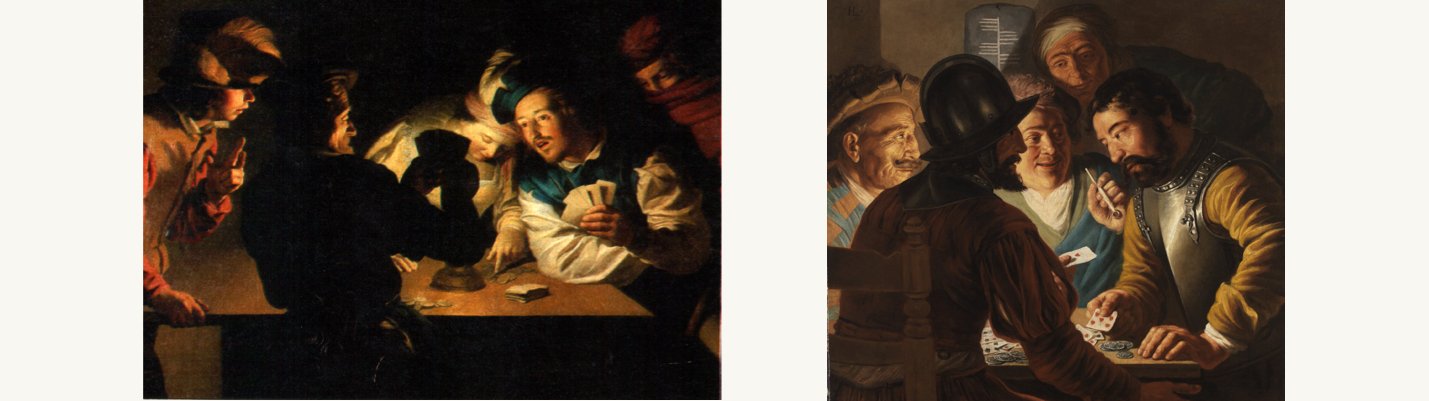
Fig. 9: Gerrit van Honthorst, The Card Players (1624; known through a contemporary workshop version, Gemäldegalerie Wiesbaden), and Jan Lievens, Card Players (1625, The Leiden Collection). Both organise tightly compressed candlelit groups around a foreground shadow figure to heighten dramatic immediacy.
Seen in this light, Folly emerges not as an isolated experiment but as the convergence of several artistic currents: the expressive and theatrical training Schalcken absorbed under Van Hoogstraten, the compressed candlelit drama associated with Honthorst and Lievens, and the structural discipline and evolving fijnschilder techniques of Dou’s studio. Under Dou’s direction, these elements are transformed through Schalcken’s emerging strengths into something more controlled and ambitious — a paired composition in which movement, timing, light, and behaviour operate as a single system organised visibly by the candle itself. The result is a work in which Schalcken’s later preoccupation with candlelit drama appears not in embryo, but in concentrated form.
3.3 Courtauld Technical Evidence
If circumstantial and stylistic arguments point to Schalcken, the material evidence of the panel itself provides further support. Independent technical examination of Folly at the Night School was carried out at the Courtauld Institute of Art by Nathan Daly, Silvia Amato, and Aviva Burnstock, whose report is published in full in Appendix 3. The examination included X-radiography, infrared reflectography, ultraviolet examination, and microscopic analysis of the paint surface. The report describes the panel as a work of uncertain date and authorship, and the findings are presented here as evidence consistent with the attribution to Schalcken rather than as proof of it in isolation. The findings are presented in three parts: the ground preparation, the flame construction and glazing technique, and the underdrawing and pentimenti.
a) Lead White Ground: A Dou Studio Hallmark
The Courtauld report confirms that the panel is executed over a white preparatory layer, visible in the X-radiograph where it has penetrated the wood grain and registered as a bright, dense layer, and in areas of paint loss at the surface [Fig. 10]. No samples were taken, and the report notes that the ground is possibly pigmented with lead white, based on radiographic opacity, but that complementary analysis would be required to confirm this. 8
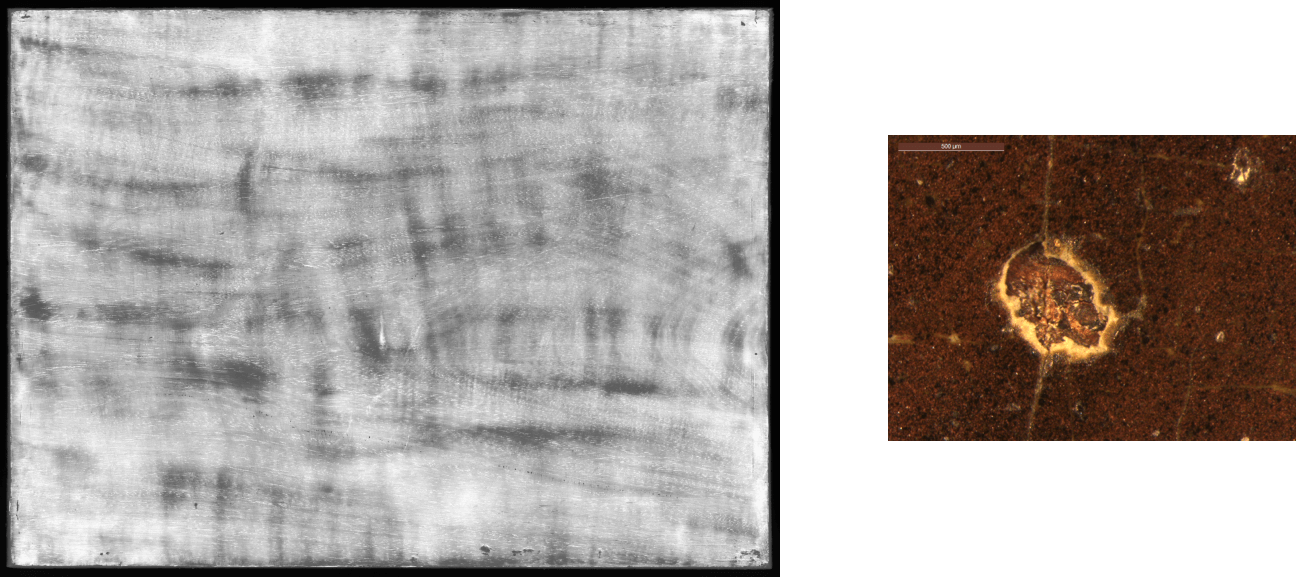
Fig. 10. White preparatory layer visible in the X-radiograph which has penetrated the grain and provided contrast; and a chip on the surface revealing the white layer beneath, suggesting lead white applied relatively thickly.
With that caveat in place, the preparation is consistent with what technical studies have identified as characteristic of Dou's studio practice. Research by Struick van der Loeff and Groen on the Mauritshuis Young Mother, confirmed and extended by Boersma and by Surh, van Tuinen, and Twilley across a group of thirteen Leiden Collection paintings, has documented Dou's use of a dense white upper ground applied in finely ground layers and polished to an enamel-like smoothness — a preparation identified as distinctive within the broader context of seventeenth-century Dutch panel painting. 9 Its presence in Folly is consistent with a panel produced in Dou's studio at this period.
The panel's surface is also consistent with a preparation of this kind: brushstrokes are scarcely visible, the finish displaying the glassy smoothness associated with Leiden fijnschilder technique at its most refined [Fig. 11] — though the Courtauld notes that accumulated varnish may contribute to this effect. This approach was not merely practical but aesthetic: a dense, reflective ground enhanced the luminosity of transparent glazes and underpinned the jewel-like clarity characteristic of Dou's finish. 10
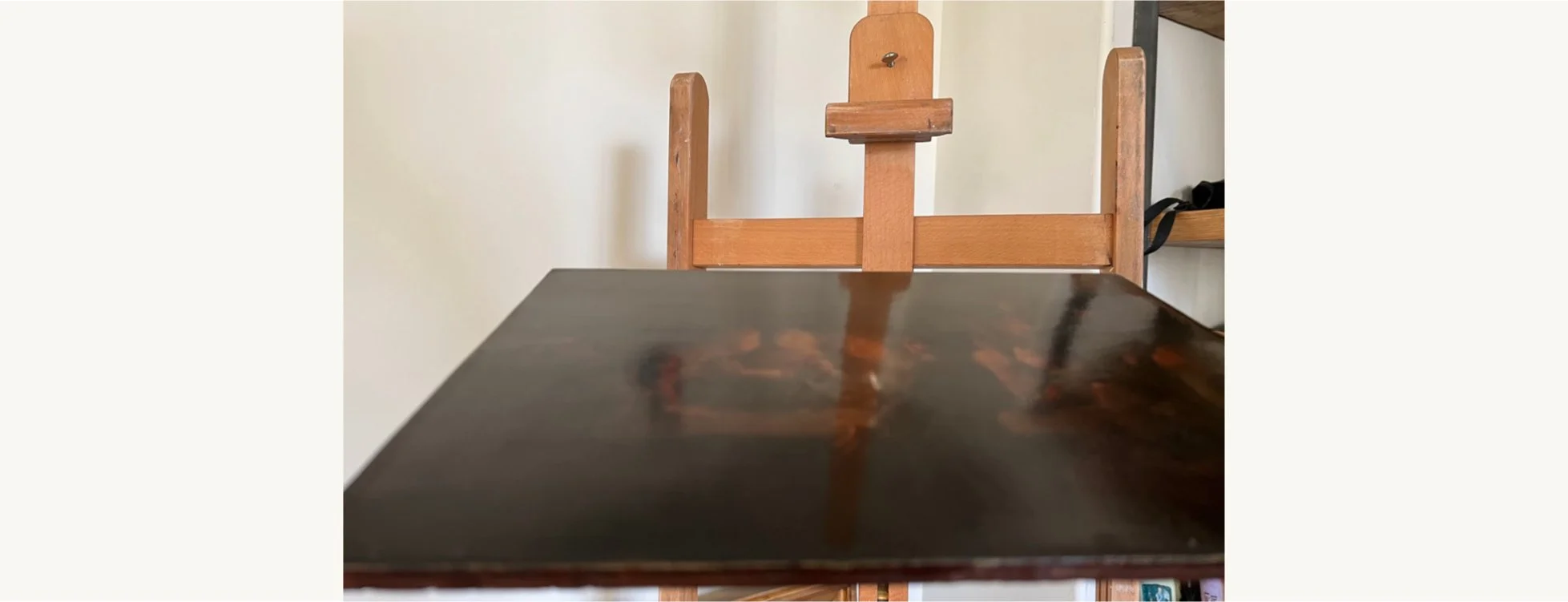
Fig. 11. Folly has a glassy finish with barely a brush mark visible, consistent with the base layer preparation and extra fine brushwork
b) Flame Construction and Schalcken's Glazing Technique
The method was a fine foundation for Schalcken's developing candlelight technique, in which the candle becomes the organising principle of the scene. The Courtauld report records the extraordinary precision of the flame’s construction: a white base for luminosity, a blue accent at the foot of the flame, a transparent red lake defining the wick, and warmer yellows and reds at the tip. [Fig. 12] From this lifelike source, as Franits observes, Schalcken understood precisely how candlelight reduces the coloristic intensities of surrounding objects, replicating this visual phenomenon with great sensitivity — the shadows diluting colour as they migrate and gradually diminish into inky blackness at the peripheries. 11 More detailed analysis of the flame and its lighting effects across faces and features in Folly is given at §5.7, “The Flame as Signature.”
These effects were achieved through the layering of thin, translucent glazes rather than tonal highlight alone — a technique consistent with what the accumulated Dou technical literature has documented as characteristic of practice in his studio. 12 That Schalcken, who trained there for three years at precisely the period when Folly was produced, should deploy similar approaches in ground and glazes is consistent with the JHNA study’s broader conclusion: that Dou’s working methods would have been transmitted to pupils, as Rembrandt’s were to him, through sustained studio practice. 13
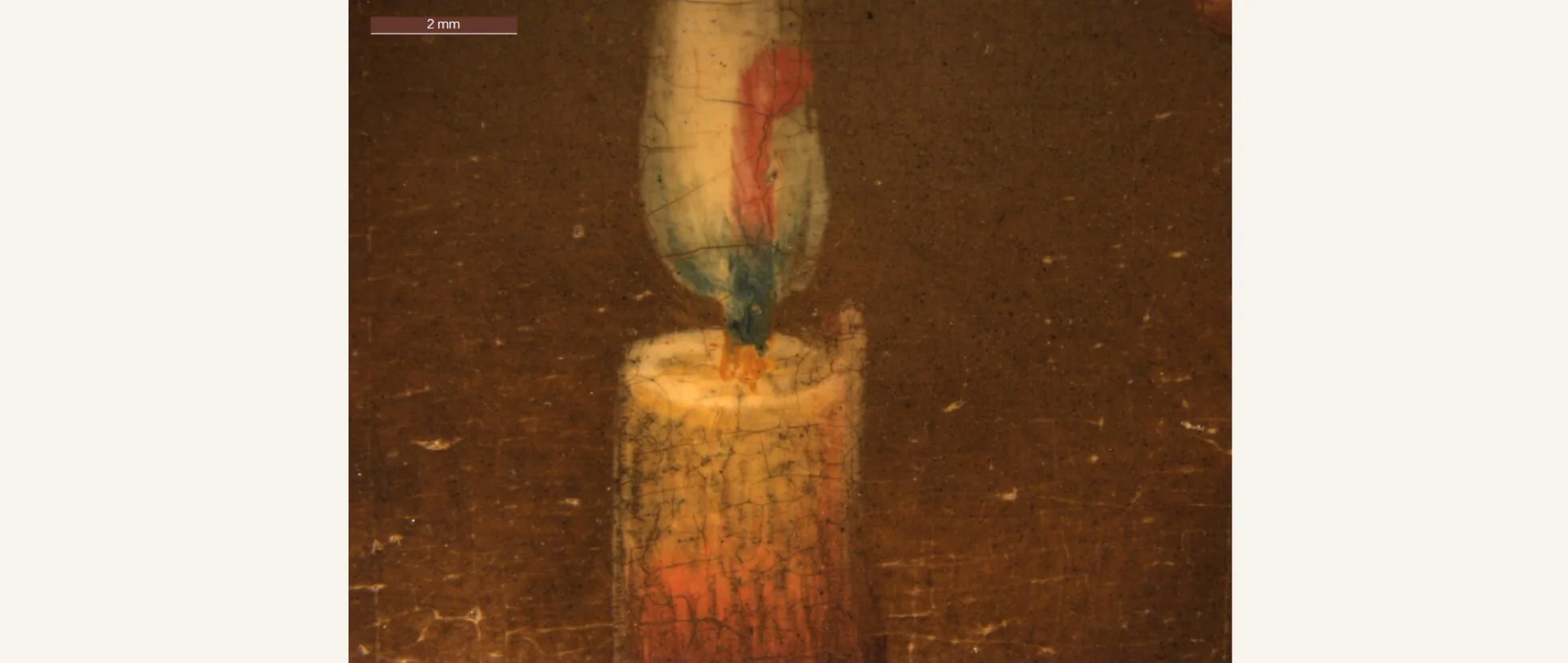
Fig. 12. Folly candle showing Schalcken’s thin glazes applied in layers: a white ground for luminosity, a blue stroke at the base, a transparent red lake for the wick, and yellow–red pigments at the tip (out of frame)
The Courtauld examination also detected a carbon-based black pigment distributed evenly through the varnish layer — consistent with a nineteenth-century toning intervention that darkens the shadow passages today without affecting the underlying paint layers. Yet even with that alteration, the underlying technique — thin, resinous glazes over a dense white ground — remains visible and is consistent with what is known of Schalcken’s practice. 14
c) Pentimenti and Original Invention
Infrared reflectography adds a further layer of evidence, revealing working changes preserved without later intervention. [Fig. 13]
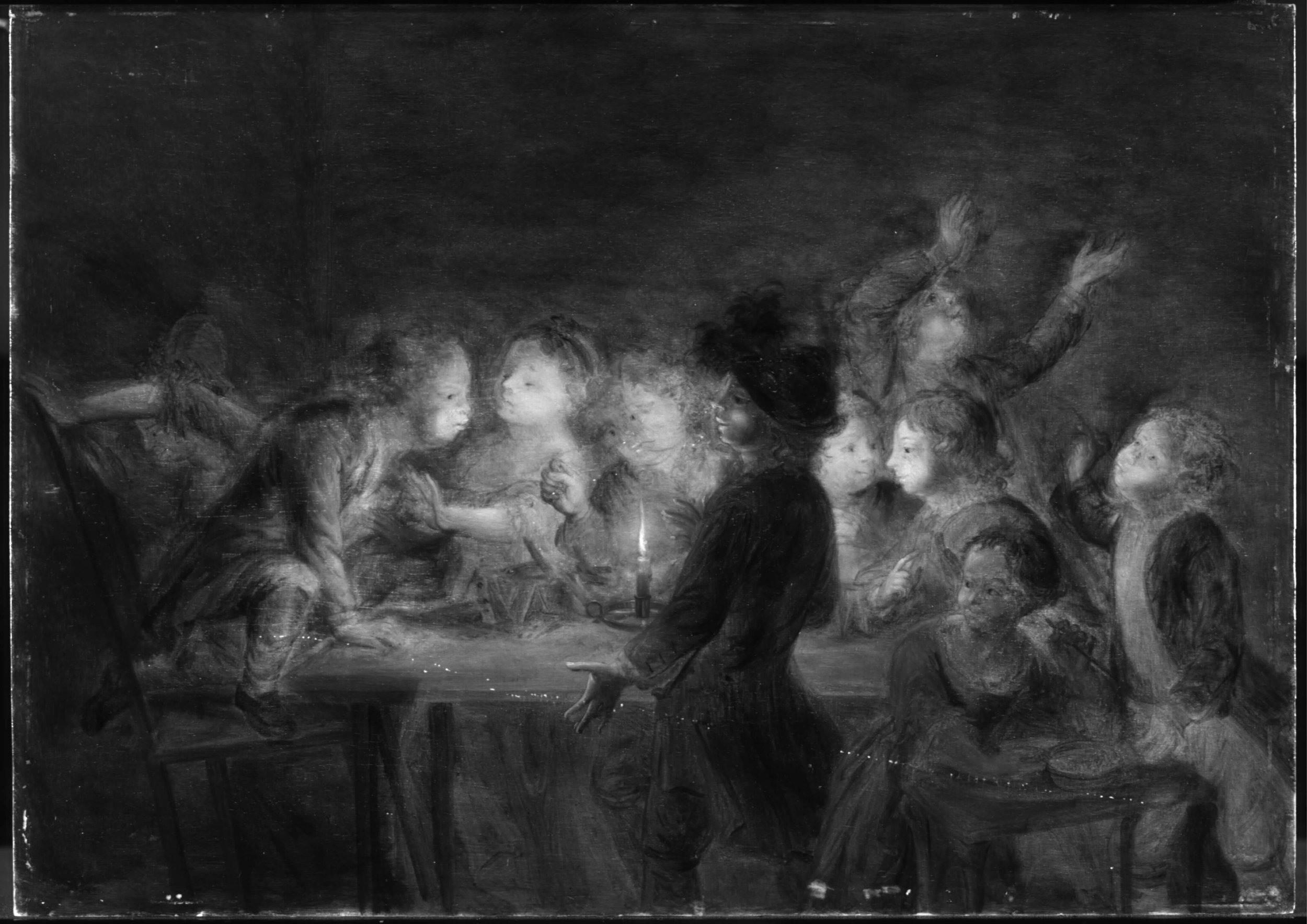
Fig. 13. Folly at the Night School — infrared reflectography.
IRR reveals Schalcken’s underdrawing and working changes, including the first placement of the assistant’s head closer to the candle, adjusted arm positions, altered fingers, and the abandoned outline of a bonnet above the girl tipping over the chair.
The report identifies three pentimenti: a now-obscured child's face to the left of the central figure, whose underdrawing lines remain visible through the paint layers; an adjustment to the face of the child near the centre with outstretched arms; and altered fingers on the child at right with raised hands. What the report confirms is that changes were made during the planning and execution of the composition, and that they belong entirely to the painting's first execution — the UV examination having shown no evidence of later restoration.
In a studio where pupils were trained through the repetition of established compositions, working changes of this kind point to original invention rather than routine studio replication — a painter addressing a new challenge rather than reproducing a known solution. This is consistent with what technical examination of Dou's own paintings has established: that working changes during execution — repositioned figures, adjusted gestures, revised compositions — are a characteristic feature of his method, documented by Struick van der Loeff in the Young Mother and Groen, Boersma, and Surh, van Tuinen, and Twilley across the group of thirteen paintings spanning Dou's career. 15 The figures in Folly appear to have been adjusted to preserve immediacy, gestures refined to register before they settle, and disorder calibrated to remain unstable rather than composed. That interpretation goes beyond what the report itself states, and is offered as such.
Examination of the infrared reflectogram also reveals, to the author's eye, the outline of a bonnet above the girl tipping over her chair — a motif not present in the final painting and not noted in the Courtauld report. The outline is clearly discernible in the reflectogram. This suggests a compositional revision in which hat-wearing was reserved for the two principal figures of authority — the teacher and the assistant. The significance of this detail for the attribution argument is discussed at §6.12, where its reappearance in Schalcken's The Parable of the Lost Piece of Silver is examined.
A further detail discernible in the reflectogram is what appears to be the faint circular outline of a soap bubble at the upper right — again not noted in the Courtauld report, and offered as the author's own observation. Its near invisibility is consistent with the technique: bubbles were typically painted in thin, translucent glazes that transmit infrared light and are easily lost to darkened varnish.
The Courtauld report confirms that, apart from the darkened varnish layer, the panel shows no signs of repair or overpainting. The evidence revealed by infrared therefore belongs entirely to the painting's first execution. 16 After the examination, when the painting was collected, Professor Aviva Burnstock remarked on the exceptional fineness of the paint handling — an observation that becomes easier to appreciate when viewing the microscopy images reproduced at §5.8.

Fig. 14. Schalcken: Old Woman Scouring a Pot, oil on panel,
28.5 × 22.8 cm, 1660s (National Gallery, London).
A Paradox of Stillness and Motion
Schalcken’s Old Woman Scouring a Pot (1660s) demonstrates how completely the young artist could absorb his master’s idiom — and thereby win Dou’s trust. [Fig. 14] Every element speaks Dou’s language: the stone-niche framing, enamelled finish, and a vanitas trio — broken pot, overturned candlestick, butterfly. The use of these motifs finds parallels in his structuring of three vanitas symbols in Folly at the Night School — the house of cards, candle and soap bubble — albeit in a very different register.
The contrasts of subject and treatment are, however, just as telling. Where the Old Woman embodies Dou’s characteristic stillness and absorption, Folly explodes into motion: children jostling, scattering cards, blowing bubbles. The true paradox is that Schalcken so won Dou’s confidence, not just in this but in more expressive, emotive painting, that he was entrusted to devise something altogether different — in deliberate counterpoint to his methodical practice.
This juxtaposition makes plain that Folly was not the product of an undisciplined apprentice, but of a considered studio experiment. Dou supplied the structure and intellectual framework; Schalcken, the exuberant life. Between them they created a diptych that held stillness and motion in calculated tension — a far richer dialogue than either could have achieved alone. 17
3.5 Early Comparative Analysis
The influence of Folly on Schalcken's subsequent career can be traced across the next thirty-five years. We begin, however, with the distinctive formal, expressive, and technical habits already visible in his earliest independent works — particularly in his handling of physiognomy, gesture, and light.
Five of the surviving paintings closest in date to Folly — Judas Returning the Thirty Pieces of Silver (c.1665–70), Hagar in the Wilderness (1667), Allegory of Virtue and Riches (1667), A Woman Singing and a Man Playing a Cittern (c.1665–70), and A Man Offering Gold and Coins to a Girl (c.1665–70) — are mostly modest in scale and ambition. They do not necessarily display the sophistication and polish that characterise Schalcken's later career. But they are invaluable for another reason: taken together, they reveal the emerging expressive vocabulary — physiognomy, gesture, and light-driven modelling — already present in Folly.
In the next section (from §4.4 Career Progression), these core markers are followed through his later works, where Schalcken's compositional instincts and candlelit idiom continue to develop, and where the structural indebtedness to Folly becomes unmistakable.
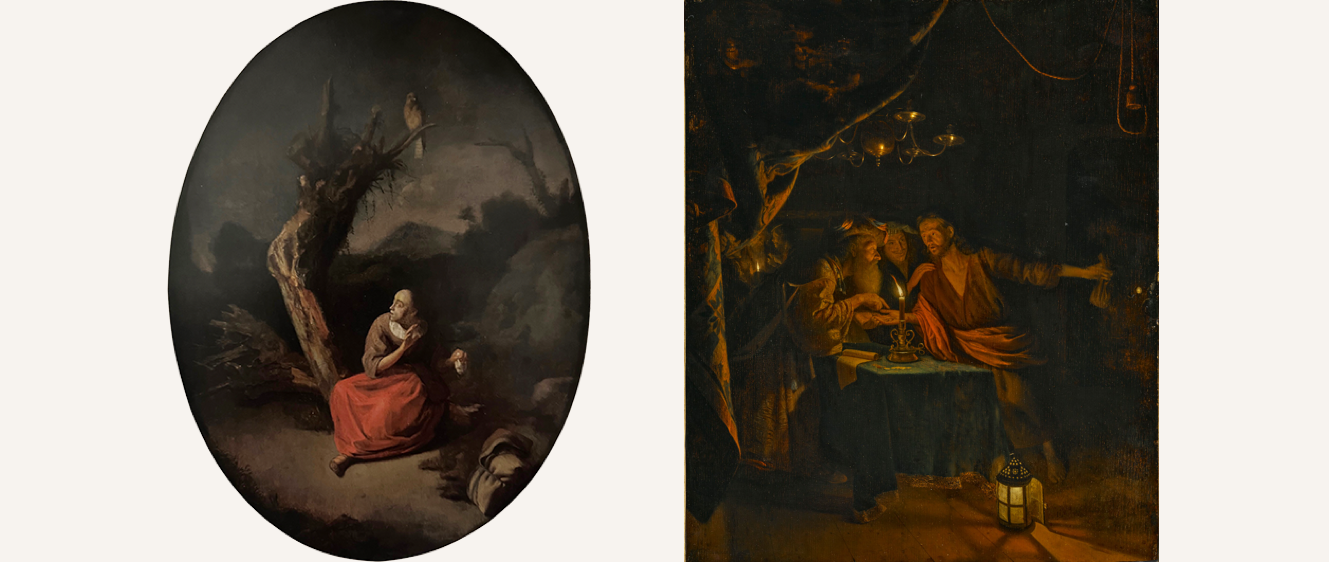
Fig. 15. Godfried Schalcken: Hagar in the Wilderness, oil on panel, 39 x 51cm, 1666-67; and Fig. 16. Judas Returning the Thirty Pieces of Silver, oil on panel, 51.5 x 42.5cm, 1665-70 (both private collections).
A. Early Expressive Language (c. 1665–70)
Two of Schalcken's first independent works, Judas and Hagar, display the physiognomic and gestural types that define Folly. His figures have slightly compressed skulls, forward-tilted jaws, and alert, protruding eyes — traits animated rather than idealised. In Folly, the sly girl peering through the chair, the impish bubble-blower, and the girl with her hand raised to restrain the mischief belong to the same expressive family as the conspirators in Judas, whose taut jawlines and widened gazes convey psychological tension. [Fig. 16]
Gesture extends this animation: the assistant's outstretched hands in Folly, countering the teacher's raised finger in The Night School, finds its analogue in Judas, where the thrust-forward delivery of the coin isolates the act of transgression in light. In Hagar, Schalcken adapts the motif for solitary drama: a raised, half-turned hand signalling vulnerability. [Fig. 15] In all three, gesture functions as psychological vector — the visible language of conscience.
Light unifies this group. In both Folly and Judas, a central candle serves as the dramatic fulcrum of the composition. In Judas, the available reproduction from the Christie’s auction (2022) does not clearly disclose the chromatic construction of the flame — possibly due to exposure and reproduction limits — but its function is identical: it anchors the action, isolates gesture, and concentrates tension within a tight visual radius. In Folly, this device is expanded into a richer chromatic and psychological theatre; in Judas, it remains taut and concentrated. In Hagar, daylight replaces candlelight yet achieves an equally tense psychological presence. Together, these works show Schalcken already deploying light not merely as illumination but as moral theatre.
B. Compression and Refinement (1667)
In Allegory of Virtue and Riches, Schalcken condensed the same expressive language into miniature scale. [Fig. 17] Gesture and symbol merge: the woman's poised hands weighing pearls against a bird become the visual enactment of moral choice, just as the assistant's outstretched hands in Folly express the loss of order. Physiognomic intensity and expressive illumination are preserved, but the drama is distilled — the symmetry of Folly's ten figures now concentrated into one. This painting demonstrates Schalcken's instinct to render a moral narrative through light, balance, and expressive movement.
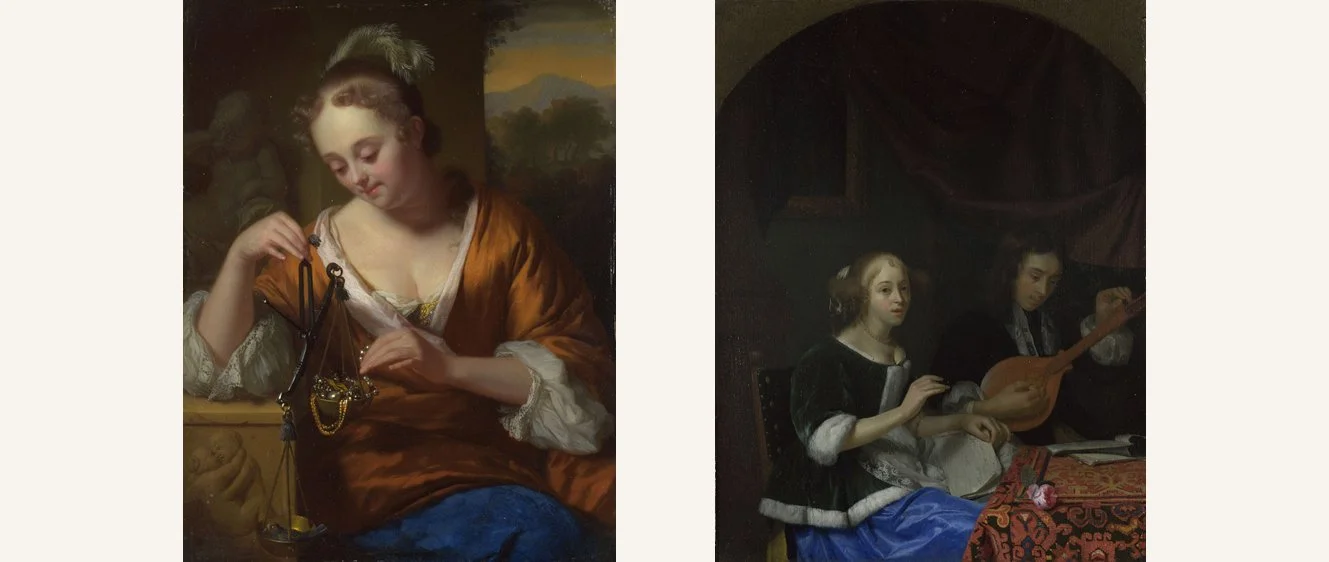
Fig. 17. Godfried Schalcken: Allegory of Virtue and Riches, oil on copper, 17.1 x 13.1cm, c.1667; and Fig. 18. A Woman Singing and a Man with a Cittern, oil on panel, 26.6 x 20.4cm, c.1665-70 (both National Gallery, London).
C. Transition to Intimacy (c. 1665–70)
A Woman Singing and a Man with a Cittern bridges the condensed drama of Folly and Virtue with the poised intimacy of Schalcken's later style. [Fig. 18] The softly raking lamplight across the singer's tilted, open-mouthed profile translates the emotional animation of Folly's children into adult harmony. The woman's hand, elegantly modelled and flexed in rhythm with the music, exemplifies Schalcken's sensitivity to expressive articulation. Fingers taper gracefully, wrists curve with lifelike rhythm, and gesture conveys both movement and emotion — the same sensibility that animates the children's hands in Folly, shoving, clenching, exclaiming, or shielding the flame in a choreography of thought and reaction. This continuity in gesture and modelling is consistent with the attribution of Folly to Schalcken's hand — literally and stylistically. Gesture becomes rhythm; sound becomes light. The work demonstrates how Schalcken transformed Dou's pedagogical architecture into the gentler art of human relationship — shedding light not on rebuke but on the empathy of two people making music together.
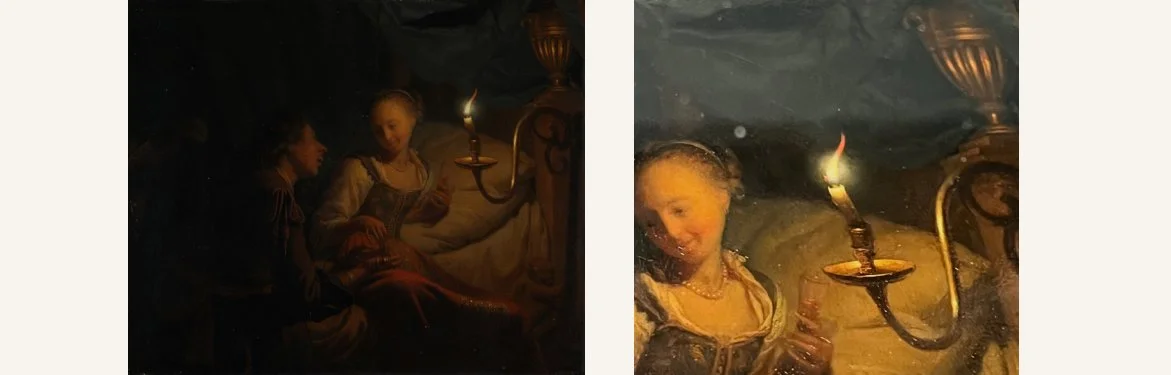
Fig. 19. Godfried Schalcken: A Man Offering Gold and Coins to a Girl, oil on copper, 15.5 × 18.9 cm, c.1665–70 (National Gallery, London); Fig. 19a. Detail photographed through the glass of the National Gallery display cabinet, showing Schalcken’s chromatically constructed candlelight and its flickering effects across surrounding surfaces.
D. Distinctive Candlelight (c. 1665–70)
Schalcken's move toward adult intimacy is not only emotional but technical. This shift is most clearly visible in A Man Offering Gold and Coins to a Girl [Fig. 19], where candlelight itself becomes a carrier of tension, desire, and charged ambiguity. Although the painting operates on a far smaller narrative scale than Folly, its candlelight remains central to the drama. Shown as if knocked askew in the charged encounter between the couple, the candle is constructed in the same chromatic manner: discrete touches of blue, yellow, and red laid over a light ground, rather than modelled through tonal highlight alone. 18
If the dating is correct, this is a remarkably early forerunner of the candlelit scenes that would later bring Schalcken commercial success in the 1670s and 1680s. While modest in scale, he now confidently uses light to sensualise the scene: the skin on the girl’s face, the glass in her hand, the soft bedding, and the brass of the candleholder — each responding differently to the fluctuating light. The candleholder, for example, with its variable highlights shifting across the curvature of the brass, demonstrates Schalcken’s increasingly refined chromatic handling of warm yellows, coppery orange-red undertones, soft fall-off into brown-black shadow, and tiny points of concentrated luminosity.
E. Synthesis: Folly as Crucible
Viewed through this sequence, Folly at the Night School emerges not as an anomaly but as the crucible in which Schalcken's mature language was forged. It anticipates the expressive heads of Judas and Hagar, the equilibrium of Virtue and Riches, the poised illumination of A Woman Singing, and — crucially — the chromatically conceived candlelight of A Man Offering Gold and Coins to a Girl.
Its physiognomic alertness, choreographed gestures, and single unifying candle bring together the key elements of Schalcken's emerging identity: emotional intensity, dramatic interaction, and light conceived as a precisely articulated, unstable force — all realised within Dou's architectural framework.
3.6 Interim Authorship Summary
The attribution of Folly at the Night School to Schalcken rests in this first assessment on a convergence of documentary, technical, and stylistic evidence.
Documentary evidence. Schalcken is the only apprentice securely documented in Dou’s Leiden studio at the relevant moment c. 1662–65, following earlier expressive training under Samuel van Hoogstraten in Dordrecht. No other known pupil at this time possessed the dramatic and pictorial capacities to create the candlelit Folly.
Technical evidence. The Courtauld analysis identified a dense white ground consistent with Dou’s studio practice, together with pentimenti, translucent glazes, and chromatically constructed candlelight characteristic of Schalcken’s developing technique. Infrared imaging confirms invention rather than replication, while the handling of the flame and its fluctuating light already anticipates effects Schalcken would refine throughout his career.
Stylistic evidence. Schalcken brings Dou’s The Night School to life through animation, theatricality, and unstable, dramatic candlelight. The same physiognomic treatments, expressive gestures, and single-source illumination recur across Schalcken’s early independent works, including Judas, Hagar, Virtue and Riches, A Woman Singing, and A Man Offering Gold and Coins to a Girl.
Taken together, this convergence of documentary, technical, and stylistic evidence strongly supports the attribution of Folly at the Night School to Schalcken and situates the painting within the collaborative environment of Dou’s Leiden studio c. 1665. Moreover, The Night School proved so formative for the young Schalcken that its effects can be traced across every stage of his career, from his earliest independent works to his mature production. This enduring influence is explored in Sections 4–6.
Footnotes to Section 3
Arnold Houbraken, De groote schouburgh der Nederlantsche konstschilders en schilderessen, 3 vols. (Amsterdam, 1718–21), vol. 3, p. 175, on Schalcken's apprenticeship with Dou and his emulation of Dou's paint handling; Piet Bakker, "Godefridus Schalcken" (2017), in The Leiden Collection Catalogue, 4th ed., ed. Arthur K. Wheelock Jr. and Elizabeth Nogrady, New York, 2023–, https://theleidencollection.com/artists/godefridus-schalcken/ (accessed April 2026), on the approximate dates of Schalcken's training under Van Hoogstraten and Dou.
Wayne Franits, Dutch Seventeenth-Century Genre Painting: Its Stylistic and Thematic Evolution (New Haven: Yale University Press, 2004), on stylistic evolution and Schalcken's early genre idiom.
Piet Bakker, "Dominicus van Tol," in The Leiden Collection Catalogue, 4th ed., ed. Arthur K. Wheelock Jr. and Elizabeth Nogrady, New York, 2023–, https://theleidencollection.com/artists/dominicus-van-tol/ (accessed April 2026), on Van Tol's guild membership in 1664 and his primarily daylit output; Cornelis Hofstede de Groot, A Catalogue Raisonné of the Works of the Most Eminent Dutch Painters of the Seventeenth Century, trans. and ed. Edward G. Hawke, vol. 5 (London: Macmillan, 1913), p. 420, confirming Van Slingelandt's guild membership from 1661; Arnold Houbraken, De groote schouburgh, vol. 3, p. 162, on Van Slingelandt's extraordinarily methodical working practice.
Guido Jansen, "Schalcken, Godfried," in The Dictionary of Art, ed. Jane Turner, 34 vols. (London: Macmillan, 1996), vol. 28, pp. 49–50, noting that Schalcken soon adopted a freer touch with gentler transitions, distinguishing his handling from Dou's more enamelled finish, and situating Schalcken in the Dou–Netscher lineage.
Cornelis Hofstede de Groot, A Catalogue Raisonné of the Works of the Most Eminent Dutch Painters of the Seventeenth Century, trans. and ed. Edward G. Hawke, vol. 5 (London: Macmillan, 1913), p. 309, noting that Schalcken gained his taste for candlelight painting from Dou and attained remarkable success in this genre "especially in his earliest pictures."
Arnold Houbraken, De groote schouburgh der Nederlantsche konstschilders en schilderessen, 3 vols. (Amsterdam, 1718–21), vol. 3, p. 175, on Schalcken’s training with Samuel van Hoogstraten and Gerrit Dou; and vol. 2, pp. 162–63, on Van Hoogstraten’s pedagogical methods, including the use of staged performance, gesture, and experiments with light and shadow in the training of pupils; Piet Bakker, “Samuel van Hoogstraten” (2017), in The Leiden Collection Catalogue, 4th ed., ed. Arthur K. Wheelock Jr. and Elizabeth Nogrady with Caroline Van Cauwenberge (New York, 2023–), https://theleidencollection.com/artists/samuel-van-hoogstraten/ (accessed 23 April 2026).
Lloyd DeWitt and Arthur K. Wheelock Jr., “Card Players” (2017), in The Leiden Collection Catalogue, 4th ed., ed. Arthur K. Wheelock Jr. and Elizabeth Nogrady with Caroline Van Cauwenberge (New York, 2023–), https://theleidencollection.com/artwork/the-card-players/ (accessed 25 May 2026). The catalogue entry includes a perceptive discussion of the compositional role of the silhouetted foreground figure and the organisation of candlelit interaction around the central flame.
Nathan Daly, Silvia Amato, and Aviva Burnstock, technical examination report on Folly at the Night School, Courtauld Institute of Art, 2025, published in full at Appendix 3.
Luuk Struick van der Loeff and Karin Groen, "Probleem, Overwegingen en Beslissingen bij de Conservatie en Restauratie van het Schilderij door Gerard Dou 'Jonge Moeder,' Mauritshuis, 1658," Centraal Laboratorium Themadag 12 (1987): 40–50; Annetje Boersma, "Dou's Painting Technique: An Examination of Two Paintings," in Baer and Arthur K. Wheelock Jr., ed., Gerrit Dou 1613–1675 (exh. cat., 2000–2001), pp. 54-63; Dominique Surh, Ilona van Tuinen, and John Twilley, "Insights from Technical Analysis on a Group of Paintings by Gerrit Dou in the Leiden Collection," Journal of Historians of Netherlandish Art 6, no. 1 (2014), DOI: 10.5092/jhna.2014.6.1.3.
Surh, van Tuinen, and Twilley, "Insights from Technical Analysis," on Dou's use of finely ground paint layers to achieve an exceptionally smooth finish; qualified by Daly, Amato, and Burnstock, Courtauld technical report, on how accumulated varnish may contribute to the effect.
Wayne Franits, Godefridus Schalcken: A Late 17th Century Painter in Pursuit of Fame and Fortune (London: Lund Humphries, 2023), p. 49.
Struick van der Loeff and Groen (1987) 40-50; Boersma, in Baer and Arthur K. Wheelock Jr., ed., (2000–2001), pp. 54-61; Surh, van Tuinen, and Twilley, JHNA 6, no. 1 (2014).
Surh, van Tuinen, and Twilley, JHNA 6, no. 1 (2014).
Daly, Amato, and Burnstock, Courtauld technical report, on the thin, resinous glazes visible over a dense white ground.
Struick van der Loeff and Groen (1987) 40-50; Boersma, in Baer and Arthur K. Wheelock Jr., ed., (2000–2001), pp. 54-61; Surh, van Tuinen, and Twilley, JHNA 6, no. 1 (2014).
Daly, Amato, and Burnstock, Courtauld technical report, on the absence of repair or overpainting.
National Gallery, London, catalogue entry for Godfried Schalcken, An Old Woman Scouring a Pot, 1660s, NG846: https://www.nationalgallery.org.uk/paintings/NG846
Chromatic range of A Man Offering Gold and Coins to a Girl was confirmed personally by the author, by viewing and photographing the painting in Room 15a, National Gallery, London.
4. PRODUCT OF ITS TIME
The diptych needs to be understood within its broader cultural setting. In the Leiden of the 1660s, boundaries were being pushed on many fronts at once: while the fijnschilders explored ever finer means of distilled visual expression, other artists like Gerrit van Honthorst, Adriaen Brouwer, and Jan Steen had been turning scenes of everyday life into dramatic social theatre. Christiaan Huygens recalibrated time with his new pendulum clock and, through experiments with microscopes and lenses, helped reveal unseen worlds, while Calvinist thought sharpened the moral resonance of number, vanitas imagery, and parable. 1 2 3
Education itself became a stage for these concerns, nowhere more vividly than in Dou’s schoolroom series. The Night School and Folly stand at this very crossroads — works of art forged in a culture newly obsessed with invention, calibration, magnification, and learning. Only in such a milieu could the smallest detail — an hourglass, a gesture, a flickering flame — carry the force of the greatest meaning.
4.1 Leiden Influence
If Folly is by Schalcken, produced under Dou’s supervision, then how does The Night School fit within the broader evolution of Leiden’s pedagogical genre?
We see a marked progression from Dou’s serene and idealised depictions of education from the 1650s — notably his An Evening School and his lost triptych The Nursery 4 5 — to Steen’s riotous Schoolroom with Snoozing Schoolmaster of c.1670–72. 6 With the rediscovery of Folly, a previously unseen study of learning grounded in human nature becomes visible – one that sits between the distilled clarity of Dou and the unruly exuberance of Steen. 7
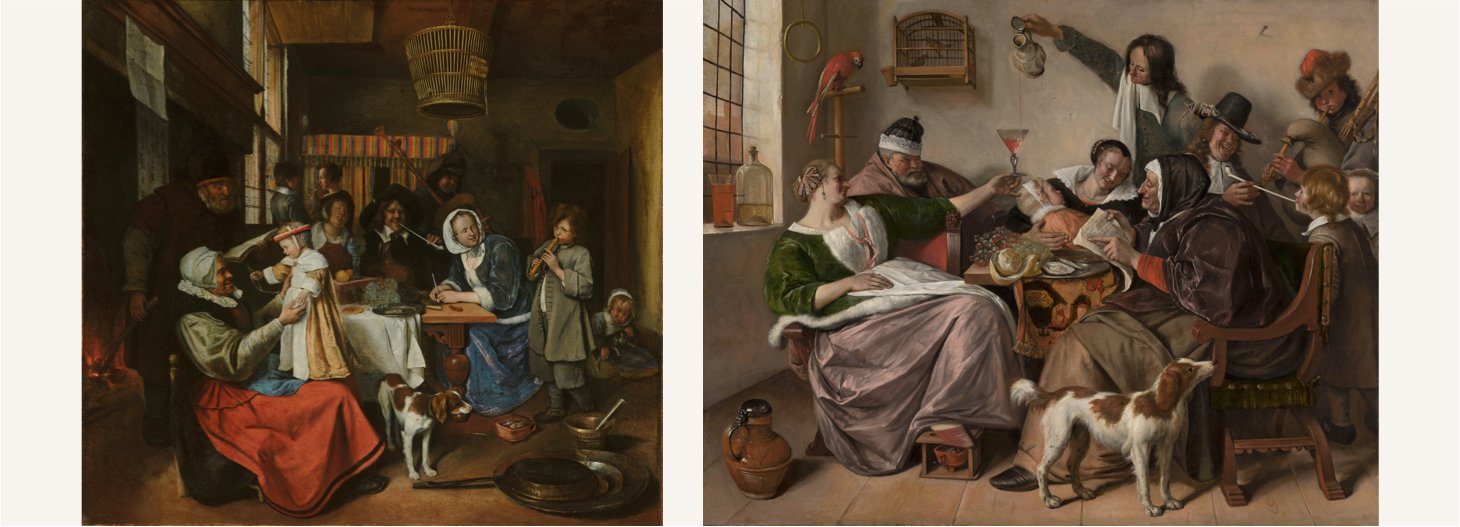
Fig. 20 Jan Steen: As the Old Sing, So Pipe the Young — an early version (left), oil on canvas, 83.8 x 91cm, c.1663-65; and a later one (right), oil on canvas, 133.7 x 162.5 cm, c.1668-70 (both Mauritshuis, The Hague)
During Schalcken's apprenticeship (1662–65) in Leiden, Jan Steen was developing his own exuberant proverb scenes — most notably the various versions of As the Old Sing, So Pipe the Young that he painted in the mid- to late-1660s. Whether through a painted example or the widely distributed prints after the theme, Schalcken would very likely have known its vision of domestic disorder — which became more extreme with each iteration. [Fig. 20] The subject quickly became one of Steen's signature moral comedies, setting the tone for a broader cultural fascination with misrule and example.
Around 1665, Steen also produced The Drawing Lesson, a composition more restrained in spirit. It features a girl in profile so strikingly like Dou’s pupil in The Night School that the echo is difficult to overlook, whether deliberate or not. At roughly the same moment — if the datings are accurate — Dou, renowned for his distilled compositions, opens the door to Folly, allowing Schalcken to counterpoint his master’s ordered classroom with a burst of Steen-like exuberance. The result is a deliberate act of narrative inversion: a contemporary vision of education tilting into chaos, rendered with Steen’s vitality but within Dou’s disciplined frame. [Fig. 21]
Folly is the keystone that transforms The Night School from a refined but ambiguous genre scene into part of a diptych about opposing forces — a visual dialogue between instruction sustained and instruction interrupted, between diligence maintained and attention allowed to lapse. Without Folly, The Night School sits uneasily in Dou's oeuvre as a return to earlier themes without clear progression. With it, the work resolves as a deliberate narrative pairing, in which learning is shown not as a fixed state but as something that must be held, renewed, and recovered over time.
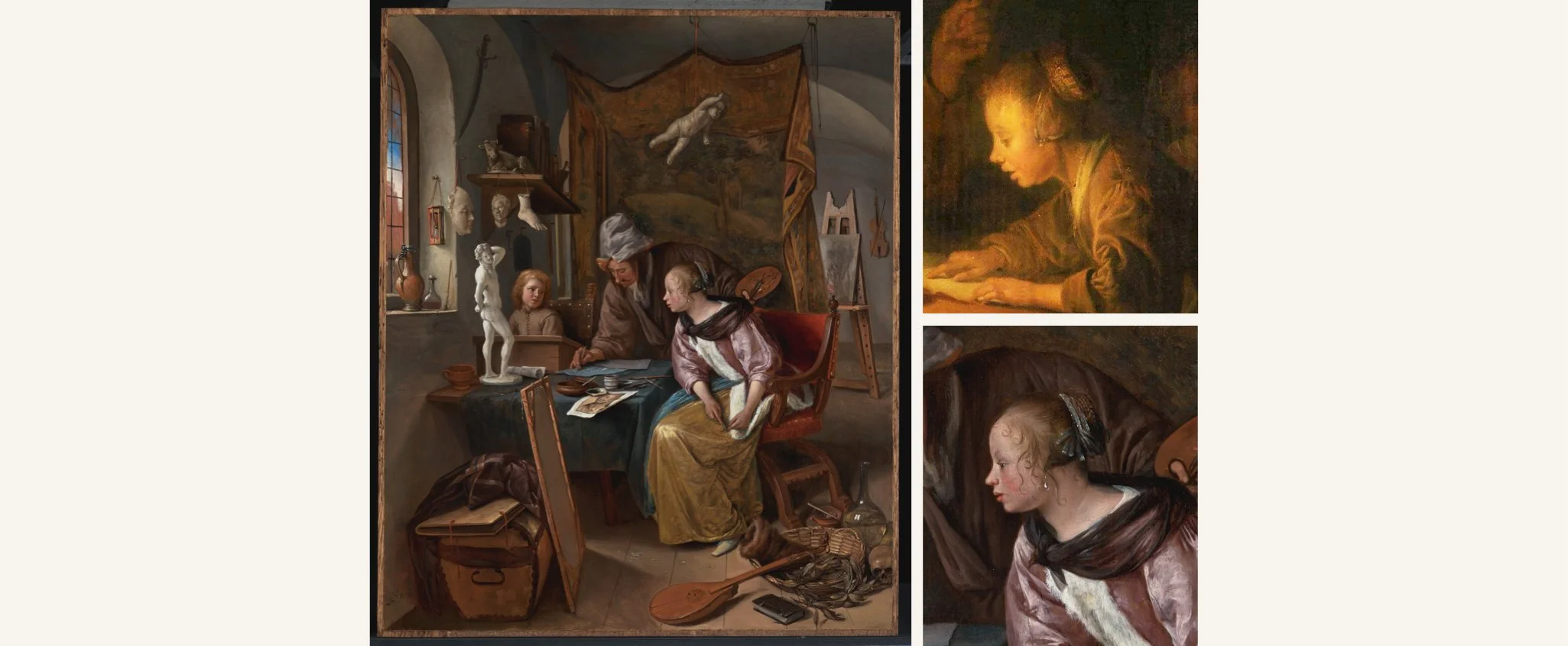
Fig. 21. Jan Steen: The Drawing Lesson, oil on panel, 49.2 x 41.2cm (Getty Museum, LA) with a strikingly similar profile view of a girl learning to the girl in Dou’s The Night School panel (top) — both are c.1665
4.2 Leiden Rivalry
This positions Folly not as an attributional curiosity, but as structurally key in the evolution of the Leiden genre. It also places Schalcken squarely within that lineage — not merely a follower of Dou or Steen, but an intermediary: the apprentice absorbing Dou's formal precision while veering toward Steen's theatrical dynamism. These suggest that Leiden's artistic development was energised by a spirit of competition that influenced and accelerated the work of all its participants.
Thus Jan Steen, working in Leiden in 1665, produces The Drawing Lesson — a painting whose subject, structure, and symbolic charge run intriguingly close to The Night School. Most striking is the girl, whose profile echoes Dou's pupil with pointed clarity. And Steen's tone is different: wryer, more worldly, shot through with amorous ambiguity — a Cupid above the girl, a nude male cast before her, and a gaze toward it that seems perhaps too intent. It is an approach that runs sharply counter to Dou's upright disciplined temperament.
Whether Steen provoked Dou, or Dou spurred Steen, the conclusion is the same: that The Night School and Folly were born of a creative environment — and a moment in Leiden — in which dialogue, competition, and shared invention pushed artists toward extraordinary solutions. A rivalry visible in paint between Dou and Steen produced a vivid cultural spark behind this extraordinary moment. It may well have been the catalyst for The Night School diptych — one of the most unusual and conceptually significant compositions of the Dutch Golden Age, a two-handed schoolroom narrative that sets Dou's composure against Schalcken's expressive life. 78
4.3 A Captured Moment
However events unfolded, Folly at the Night School is astonishing in its energy. Unlike the poised, balanced compositions that define much of seventeenth-century Dutch painting — even those depicting misbehaviour or decay — this work moves. It seizes a precise, collapsing instant: cards mid-fall, glances exchanged, a chair tipping, a candle flickering. Every figure participates in the disruption. This is not a tableau but a drama in motion. Few works of the period orchestrate such a dense interplay of gesture, gaze, and dramatic timing with equal spontaneity and control. It is a singular statement of narrative vitality.
The Night School diptych unites not only two panels but two currents of Dutch Golden Age painting.
On one side is Dou's hallmark: exquisitely rendered, finely calibrated scenes of diligent instruction — measured, dignified, and precise, lit with calm candlelight and inhabited by introspective figures. A painting to admire.
On the other, Folly erupts with theatrical spontaneity — noisy, impulsive, precarious — alive with rhythm, warmth, and the cheerful disorder of Jan Steen. A painting to love.
This dual lineage is rare, and its combination here is what gives the diptych its unusual power. The diptych becomes more than exceptional craftsmanship and conceptual unity: it is a living bridge between two poles of Dutch art — restraint and release, discipline and indulgence, diligence and folly — that uniquely come together at that time in Leiden. As will be explored further in §5.10, this contrast is not only compositional and thematic but is carried through the figures themselves, whose differing modes of expression give visible form to the diptych’s underlying argument.
4.4 Career Progression
In §3.5 (Early Comparative Analysis), a group of five early paintings by Schalcken was examined for what they reveal about the authorship of Folly. Here the focus reverses: the same works — and others that followed — are considered on their own terms, as milestones in Schalcken's development as a master, while still revealing how his formative experience with Dou and Folly continued to shape his art.
In many ways Hagar and Virtue, painted in 1667, stand as the antithesis of Folly — conceived perhaps by Schalcken as contrasts to its challenges and as tests of his range.
Hagar whittles the drama down to a single adult figure in natural light. Schalcken focuses on Hagar's mental anguish. Look closely, however, and, just like the teacher's assistant in Folly, Hagar's inner tension is conveyed through the combination of an open-mouthed profile and reactive gesture. The paint handling of both closely echoes one another, while achieving a very different emotional register.
Virtue is equally revealing. Painted on copper at the minute scale of just 17.1 × 13.1 cm, it shows a solitary woman weighing gold and pearls against a bird. Her parted lips, teary cheeks, delicate weighing gesture, and intent gaze convey the recognition that virtue carries the greater force. What Folly orchestrates across ten figures around a collapsing house of cards, Virtue distils into one: an ethical choice dramatised through gesture, physiognomy, and symbolic object — the bird standing for virtue as clearly as the house of cards stands for folly. The painting demonstrates Schalcken's instinct to dramatise ethical oppositions with clarity even at miniature scale.
Around the same years, Judas (c.1665–70) marks one of Schalcken's earliest surviving dramatic scenes with multiple figures. Its relationship to The Night School is not incidental. The parallels are structural and persistent: a left-to-right narrative sweep; intent faces gathered around a single candle; a foreground lantern echoing secondary illumination; a heavy curtain shaping the pictorial space; and, most tellingly, a moment of moral crisis crystallised by an outstretched arm. In The Night School, it is the assistant at the table of folly who becomes the focus of rebuke; in Judas, the bag of silver assumes that role. The axis of tension remains constant — only the actors and setting change.
This continuity is not the mark of casual influence, but of deep absorption. Judas reactivates the ethical and compositional grammar forged in Dou's studio, translating it into a new narrative register. Although stylistically distinct from Schalcken's more polished later nocturnes, the painting remains closely aligned with Folly in its looser, sketch-like handling of figures and drapery; its reliance on expressive, psychologically charged faces to carry narrative meaning; and its use of candlelight not merely to illuminate, but to heighten the dramatic tension and the moment of judgement.
Seen in this light, Judas reinforces the attribution of Folly to Schalcken not through resemblance alone, but through continuity of thought. It shows an artist returning, in the years immediately following his work with Dou, to a visual and ethical framework first tested in The Night School project — one that would continue to inform his thinking long after the original diptych itself had passed from view.
Alongside this return to moral crisis, Schalcken begins to explore a different register: the depiction of adult intimacy. In A Woman Singing and A Man Offering Gold (both c.1665–70), he turns to scenes of private encounter that would become central to his later career. As in The Night School, the tension of these works lies in their openness to interpretation. Are the music-making pair more closely involved than decorum admits — hinted at by the painting of naked legs on the wall behind them and the rose placed on the table? 9 Why is the candle lighting the amorous couple askew, and will the girl accept the coins? These paintings function as compact echoes of the left-to-right narrative and the diptych’s open structure: meaning is not imposed, but activated through the viewer's judgement.
Taken together, these early works show not a rapid departure from Dou's tutelage, but how fully Schalcken absorbed and sustained what he learnt in the execution of Folly. Different as they are in subject and ambition, all preserve the same expressive consistency — physiognomic intensity, gesture as an axis of tension, and light as the agent that binds the moment, suggests consequence, and invites judgement. What changes is not the underlying intelligence, but the register in which it is exercised.
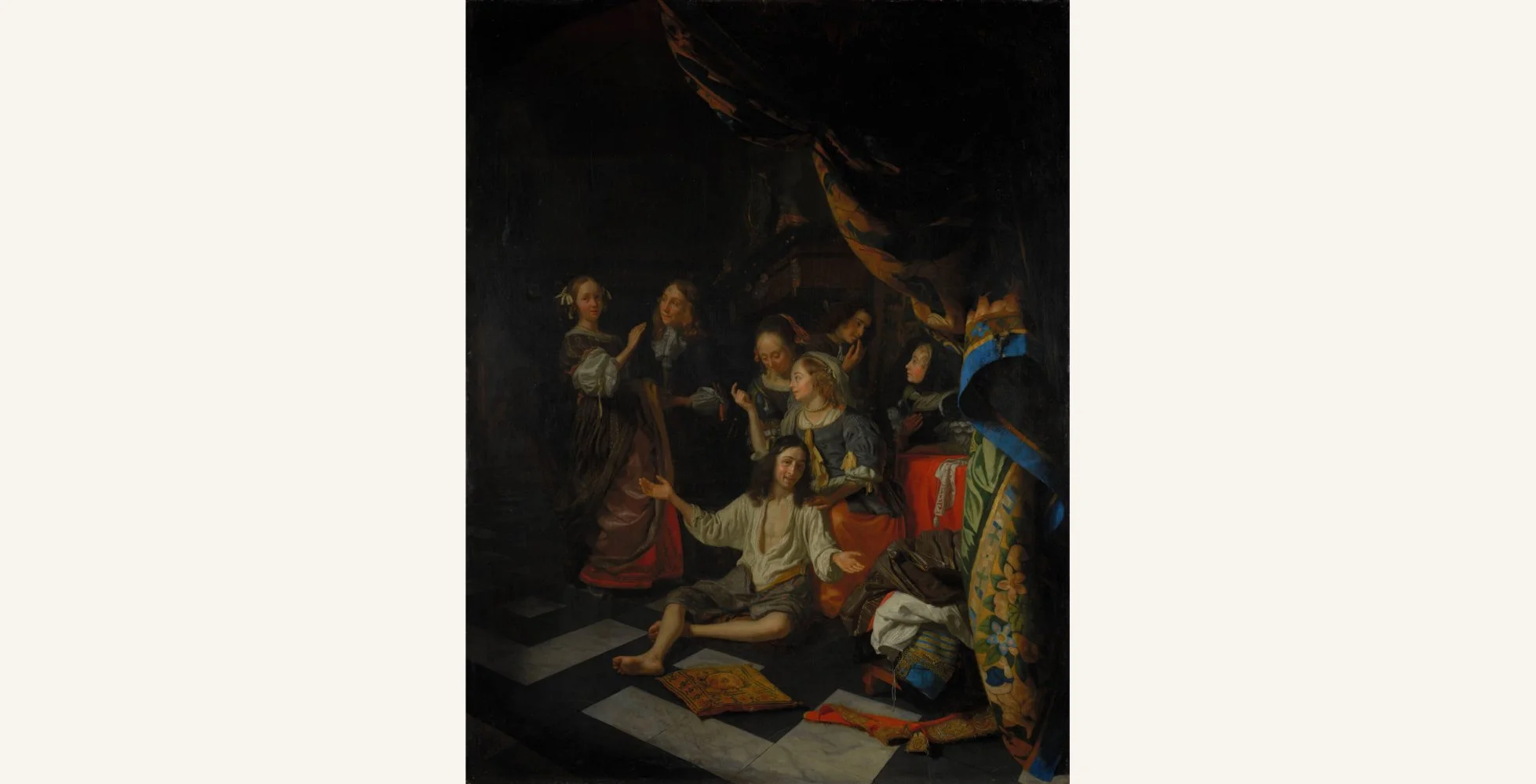
Fig. 22. Godfried Schalcken: The Game of Lady, Come into the Garden, oil on panel, 63.5 x 49.5 cm, 1668–70 (Royal Collection Trust, London)
4.5 Social Evolution
As his painterly style and choice of subject matter evolved, echoes of Dou’s influence and the structuring influence of The Night School persisted in Schalcken’s complex, multi-character compositions — from the convivial grouping of A Family Concert (late 1660s) to the staged interplay of The Game of Lady, Come into the Garden (c.1668–70). [Fig. 22]
This latter painting is more richly coloured, more polished, and more overtly theatrical than the Leiden diptych. Yet the links are unmistakable: a stage curtain, a crowd alive with gestures and glances, and a comic narrative built from interaction. At the centre, a young gallant open-handedly presents the scene to the audience. Schalcken had discovered this capacity for joyful animation with Folly; Lady, Come into the Garden demonstrates how he carried it into his more socially outgoing independent career. 10
4.6 The Artist as Conductor
In Folly, and across a number of his later multi-figure works — Judas, A Woman Singing, Lady, Come into the Garden, A Family Concert, and The Parable of the Lost Piece of Silver (discussed below) — Schalcken does more than paint; he steps into the scene to conduct. In each, a self-reflective figure stands within the drama: the assistant who beholds the classroom's chaos, the penitent who gestures toward restitution, the cittern player shaping harmony, the gallant presenting the playful scene, the man half in shadow observing the family concert, and the shadowed internal witness in the lost silver parable. Their placement varies — sometimes central, sometimes peripheral — yet all act as extensions of the artist himself.
Each corresponds to his plausible age and likeness at the moment of painting. The assistant in Dou's schoolroom could not literally be Schalcken, yet he reads as a surrogate: the young creator as dazzled by the scene he has conjured as the assistant is discombobulated by the disorder he has failed to contain. In the later works, that self-presence becomes overt — a deliberate signature of authorship that others would recognise.
Together these paintings chart the evolution of a painter who took such pleasure and ownership in creation that he could not help but paint himself into it. One can almost imagine him nodding his head — or bowing to the ensuing applause.
View paintings with a Schalcken-like figure
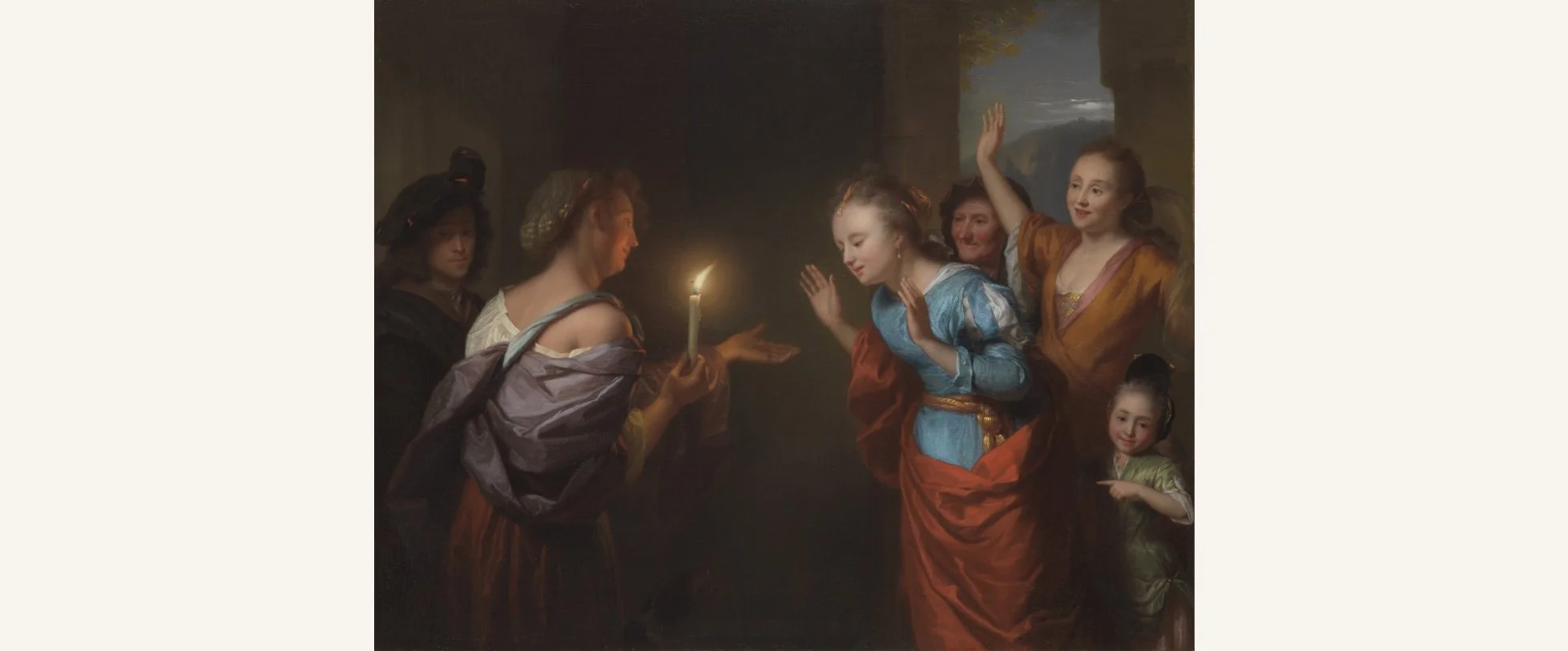
Fig. 23. Godfried Schalcken: Parable of the Lost Piece of Silver, oil on canvas, 39.5 x 49.3 cm, c.1680–85 (Leiden Collection, New York)
4.7 Spiritual Register
The Parable of the Lost Piece of Silver (c.1680–85, The Leiden Collection) extends this continuity two decades later, translating the expressive joy of Folly into spiritual subject matter. [Fig. 23] It is easy to imagine why the theme appealed to Schalcken: a moment of revelation by candlelight, offering an ideal stage for his distinctive gifts — expressive interplay of light, gesture, and emotional climax. Luke 15 describes the instant of finding the lost coin, and it is precisely this charged moment — recognition, joy, illumination — that Schalcken seizes upon. 11
The echoes of The Night School are immediately apparent: the left-to-right reading, raised palms, pointing figure, and candle-bearing woman replay the expressive hand language first choreographed two decades earlier, now transposed into a sacred register. The raised arms lifted in wonder are to heaven rather than to bubbles, yet the psychological rhythm remains: a candlelit trigger, a collective reaction, a burst of human animation.
The compositional roles repeat with equal clarity. The small pointing child at lower right mirrors the bread-eating girl in the same position in Folly, quietly observing the drama as it unfolds. And in both scenes Schalcken inserts a self-reflective, shadowed witness within the action — the assistant in his black plumed hat in Folly, answered by the man in the tilted black flat cap in Lost Silver — each embodying the artist as creator and conductor of the scene he paints.
The very architecture first tested in Folly becomes the mental template for Schalcken's mature religious drama fifteen to twenty years later. What Dou supplied as structural and ethical framework, Schalcken absorbed as compositional instinct. Folly is not merely an early work: it is the generative experiment from which Schalcken's later mastery of candlelight, gesture, and expressive revelation evolved.
The same structural and symbolic thinking, first germinated in Dou's studio, reaches majestic fruition some thirty years later in The Parable of the Five Wise and Five Foolish Virgins (1700). [Fig. 24]
Where The Night School embeds the Calvinist 5/5 symbolism subtly — as a logic to be discovered through attention, number, and behaviour — Virgins makes that ratio explicit in both title and structure. Here, the ethical arc is reversed and clarified. The five wise virgins, their lamps burning brightly, dominate the left of the scene with a composed, almost choreographed poise. To the right, the foolish virgins stand in partial shadow: their lamps dim or extinguished, with two omitted entirely, as if already pushed beyond the picture's edge. The device functions almost as a single-panel echo of the Night School–Folly pairing. The polarity is compressed into one frame while retaining the same left-to-right narrative sweep. And where Folly builds its action on a fragile 5/4 majority of the unruly — just enough to tip the scene into collapse — Virgins presents a 5/3 dominance of the wise that allows order, light, and composure to prevail. The numerical logic is identical in conception, though opposite in outcome. In both cases, number is not dry arithmetic but a painterly instrument used to weight the narrative and steer the viewer's judgement.
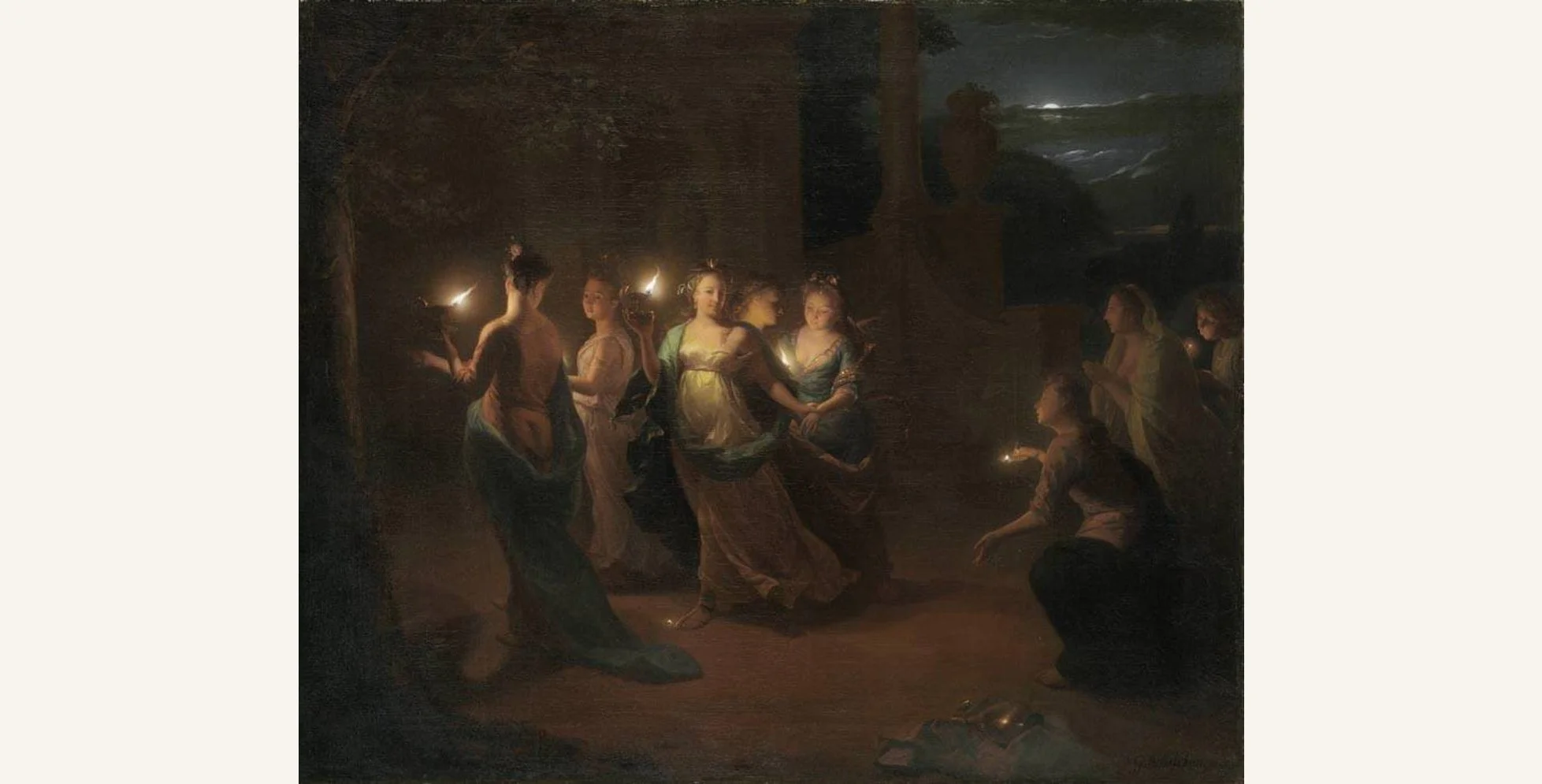
Fig. 24. Godfried Schalcken: The Five Wise and Five Foolish Virgins, oil on canvas, 93.8 x 113.4cm, 1700 (Alte Pinakothek, Munich)
The two works thus operate as parallel parables, but with different emphases and registers. The Night School functions as a contemporary parable, translating ethical reflection into the lived world of the classroom. It counterpoints the wise and unwise use of time as it unfolds within a living process: learning gained, lost, and regained through attention, lapse, and correction. Virgins, by contrast, is explicitly scriptural. It addresses the wisdom or folly of preparation before the decisive moment arrives. One parable is temporal and experiential; the other eschatological and resolved. Though subject and composition differ, the pictorial intelligence that shapes them is recognisably the same.
The theatricality of Virgins is now fully matured. Its figures are more idealised, its lighting more symbolic, its drama more ceremonial. Yet beneath this polish lies a mental architecture traceable to the formative experience of The Night School: the structuring of narrative through opposition, the choreography of light as dramatic agent, and the use of number to tip equilibrium rather than simply describe it. The deep impression of working under Dou's tutelage in that early project shaped Schalcken's compositional instincts for decades.
4.8 Fine Bookends
Between Folly at the Night School and The Parable of the Wise and Foolish Virgins, Schalcken's art evolves from the charged immediacy of youth to the poised theatricality of mastery. In Folly, we encounter a young artist pushing narrative compression to its limit: ten figures packed into a panel of just 22.5 by 30.6 centimetres, caught at the exact instant when order gives way. In Virgins, that energy is slowed, clarified, and ritualised. Light no longer flickers under threat; it stands as judgement already passed.
Over the intervening decades, Schalcken's brush grows more deliberate, his settings more elegant, his figures increasingly idealised. He absorbs the refinements of court portraiture, the tastes of Continental and English patrons, and the heightened sensuousness of his mature manner. By the time of Virgins, light has shifted from the flickering drama of Folly to the symbolic, devotional glow of an allegory. The structural logic holds, but the tempo is transformed: Folly is movement; Virgins is serene.
No other surviving work in Schalcken's oeuvre matches Folly's compressed energy, yet its compositional intelligence, psychological interplay, and proto-symbolic handling of light are the very qualities he would refine throughout his career. In Virgins, these traits reach full maturity — measured, luminous, and imbued with spiritual gravitas.
Folly and Virgins stand as expressive bookends to Schalcken's career: one bursting with the unruly brilliance of youth, the other composed and lamplit, each a pinnacle of its moment. Between them lies a lifetime of perfecting drama through light — and it was in Folly that Schalcken lit the match.
Footnotes to Section 4
Christiaan Huygens, Horologium (1658) and Oeuvres complètes (lens and microscopy writings). Epitomises Leiden’s culture of calibration and magnification.
Eric Jan Sluijter, Seductions of Sight (Zwolle: Waanders, 2000), 145–149. On Calvinist number symbolism as “plain-spoken moral devices.”
Arthur K. Wheelock Jr., The Leiden Fijnschilders (Washington, 1988). On the studio’s optical and moral precision.
J. A. Emmens, “Gerrit Dou’s ‘Nursery’ and the Problem of Genre Painting,” NKJ 11 (1960): 71–82.
Ronni Baer and Arthur K. Wheelock Jr., Gerrit Dou 1613–1675: Master Painter in the Age of Rembrandt (Exh. cat., 2000), entries on An Evening School and The Night School.
Guido J. J. van der Veen and Arthur K. Wheelock Jr., eds., Jan Steen: Painter and Storyteller (Exh. cat., Washington/Amsterdam, 2016), 83–88. For Steen’s narrative disorder.
Guido J. J. van der Veen and Arthur K. Wheelock Jr. (eds.), Jan Steen: Painter and Storyteller (Washington/Amsterdam, 2016), essays on Steen’s moral theatre.
Guido J. J. van der Veen and Arthur K. Wheelock Jr., eds., Steen: Painter and Storyteller (Washington / Amsterdam, 2016), cat. nos. 58–60., catalogue entries for As the Old Sing, So Pipe the Young (c.1665) and The Drawing Lesson (c.1665). Dating and profile-girl comparison.
National Gallery, London, A Woman Singing and a Man with a Cittern, oil on canvas, c.1665–70. Official catalogue entry: discussion of erotic ambiguity, the painting-within-the-painting showing naked legs, and the rose as a conventional signifier of romantic love. National Gallery online catalogue.
Royal Collection Trust, The Game of Lady, Come into the Garden, c.1668–70, RCIN 405343, https://www.rct.uk/collection/405343/the-game-of-lady-come-into-the-garden
The Parable of the Lost Piece of Silver, c.1680–85, oil on canvas, The Leiden Collection, New York. Arthur K. Wheelock Jr., in The Leiden Collection Catalogue (New York, 2017–), online edition: https://www.theleidencollection.com/artwork/the-parable-of-the-lost-piece-of-silver/. The entry notes Schalcken’s focus on the moment of rejoicing, the ‘lamp’ as symbol of divine illumination, and the probable self-portrait at left.
5. A STUDIO EXPERIMENT
If the previous section situated The Night School and Folly within the wider artistic energies of Leiden and followed their consequences into Schalcken's later work, the focus now turns inward — to the studio where those energies were first tested and transformed. Gerrit Dou's workshop was famed for its discipline: measured procedure, immaculate technique, and a pedagogical rigour unmatched among the fijnschilders. Yet in 1665 this most controlled of environments produced something strikingly new: a diptych in which learning itself becomes dramatic — structured through time, tested by disorder, and made visible through candlelight, gesture, and children caught at the moment order gives way.
What conditions in the studio allowed this experiment? What relationship between master and pupil made it possible? And how did Dou’s long-standing interest in education become, in this last paired design, a living drama of attention, discipline, and human development? The answers begin with an apprenticeship that, by its final year, had evolved into something exceptional: a partnership of trust, respect, and shared ambition that reached its height in the year The Night School was conceived.
5.1 A Special Relationship
The evidence points to Folly as the outcome of an unusually deep master–apprentice bond. Gerrit Dou was not only Godfried Schalcken’s teacher but also his legal guardian — a rare overlap of artistic and paternal responsibility that gave their relationship a degree of closeness uncommon within the customary studio arrangement. 1
In the mid-1660s, around the close of Schalcken’s apprenticeship, Dou painted at least two closely related self-portraits. Broadly dated to c.1665, these works show how Dou chose to present himself at around the time of The Night School: not simply as a master of technique, but as an artist whose authority rested on learning, judgement, and self-discipline. In the Metropolitan Museum of Art portrait [Fig. 25], the palette and brushes assert his vocation, while the substantial secular book and the caged bird articulate a familiar Leiden ideal — painting as an intellectual calling governed by education and self-command, the bird suggesting natural talent held in disciplined restraint. He wears a wide-brimmed, flat-crowned felt hat of the kind associated with sober, learned identity.
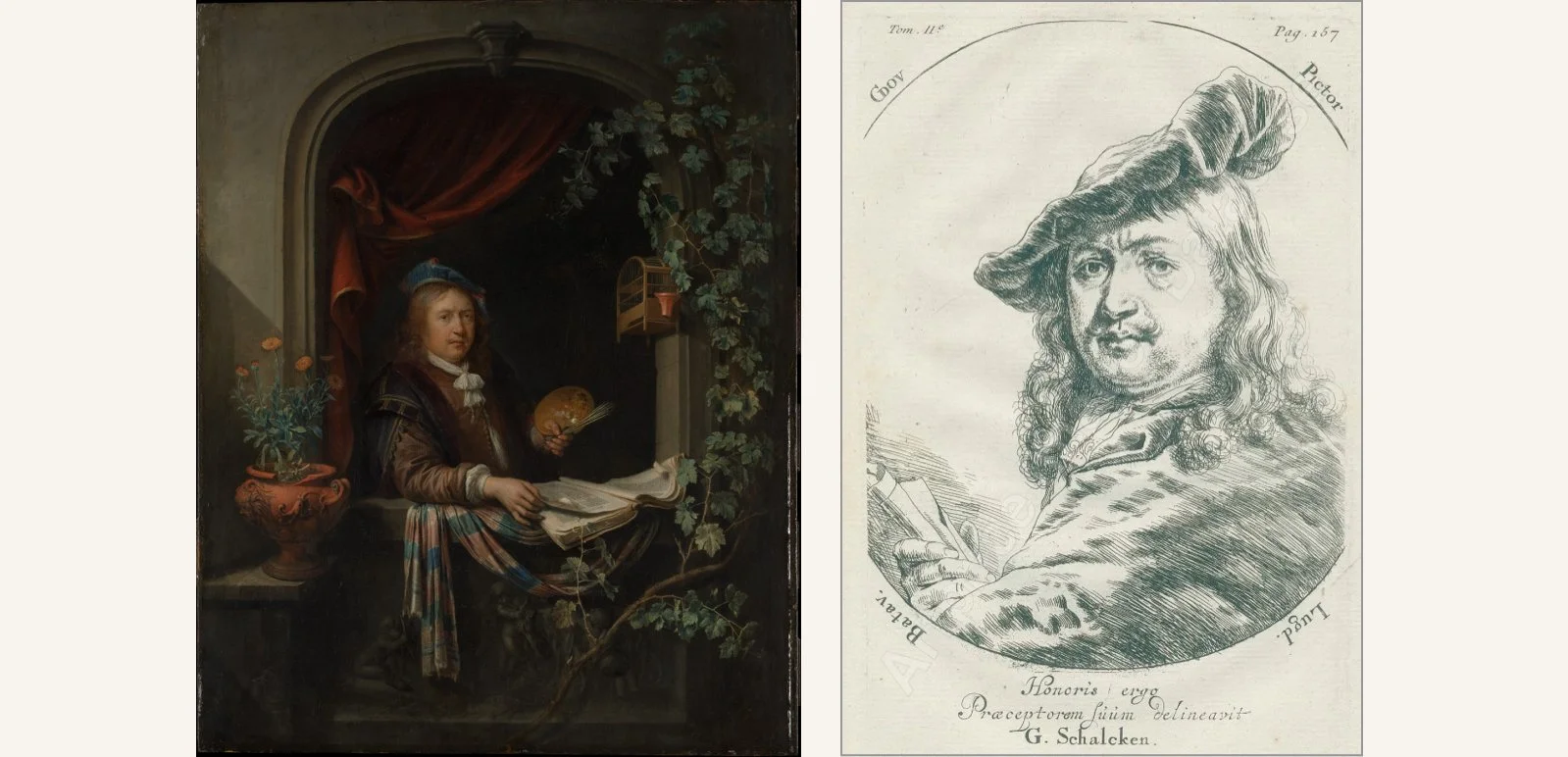
Fig. 25. Gerrit Dou’s self-portrait, oil on panel, 48.9 x 39.1cm, c.1665 (The Metropolitan Museum of Art, New York); and Fig. 26. Godfried Schalcken’s etching of him, probably printed from copper, 16.5 x 12.2cm, also c.1665 (Rijksmuseum, Amsterdam).
Schalcken echoed that self-definition directly. At the end of his apprenticeship he produced an engraved portrait of Dou, inscribed in Latin: Honoris ergo / Praeceptorem suum delineavit / G. Schalcken — “Out of respect, Schalcken sketched his teacher.” [Fig. 26]² ³ The likeness closely follows Dou’s self-portrait but in reverse, reproducing the same wide-brimmed, flat-crowned hat — worn, as in the self-portrait, the correct way round once the mirror reversal is accounted for. Such an overt tribute by a pupil to a master — in a medium that could circulate — was highly unusual and appears to mark a particularly significant moment in their relationship.
Around the same time, Johan de Bye acquired and exhibited Dou’s The Night School panel on its own in Leiden, thereby detaching it from the companion work now identified as Folly. [4] If the diptych had been conceived collaboratively within Dou’s studio, as this dossier argues, that separation would have brought to an abrupt end their extraordinary artistic partnership. Seen in this light, Schalcken’s engraving may record not simply respect for his teacher, but recognition of a formative collaboration at the moment of its dissolution — a parting explored further in §6.10 and a tribute he would deepen many years later through Lost Silver revealed in §6.12.
The print’s reproductive medium may also have allowed Schalcken quietly to place his own name within the orbit of de Bye’s exhibition devoted to Dou’s paintings. Yet whatever its precise original context, the engraving attests to a relationship of unusual depth and mutual regard.
Set beside The Night School, the resonance of the self-portrait sharpens. The teacher — elevated above the candle and charged with directing the lesson — embodies the same conviction: that education lifts, cultivates, and dignifies; that through learning and discipline a person may rise to a position of responsibility and respect.
In this light, the diptych reflects not only Dou's views on teaching but Dou's understanding of painting as an intellectual vocation. The Night School is about diligence, learning, and the ordering of time and impulse — precisely the values his self-portrait expresses. That Dou gives both the teacher and himself, in his self-portraits of the mid-1660s, a similar wide-brimmed, flat-crowned hat — a hat that, through its repeated association with learned identity and self-discipline in these works, may usefully be called a “scholar’s cap” — strengthens the association between painter and teacher. Both figures embody authority grounded in learning, discipline, and self-command. Schalcken recognised this and built his tribute around it. The works, and the men, are in harmony.
5.2 Evolution of Learning
The portrait engraving thus marked the natural conclusion of an apprenticeship that had deepened into collaboration. Schalcken had proved himself not only a master of Dou's meticulous technique, but a pupil whose evident respect for the master was matched by bold imagination — someone capable of absorbing Dou's ideals while extending them with confidence and expressive force. Such an equilibrium of discipline and initiative helps explain how a work like Folly could take shape within Dou's studio: the master secure enough to delegate a companion scene requiring counterpoint, and the pupil skilled enough to carry its narrative forward in his own idiom without breaking the unity of the whole. Dou's pedagogy — grounded in demonstration, imitation, and calibrated challenge — created precisely the conditions under which a demanding related scene could be entrusted to a younger hand, and within which the processes of learning that his paintings explore were themselves enacted. 5
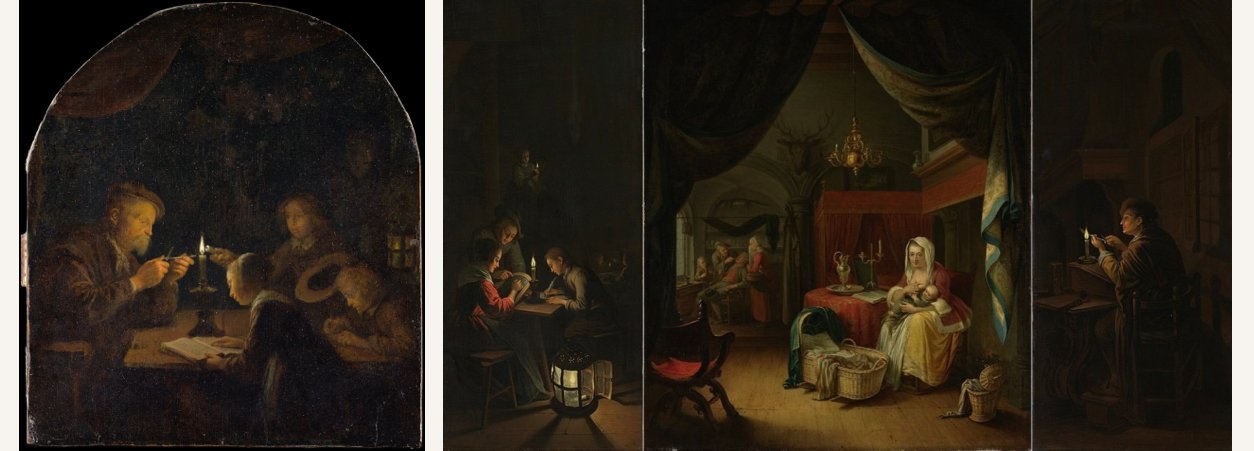
Fig. 27. (Left) Gerrit Dou, An Evening School, oil on wood, 25.4 × 22.9 cm, c.1655–57 (Metropolitan Museum, New York); and Fig. 28. Gerrit Dou, The Nursery, c.1660–65, known today only through a 1770 copy by Willem Joseph Laquy (Right) after Dou’s lost oak-panel triptych, which sank in 1780 on its passage to Catherine the Great in St Petersburg.
Dou was an artist whose interest in education extended well beyond the schooling of apprentices. Over the previous decade, he returned repeatedly to the theme in a sequence of works that together form a sustained enquiry into the nature of learning and how it might be represented in paint. No patron is likely to have encouraged such prolonged focus on this subject. It was a personal quest.
An Evening School (1655–57) [Fig. 27] marks the point of departure. A small, candlelit group gathers in quiet concentration, the act of learning contained within a compact, arched-top panel. In the slightly later Night School in the Uffizi (c. 1660) [Fig. 29], the scale expands: the panel more than triples in area, the number of figures increases, and the interior deepens into a more fully realised classroom.
In the lost triptych The Nursery (c. 1660–65) [Fig. 28], the enquiry breaks out from the single panel into a life-stage structure, unfolding across three scenes that trace development from infancy through instruction to practice — a progression that, as J. A. Emmens observed, accords with Aristotle’s observation that “three things are needed to achieve learning: nature, teaching, and practice; but all will be fruitless unless practice follows nature and teaching.” 6
And in The Night School diptych (c. 1665) [Fig. 29], the enquiry reaches its fullest expression as a lived system, in which learning is no longer contained or sequentially distributed, but enacted across two scenes in real time — a condition that must be established, maintained, and is always liable to disruption.
Seen against this trajectory, Schalcken’s role in Dou’s ambitions comes into clearer focus. The extension of the theme into a paired design — one panel ordered, the other unstable — suggests not simply delegation but a collaborative expansion of the problem itself, in which contrast becomes the means by which learning is tested and made visible.
What unites this sequence is Dou’s sustained use of candlelight, not simply as illumination but as a temporal device through which learning — and especially practice — becomes visible. In An Evening School, the flame enables study beyond daylight, its duration silently setting the bounds within which attention must be sustained. In the Uffizi Night School, that temporal condition is extended across a more complex interior, with multiple light sources articulating a shared space of learning. In The Nursery, light is distributed across panels to structure development, aligning with the progression from nature to teaching to practice. And in The Night School, the structure of the Uffizi composition is returned to and intensified: candlelight is extended across five sources — its duration underscored by the hourglass — and placed under pressure by the very behaviour it illuminates. Here, practice is no longer assumed but tested: attention must be maintained against distraction, and the time required for learning is shown to be fragile, contingent, and always at risk if practice fails.
The reunited diptych marks the culmination of this enquiry. What had been conceptual structure in The Nursery becomes real-time drama across two interdependent scenes. Order does not simply exist; it is achieved, tested, and momentarily lost. Diligence does not stand opposed to folly in principle, but is shown to give way when time is mishandled. The structure is unprecedented in Dou’s oeuvre: a continuous temporal argument delivered through two unequal panels designed to be read as one.
This achievement did not emerge fully formed. It is the result of compositional and conceptual experiments over many years, through which Dou progressively rethought how learning might be represented in paint. That process of rethinking is most legible in the passage from one Night School to the other — a comparison the following section explores in detail.
5.3 Compositional Precedent
Around 1660, some five years before the Rijksmuseum panel, Dou painted the smaller single-panel version of the Night School scene, now in the Uffizi. It already contains the essential elements of the theme: the teacher at the table, the girl reading beside the candle, two students walking beyond, and a rear table group. The scene is coherent, contained, and self-sufficient, though somewhat looser in its organisation when compared with The Night School. Nothing in it invites continuation beyond its frame.
The later Night School reworks this design decisively, indicating that Dou now had a more ambitious vision of what the schoolroom could achieve. The figure count increases, the space deepens, and the internal geometry tightens. Most significantly, a series of additions transforms the picture from a closed composition into a directional structure. [Fig. 29]
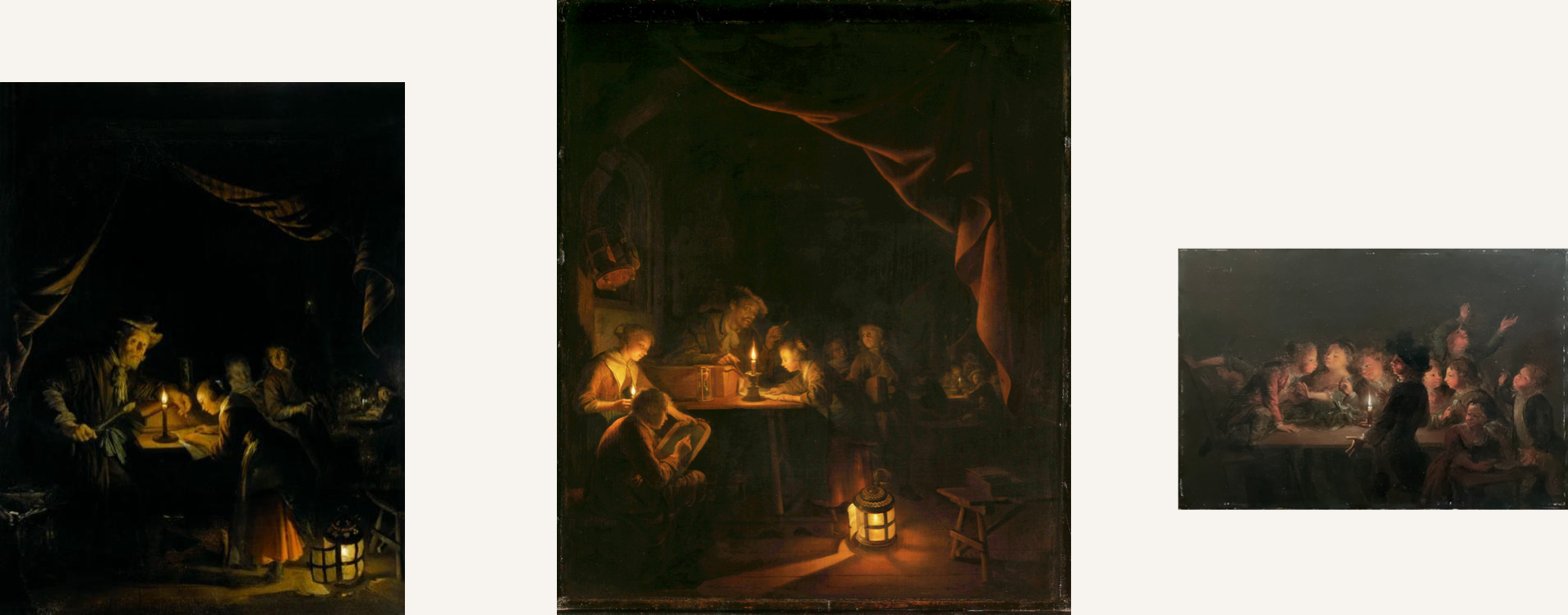
Fig. 29. Compositional development of the Night School theme.
Left: Gerrit Dou, Schoolroom by Candlelight, c.1660, oil on panel, 45.9 x 36.4cm, Gallerie degli Uffizi, Florence.
Centre–Right: The Night School reunited — Gerrit Dou, The Night School, c.1665, oil on panel, 53.8 x 42cm, Rijksmuseum, Amsterdam, shown with Godfried Schalcken, Folly at the Night School, c.1665, oil on panel, 22.5 x 30.6cm, private collection.
Seen together, the later panels reveal how Dou reconceived the earlier composition so that its structure and meaning unfold across two works. Paintings are to scale.
The teacher, now standing, stares and points outward. His gesture no longer addresses the pupil before him; it projects beyond the frame. Instead of two curtains, there is one drawn aside, like a stage wing opening a rightward axis. Its candlelit lower edge forms a strong diagonal that, when the panels are reunited, carries the viewer's eye toward the heart of the action in Folly. The bench is brought forward and made structurally prominent, angled one way toward the girl who reads and the other toward a gap at the table from which it has been moved. Books are placed upon it — instruments of learning visibly present yet conspicuously absent in the companion scene. The reading girl is given the scale and features of the younger pupils there, marking her as one of them. The hourglass and drum introduce explicit measures of time and order. In the foreground, the floor lantern is intensified and, together with a pupil writing by candlelight, establishes a chain of illumination linking the figures across the panels in a harmony of reds, blues, and browns.
Each of these changes increases the painting's directional, temporal, and narrative force. None is merely ornamental. Each clarifies the internal logic of the scene while simultaneously establishing relations that extend beyond it — a strategy consistent with Dou's characteristic use of outward-looking gesture and gaze to direct the viewer and inflect moral emphasis, as noted by Sluijter and others. 8
Seen beside Folly, these additions are best understood not as enrichments but as structural components. The teacher's outward gesture establishes the need for a corresponding action. The opened curtain becomes a directing element rather than a backdrop. The books on the bench form a narrative bridge between the scenes. The reading girl aligns with the children at the Folly table. The hourglass and drum establish the governing theme of measured time and how it is used. The light that sustains learning in one scene becomes, in the other, the very light whose stability is tested.
The candlelight, too, operates architecturally. The pools of light that illuminate study in the classroom increase in number and intensity, advancing across the divide like stepping-stones for the eye and binding the two interiors into a single unfolding drama.
The enlargement of the panel reinforces this transformation. The earlier composition sustains only a small group; the later work accommodates ten figures without congestion, allowing it to stand in full figurative balance with its smaller counterpart, which likewise contains ten. The increase in scale is therefore not simply a matter of ambition or display. It is functional: providing the spatial and narrative capacity required for a paired design.
The later panel is thus not a refinement of the earlier composition, but a re-formed one — adjusted, extended, and strengthened so that its full meaning unfolds in a new way across two panels. It is difficult to account for these deliberate alterations except as evidence of a compositional rethinking of The Night School, conceived in deliberate relation to the corresponding scene in the companion panel.
The transformation extends beyond structure to characterisation. The figures in the Uffizi panel inhabit the scene informally — their bearing loose, their posture unstudied. Those in the Rijksmuseum panel carry themselves with a composed purposefulness — a collective rectitude of bearing felt before it is analysed. Dou has not merely reorganised the composition; he has reconceived its figures. In the earlier painting they remain grounded in the same visual world as the children of Folly — relatively at ease, their demeanour unformed. In the later panel, by contrast, they are lifted into the disciplined condition that learning produces: attentive, self-possessed, and purposeful. The contrast is not incidental but constructed. It establishes, at the level of the human figure, a developmental arc across the diptych that gives physical form to impulse and its cultivation. This is explored further in §5.10.
The diptych was thus not an isolated invention but the final form of a design that Dou developed over several years. What begins in the earlier panel as a self-contained scene is systematically restructured into a composition whose full meaning depends on extension beyond its frame. The density of interlocking cues — spatial, temporal, narrative, and human — is therefore not incidental enrichment but the result of sustained pictorial thinking. The work’s richness arises from duration: it is a composition matured into dynamic tension.
The compositional evidence therefore returns us to the studio. If the final diptych was built around productive difference — ordered study answered by unstable counterpoint — then its making must have depended on a working relationship capable of sustaining that contrast without breaking the unity of the design.
5.4 A Master’s Instruction
How the collaboration itself developed is not known, but it is likely they had the Uffizi panel as foundation to discuss and work from, as the earlier painting appears to have remained in Dou’s possession until his death and is recorded in his 1675 inventory. 9 Whether Dou developed his panel first or whether they planned the diptych together from the outset, the outcome is decisive: the structure holds. Geometry, sightline, and narrative function bind the two scenes so tightly that difference itself becomes productive. The diptych’s unity is too precise to be accidental, yet its expressive duality is inseparable from a design conceived to accommodate — and exploit — contrast.
With this in mind, imagining how Dou might have briefed Schalcken on the counterpart panel gives pause for thought. What follows is one way such a dialogue might have unfolded:
Godfried, I think you are ready for your last exercise. Come look at my Night School: see, the hourglass is turned and the lesson begun. The girl I am painting has stepped forward to read, but her teacher looks up — there is noise from the table she has left. Now imagine: without her good example, her classmates are causing a commotion.
I want you to paint that. Take this small panel and show the chaos that follows — nine children (the number is important) gathered round a table, their mischief building one upon the other.
But don’t paint it as I would — do it looser, with more life, as I have seen you do. Put your full energy into it. The contrast is essential. I want the struggle between diligent learning and unruly children to excite the eye. So think hard, and come back to me with ideas for how they misspend their time.
We shall plan it together — with a teacher’s assistant who has failed to restart the class after break, shrugging back uncertainly at the teacher’s raised finger. That is key, to bind the two and show the true folly.
And one more thing: do it as a fleeting moment, lit by a single candle — the light of learning itself. Make it a living flame, as I know you can; that is your strength, and it will be your future. Let us show that Mr Steen what learning truly demands — not scenes to make Leiden snigger, but a lesson for the mind.
”5.5 Choreography of Consequence
What Schalcken produced under Dou's oversight was no student exercise, but a work of invention, virtuosity, and compositional daring that rivals The Night School itself. If Dou's panel establishes the structural conditions of order, Folly demonstrates what happens when those conditions fail. The force of Folly lies not only in its fine painting but in the way Schalcken choreographs consequence itself. Unlike most genre scenes, which freeze an incident, this composition crackles like a fuse. One gesture sets off the next: a house of cards totters, a chair tips, a bubble drifts upward, glances dart across the room. The scene is not merely animated but sequential — a true chain reaction. [Fig. 30]
The trigger is prepared in The Night School. There, the teacher has just turned the hourglass to begin the lesson. The implication from the cards and the girl still eating is that this marks the end of the children's break. At that moment a girl has risen from the table and stepped across into the calm of reading aloud to the teacher. But the assistant has failed to restart the class at the Folly table, and the older girl's departure breaks the balance: five more disruptive children now outnumber the four more orderly pupils that remain. That imbalance does not simply animate the children; it endangers him. His inattention has allowed disorder to take hold, and the teacher's pointed finger makes clear that the consequences of their behaviour are also his.
From this imbalance the narrative energy is released. At its heart is the candle: not a still point, but a flickering centre of illumination and danger. Schalcken renders it with astonishing delicacy, using an embryonic layering of blue, red, and yellow touches on a white ground, markedly more lifelike than Dou's own. Around it the drama converges. The collapsing house of cards transforms a familiar vanitas emblem into action — fragility, folly, and imminent disaster compressed into a single image, lit by the flame that is itself threatened. It is among the most conceptually audacious still lifes of the Golden Age.
Toward this flame every force cascades. The girl shoves her neighbour's chair backwards, thrusting him forward onto the table. He blows to the right, toppling the cards and threatening the candle. The flame and the soap bubbles rise while the cards tumble. Hands and arms encircle the light in choreography — admonition, mischief, surprise, warning — each answered by a glance, a tilt of the head, a smirk or gasp of alarm. Even the small girl in the foreground joins the chain: half-absorbed in eating, she gleefully looks across the table towards the teacher in The Night School panel, her sideways glance bouncing the viewer's eye back across the diptych and tightening the scene's remarkable foreground compression.
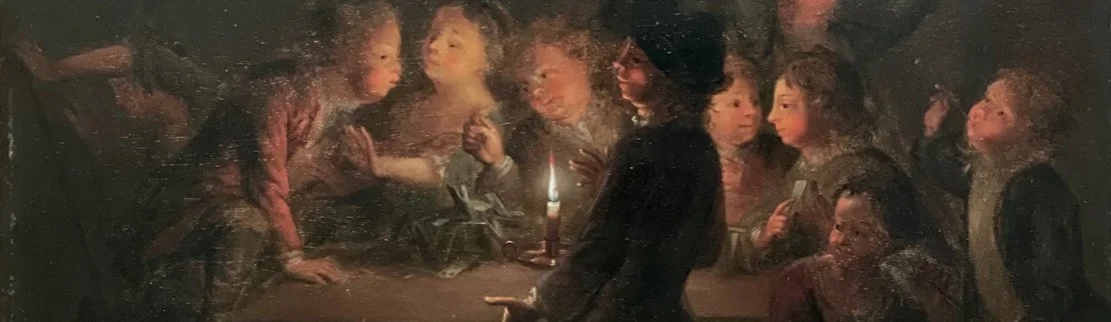
Fig. 30. Folly at the Night School: A compressed landscape view revealing the cascade of glances, actions, and reactions around the candle’s living flame.
The result is a pictorial energy unusual in the period. Jan Steen conjured boisterous disorder, but his interactions are more diffuse. In Folly, by contrast, every gesture is bound into a single cascade: tightly structured, sequential, converging on the threatened flame. Where Steen's humour spills outward, Schalcken's energy drives inward, focused and explosive.
No detail conveys this radical energy more vividly than the collapsing house of cards. Card-building was a known pastime in European court culture by the early seventeenth century — the earliest documented reference is a journal entry of 6 October 1606 recording the young Louis XIII amusing himself making card castles — and by the 1640s the phrase “house of cards” had entered English as a figure for futile human endeavour. Yet in the Dutch context the motif appears to have had no established name or pictorial tradition. Eddy de Jongh’s Questions of Meaning, whose systematic survey of symbolic motifs in seventeenth-century Dutch genre painting is precisely where one would expect to find earlier examples, records none. 10
Yet the absence of an established Dutch term or pictorial tradition does not mean that children did not build such structures. Any culture in which there were playing cards could readily discover the amusement and fragility of balancing them together, and Folly itself suggests the activity was immediately intelligible. Scenes of card-playing had been familiar in Leiden for over a century, from the widely circulated prints and paintings of The Card Players by Lucas van Leyden (1494–1533), 11 to the compressed candlelit scenes of Gerrit van Honthorst and Leiden’s Jan Lievens a generation earlier (§3.4). In Folly, this established motif recurs in the boys at play, even as it is extended into the more precarious stacking of cards.
In the known later instances — notably Hogarth’s A House of Cards and Chardin’s four versions of The House of Cards in the 1730s and 1740s — the structures are intact: the stacked cards fragile by implication, their fall anticipated rather than witnessed. A print after a lost painting by Charles Antoine Coypel of 1725 comes closest — a boy blows, a girl reaches out to stop him, one card has begun to fall — but the structure largely holds. 10
In Folly, by contrast, the cards are already blown sideways, mid-collapse, toppling toward the candle at the precise moment when order gives way to chaos. The infrared reflectogram shows that Schalcken worked and reworked this passage during execution — evidence of deliberate invention. The motif has become event — a transformation that suggests the combined contribution of both artists to an image that, with the bubble to the right, conveys the playful waste of classroom time, in which all effort comes to nothing.
Nothing in Dou’s earlier work anticipates such compressed movement and cascading instability, yet it is equally hard to imagine a painter at Schalcken’s early stage arriving at so exacting a narrative structure without Dou’s discipline. Dou provides the architecture — the pedagogical, temporal, and compositional framework — while Schalcken energises it from within. His lighting and timing are pivotal, illuminating the chain of consequence that runs through the scene. What emerges is not a division of labour, but a genuine collaboration in which control and volatility sharpen one another.
5.6 Time Made Visible
What Schalcken adds to this choreography of consequence is something even rarer: a radically new way of picturing time.
Centuries before the invention of photography, the reunited diptych articulates a distinction we now associate instinctively with the camera: the difference between slow exposure and fast exposure. This modern analogy is not offered to suggest photographic thinking, but to clarify an innovation that was entirely seventeenth-century in conception — a fundamental difference in how time itself is made visible.
Dou's The Night School presents a sustained tableau. Figures appear held in equilibrium, as if the scene and its relationships have settled into a state of legibility while they are observed and painted. Time feels distilled; only the hourglass signals its passing. Schalcken's Folly, by contrast, records a precise moment to make that passage visible.
This difference is deliberate and structural. In Folly, nothing is posed at rest. Motion is not resolved into composure but observed in action. Cards caught mid-fall are central to this perception. The girl shoving the chair is a shadowy blur of movement. The boy's breath pushes through the air. Glances ricochet too quickly to stabilise. The candle flickers, illuminating faces, bubbles, and collapsing cards in a light that itself refuses to settle. Schalcken arrests motion in order to see it — but not to stop it.
The falling house of cards is the key to how the whole scene is read. A toppling structure might still belong to a composed genre scene; cards suspended mid-fall cannot. They exist only for an instant — a split second between balance and collapse. In choosing to paint that instant, Schalcken must observe, memorise, and reconstruct a moment he could scarcely see. This is heightened naturalism of a new order: not the patient description of surfaces, but the reconstruction of fleeting time itself.
It is this captured instability that gives Folly its extraordinary force. Because nothing is resolved, consequence is alive. The collapsing cards, the tipping chair, the threatened flame, the assistant's reactive gesture — the future presses against the present. What happens next is not illustrated, but felt.
In this way, Schalcken transforms Dou's pedagogical architecture into something newly experiential and radical: a drama not only to be seen, but to be lived in time and read.
5.7 Reading Time in Paint
Because Folly narrows time to an instant, Schalcken can show its unfolding within a single compact scene. The painting does not merely depict an action; it compresses a behavioural chain. What Folly at the Night School articulates — and what makes it so rewarding — is a sequence the viewer instinctively reconstructs in the mind rather than simply observing the painted moment. Part of this sequence is immediately visible in the physical chain of movements across the scene; part lies beyond the instant and must be inferred as cause and consequence.
Most fijnschilders — Metsu, Van Mieris, Van Slingelandt — still the world into composed moral tableaux, presenting behaviour already settled into legible form. Folly, by contrast, animates an entire sequence within a single frame.
The viewer registers the before — the children's break of play and food, and the assistant's failure to restore order; the now — the instant when disorder tips into collapse; and the after — the imminent fall, the threatened flame, the disruption of the class. Multiple temporal states coexist within one arrested moment, requiring the viewer to infer cause and anticipate consequence. Time is not narrated; it is reconstructed in the mind.
This compression has few true precedents. Jan Steen gestures toward narrative flux, but his scenes tend to erupt all at once. In Folly, sequence is built with far greater precision, allowing energy to travel through the scene in a directed chain — like motion observed in the moment, yet palpably ongoing. In this sense, the painting reaches beyond Leiden genre practice altogether. Its temporal intelligence anticipates the narrative modernity of Hogarth, who a century later would unfold moral drama across serial images. Here, that same logic is condensed into a single frame.
Crucially, this is not temporal bravura for its own sake. Time becomes an active agent in the painting's meaning. The fragile rhythm of learning — play giving way to study, freedom to discipline — is shown at the exact instant it fails. Consequence presses into the present: the future is felt, not illustrated.
Even gesture participates in this temporal logic. Raised arms and lowered hands establish opposing vectors of motion and intent — exuberance and alarm — registering the clash of emotional tempos within the same moment. Nothing has yet happened, yet everything is about to. The scene does not simply depict an event; it declares its moment in time.
5.8 The Flame as Signature
If Dou's hallmark was microscopic stillness, Schalcken's was the mastery of microscopic fire. The candle in Folly at the Night School — scarcely a few millimetres high, yet constructed in sub-millimetre strokes of blue, red, and yellow on a white ground — is likely the earliest surviving expression of the technique that would come to define his career.
The Courtauld report records the extraordinary precision of its construction: a white base for luminosity, a blue accent at the foot of the flame, a transparent red lake for the wick, and warmer yellows and reds at the tip. Under magnification these resolve into strokes less than a millimetre wide, with pigments ground to near-microscopic fineness. At life-size the flame can be believed to quiver; at this scale it reveals itself as a feat of controlled dissection — fijnschilder discipline applied to fire. [Fig. 31]

Fig. 31. Microstructure and chromatic construction of the flame in Folly at the Night School. Left to right:
(1) sub-millimetric detail of the lower flame (0.5 mm scale), showing microscopic layering of blue, red and yellow pigments;
(2) the wick with transparent red lake glaze strokes at 1 mm scale, some wick strands as fine as 0.05 mm;
(3) the luminous upper candle, wick, and flame at 2 mm scale;
(4) the yellow-to-red tip of the flame and reflected highlights on the assistant’s fingers (2 mm scale), showing Schalcken’s signature candlelit modelling.
In the Leiden of the 1660s — where Huygens and his peers were extending the reach of sight with magnifying lenses — Schalcken brought a similarly microscopic focus to painting. 12 The strands of the twisted wick, some no more than a twentieth of a millimetre, would have been executed with a single fine hair or an equivalently refined point, working at the limits of vision and possibly with the aid of a glass lens. This is fijnschilder technique taken to an extreme: fire itself dissected and rebuilt at a scale so fine it requires magnification to be fully appreciated.
What is remarkable is not only the minuteness of the execution, but its ambition to suggest life. Fire is never still: it flickers, shifts, and reforms from instant to instant. To paint it convincingly is therefore not simply a matter of colour, but of constructing an image that appears caught in motion, even though it is patiently made.
Schalcken does not simply arrest an instant of flame, as he does the falling cards. Instead, he constructs that sense of movement through accumulated observation — layering colour, adjusting tone, and refining edges with such care that the flame, and the light it casts on the surrounding figures, could be thought to quiver. Faces emerge from darkness according to their proximity to its unstable glow, while gesture, reflection, and emotional emphasis radiate outward from its shifting centre. The flame thus organises visibility itself.
This optical sensitivity extends to the treatment of the faces around the candle. Schalcken adjusts the illumination on each carefully: soft warm reds along the cheeks, minute highlights on nose and lips, shadows carried in fine translucent glazes that fall away from the flame's radius. No two faces are lit in quite the same way, because no two occupy the same position within it. These are not conventional genre heads but candlelit physiognomies built stroke by stroke, each calibrated to a real optical effect — and each given distinct psychological individuality. [Fig. 32]

Fig. 32. Candlelit facial modelling in Folly at the Night School (each c.2 mm scale -top left of each image).
Microscopy images showing Schalcken’s emerging talent for rendering differing emotional states with signature technique: warm red modelling, yellow highlights turning towards the flame, and finely modulated shadows falling away from it. Note: The lighting conditions used in the Courtauld microscopy photography make the faces appear warmer.
Across the reunited diptych, five lights structure the action: four steady flames in The Night School — emblematic, monochromatic, and signalling the ideal of learning — are balanced by a single more lifelike flame in Folly. Schalcken's flame is different in kind. It is not emblem but experience: a fragile light rendered with microscopic realism, illuminating faces, cards, and bubbles at the very instant they threaten collapse.
The symbolism this suggests is clear without being forced: in Dou's panel the light stands for the principle of learning; in Schalcken's, it becomes the lived moment in which that learning is tested — a flame that can be snuffed out in an instant. The contrast between the two is too exact and too integral to the structure of the diptych to be accidental. It points to a deliberate conception in which the counterpoint of order and lapse is distributed across the two panels, with the more volatile element realised in the companion scene. In this context, Schalcken’s flame — more lifelike, microscopic, and chromatically constructed — emerges as a signature device: it goes beyond bravura to become the living heart of the drama, embedded within Dou’s architecture.
Later Schalcken candle pieces show the same optical language reiterated and deepened: flames built in layers of glaze and highlight, structured at the scale of millimetres, always slightly varied, responding to the lean of the candle, the burn of the wick, and the movement of air around it. [Fig. 33] That variability is telling: he was not repeating a formula but returning to a method first apparent in Folly, refining its expressive range and emotional register as it organises each scene. Folly likely captures a moment of origin — the instant when microscopic painting, Leiden optics, and dramatic invention converged to ignite the career of arguably the most exacting candlelight painter of his time.
In 1695, at the age of 52, Schalcken painted himself as a younger artist. [Fig. 34] Shown with candle and palette, he signals how formative his passion for candlelit painting — first cultivated in Dou's studio — remained throughout his life.
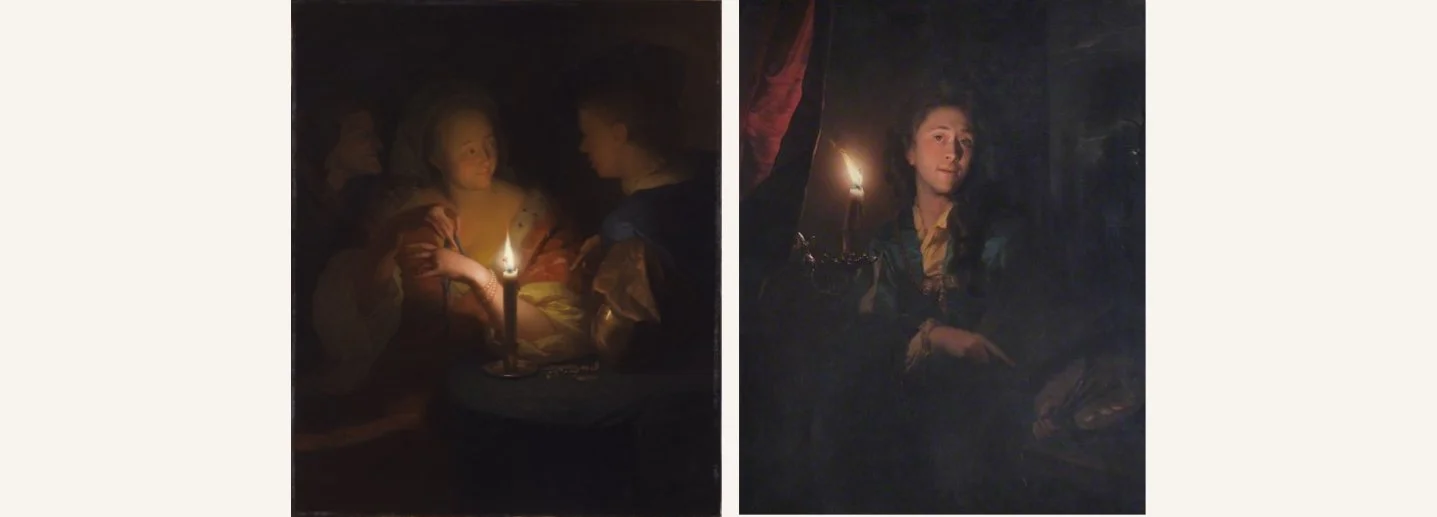
. Later candlelit works by Schalcken.
Fig. 33. Left: The Lovers, oil on canvas, 76.5 × 63.8 cm, c.1692–1706 (The Leiden Collection, New York), showing variation of the multi-layered candle-flame construction first explored in Folly, here adapted to an intimate narrative setting.
Fig. 34. Right: Self-portrait with Candle, oil on canvas, 109.5 × 88.5 cm, 1695 (Leamington Spa Art Gallery & Museum). Schalcken presents himself as a younger artist, candle and palette in hand, affirming the centrality of candlelit painting to his artistic identity.
5.9 Children with Life
Over the past four years I searched repeatedly — and found no clear parallel — for a Dutch seventeenth-century artist who painted children at scale with the life and energy found in Folly at the Night School. For some time, this absence proved an obstacle to determining the work’s authorship.
The reason, I came to realise, is that the depiction of so many children to convey the lived reality of teaching in Folly was itself an unusual ambition — one that sets the painting apart within Dou’s studio, Schalcken’s career, and Dutch art more broadly. Schalcken’s catalogue raisonné indicates that he went on to produce a number of smaller paintings featuring children over the course of his career, many of which have not survived. 13 None, however, appear to have approached the figure scale of Folly. Among surviving works, there are notable depictions of children — some charming, some moralising, some satirical — yet few rise to the artistic and psychological level achieved here, within a composition of such intensity. Elements of its achievement can be found elsewhere, but nowhere else are they brought together with such orchestrated human vitality.
a) Psychological Characterisation
Many artists of the period could render a convincing likeness of a child; fewer could infuse each with an individual personality. Jan Steen's The Feast of St Nicholas (c.1665–68) is perhaps the best-known example of a multi-child narrative, its bustling energy underpinned by sharply observed facial expressions. [Fig. 35] Yet even Steen tends toward broad character types — the mischievous boy, the sulking girl — rather than the precise psychological specificity seen in Folly, where nine distinct figures each register a different emotional state in response to the unfolding chaos.
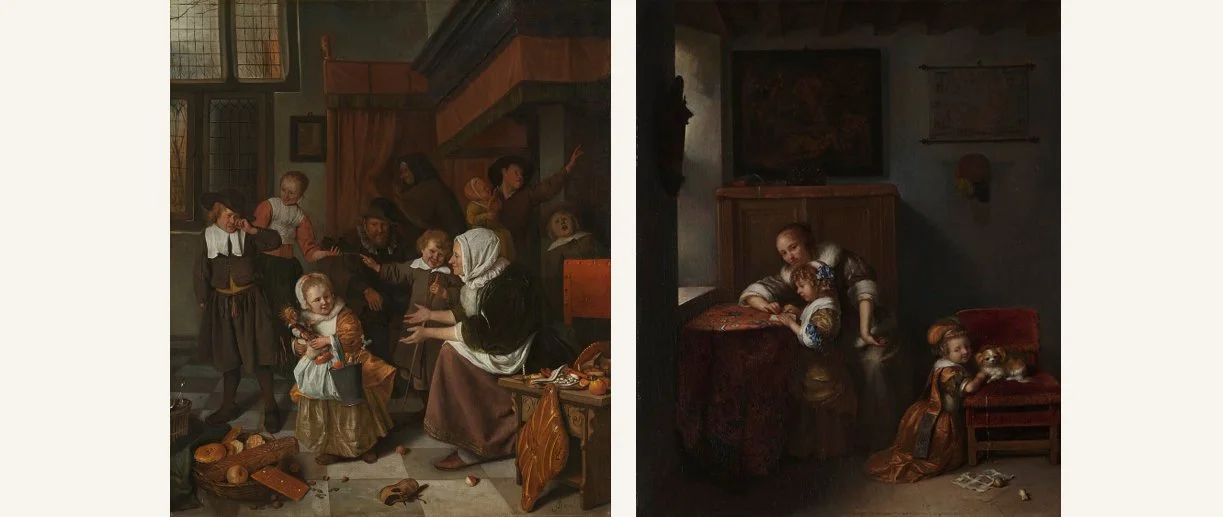
Fig. 35. Jan Steen: The Feast of St Nicholas, oil on canvas, 82 x 72.5cm, 1665-68 (Rijksmuseum, Amsterdam); and Caspar Netscher: A Lady Teaching a Child to Read, and a Child Playing with a Dog, oil on panel, 45.1 x 37cm, 1664 (Wallace Collection, London)
b) Choreography of Gesture and Glance
Caspar Netscher's A Lady Teaching a Child to Read, and a Child Playing with a Dog (1664) demonstrates the intimacy possible in small-scale genre works, but the interactions are limited to two children. [Fig. 35] Folly compresses ten interacting figures into a panel of just 22.5 × 30.6 cm, maintaining both narrative clarity and dynamic movement — a feat that demands an unusually sophisticated grasp of visual choreography.
c) Candlelight and Atmosphere
Gerrit Dou himself, in works such as The Young Mother (Mauritshuis, 1658), could light children with extraordinary subtlety, yet he tended to set them within static, moralising compositions. The candlelit child scenes of Schalcken’s later career — for example, Boy Blowing on a Firebrand (private collection, c.1690s) — are technically accomplished but intimate and contained. Folly appears to be among the very few seventeenth-century paintings to combine multiple children, candlelight, and a sustained narrative into one coherent, energised scene.
d) Tonal and Interpretative Complexity
Other Golden Age painters achieved excellence in their chosen registers — Ter Borch in refinement, Steen in humour, Netscher in elegance — but rarely did they layer humour, charm, and ethical seriousness in equal measure. Folly succeeds in doing so without slipping into caricature or sentimentality: the children are mischievous yet believable, their mix of joy and concern palpable, their pedagogical significance left open to reading rather than didactically imposed.
e) A Category of Its Own within the Genre
Placed alongside its peers, Folly at the Night School emerges as a striking outlier within the genre. It matches Steen in animation, Dou in technical finish, and Schalcken’s other works in candlelit atmosphere — but synthesises these elements into a single, tightly controlled composition that speaks in a voice all its own. If The Night School is a masterclass in diligent stillness, Folly is its kinetic, luminous counterpart. Together, they occupy an unusual position within the history of Dutch Golden Age depictions of children.
The faces themselves reinforce the attribution to Schalcken. The children — and the assistant among them — share a vivid, almost impish expressiveness that is animated rather than idealised, observed rather than typified. In place of Dou’s didactic exemplars, Schalcken gives us living beings: mischievous, self-aware, and sympathetic. Even the assistant shares their vitality — a youth still learning self-command.
Within this expressive register lies Schalcken’s distinctive contribution: he transforms the conventional emblem of folly into a study of character in motion, using light itself as the instrument of empathy. The result is recognisably his — a pedagogical scene re-imagined as human drama, and open to interpretation rather than closed by it.
Schalcken does not appear to have painted children on this scale again. While his catalogue indicates further small-group scenes — many now lost or untraced — no surviving works match the density and dynamism of Folly. The exceptional circumstances of Folly, conceived within Dou’s studio and under his direction, were not repeated; and although Schalcken married in 1679 and reportedly had seven children, only one survived to adulthood — a personal loss that may well have discouraged a more sustained return to the genre he painted so well. 14
5.10 Physiognomy as Argument
The faces of Folly and The Night School are not merely well observed — they function as a visual register of the diptych’s central contrast. In Folly, the children’s animated features are grounded in the physiognomic language of Dutch genre scenes of everyday life — a rich tradition running from Pieter Bruegel the Elder through Adriaen Brouwer to Jan Steen — where appetite, impulse, and sociability are rendered with immediacy. 15 In The Night School, by contrast, the figures display a composed bearing and controlled expression associated with learning and discipline. Across the two panels, physiognomy becomes argument: the animated faces of Folly and the composed faces of The Night School embody the two poles of the diptych’s developmental arc — impulse and its cultivation — rendered visible in paint.
Schalcken does not condemn the children’s vitality but illuminates it as vitality awaiting education. Two figures make this logic most legible. The assistant in Folly, whose features align him with the children rather than with the teacher, makes the point with particular precision: his lapse is not moral failure but developmental truth, the mark of a young man not yet sufficiently formed to exercise the authority his role requires. And the reading girl, crossing from the Folly table into the ordered world of the primary panel, carries both conditions simultaneously — her features still faintly impish, her attention already gathering into discipline. She is the developmental arc made visible in a single figure.
The logic extends to every legible face in both panels, and reaches its culmination in the teacher himself — whose distinctive rendering, examined in §6.6, reads not as an isolated anomaly but as the highest point of a developmental sequence written across the faces of the entire diptych. The children in Folly are at its foot — raw vitality, and limited self-control in varying degrees. The assistant is partway up but not yet fully disciplined. The reading girl is in transition, her fluency developing through practice. The composed, older pupils in The Night School have arrived at concentrated engagement, and at lower left present the more advanced stage of writing, consistent with contemporary schooling practice in which reading preceded writing. 16 The teacher stands at the summit, his features and gesture the visible evidence of what education can achieve and the attention it demands. Finally, he and the reading girl before him — the central focus of the diptych — together distil the three essential elements of learning: nature, teaching and practice.

Fig. 36. The five female figures articulate the full spectrum of the diptych’s developmental argument, from cultivated understanding back to unruly impulse.
The five female figures distributed across the diptych articulate this developmental logic with particular clarity. At its highest point stands the older figure associated with Cognitione, embodying the ideal of learning itself. Next, the reading girl before the teacher has already crossed into disciplined practice. A third girl, still at the Folly table, attempts to restrain the boy blowing at the cards and candle, reacting to the disorder even if unable to prevent it; unlike the small girl eating on the bench, who is an amused yet idle witness to the unfolding drama. Most extreme is the girl pushing over the chair, who actively escalates the disorder around her. Together, the five female figures trace the full spectrum of the diptych’s pedagogical argument, from cultivated understanding and disciplined attention back to impulse and disorder; from distilled composure and the light of learning back to raw immediacy and shadow. [Fig. 36]
What appears at first glance as a difference in figure types between two panels by different hands is therefore precisely the point. The faces are not meant to match but to contrast. That contrast is calibrated with the precision one would expect from a work in which every element serves a purpose — a diptych whose unity depends not on similarity but on the structured ordering of difference. It may even have formed part of the logic behind Dou’s use of Schalcken as the countervoice to his own panel: the younger painter’s greater immediacy and theatrical energy allowed difference itself to become structurally productive within the diptych.
maller details within Folly reinforce the same principle. The two boys playing cards are arranged in semi-profile and profile views that subtly mirror the profile variation of court cards. The visual rhyme is slight but precise: in a scene where play increasingly governs behaviour, the players themselves embody the game in which they are engaged. Physiognomy and arrangement are thus part of the diptych’s larger system of meaning, which rewards the viewer the more it is discovered. [Fig. 37]

Such contrasts align more broadly with early modern ideas about the relation between outward expression and inner disposition, as discussed in works such as della Porta’s De humana physiognomia (1586). 17 Whether Dou or Schalcken had knowledge of such theories cannot be established, but the visual language is clearly legible in the contrast between Dou's figures and the familiar genre types of the period with which the figures in the Uffizi version and Folly are more aligned. This physiognomic contrast is further embedded in the diptych through the equal figure counts across the two panels (see §2.5), which reinforce the sense of a deliberately ordered system in which difference is calibrated rather than incidental.
The rediscovery of Folly thus brings a final coherence to Dou's thinking across seven panels — two single paintings, a triptych, and a diptych — developed over a decade on the theme of education: a coherence obscured for centuries by the disappearance of four of the panels. 18
Footnotes to Section 5
Arnold Houbraken, De Groote Schouburgh der Nederlantsche Konstschilders en Schilderessen (1718–21), vol. 3, p. 166. Early biographical reference to Dou and his pupils; important for understanding how Schalcken’s apprenticeship was remembered.
Godfried Schalcken, Portrait of Gerrit Dou, engraving (1665), inscribed “ex reverentia, Schalcken delineavit praeceptorem.” Surviving examples in Leiden University Library and British Museum. A personal tribute that explicitly honours Dou as master.
Wayne Franits, Godefridus Schalcken: A Dutch Painter of Late Seventeenth-Century Genre and Portraits (exh. cat., 1996), cat. no. 1, pp. 24–25. Catalogue entry for Schalcken’s engraved portrait of Dou, with discussion of context and meaning.
C. Hofstede de Groot, A Catalogue Raisonné of the Works of the Most Eminent Dutch Painters of the Seventeenth Century, vol. I (London, 1913), p. 415, no. 206; Rijksmuseum “Stories” page on Gerrit Dou.
Eric Jan Sluijter, Seductions of Sight: The Art of Gerrit Dou, 1613–1675 (Zwolle: Waanders, 2000), esp. 55–59. On Dou’s pedagogical imagery and the moral charge of number and parable in his schoolroom scenes.
J. A. Emmens, “A Seventeenth Century Theory of Art: Nature and Practice.” A Review of Arts Life and Thought in the Netherlands, 1969, 30-40, on how The Nursery triptych aligns with Aristotle’s observation about learning.
Baer and Arthur K. Wheelock Jr., ed., Gerrit Dou 1613–1675: Master Painter in the Age of Rembrandt (Washington & The Hague, 2000), cat. no. 27 (An Evening School). Contextualises Dou’s refinement of the schoolroom theme in single-panel form.
For Dou’s characteristic use of outward-looking gesture and glance as a device of viewer direction and moral emphasis, see Eric Jan Sluijter, “Gerrit Dou, Rembrandt, and the Scholarly Image,” in Seduction and Skepticism: Gerrit Dou’s Art of Allegory (Amsterdam, 1993), 57–74; and Quentin Buvelot (ed.), Gerrit Dou 1613–1675: Master Painter in the Age of Rembrandt (The Hague: Royal Picture Gallery Mauritshuis, 2016), esp. essays on narrative construction.
Dou’s death inventory, 1675 (Stadsarchief Leiden, Notarial Archives). See also E. van der Willigen, Les Artistes de Harlem (Haarlem, 1870), 129, which transcribes the entry “een nagt schooltje met veele beelden” (“a little night school with many figures”), corresponding to the Uffizi Night School.
David Mitchell, 'Card Castles / Houses of Cards / Chateaux de Cartes', Public Paperfolding History Project, https://www.origamiheaven.com/historyofcardcastles.htm (last updated 1 September 2024, accessed May 2026), which records the Héroard journal entry and surveys all known examples; for the Coypel print specifically, see Mitchell, 'Castles from Playing Cards', Life, Death and Paperfolding (Substack, 20 July 2024), https://davidgrahammitchell.substack.com/p/castles-from-playing-cards (accessed May 2026). De Jongh's survey is in Questions of Meaning: Theme and Motif in Dutch Seventeenth-Century Painting, trans. Michael Hoyle (Leiden: Primavera Pers, 2000).
For Lucas van Leyden’s Card Players and the early dissemination of card-playing imagery, see The Card Players, Museo Nacional Thyssen-Bornemisza, Madrid, https://www.museothyssen.org/en/collection/artists/leyden-lucas-van/card-players (accessed May 2026).
On the Leiden culture of optical experimentation, see Eric J. Sluijter, Seductions of Sight (Zwolle, 2000), 31–39; Huib J. Zuidervaart, “Huygens and the Development of Optical Instruments,” in The World of Christiaan Huygens, 1629–1695 (Dordrecht, 1994), 165–183.
C. Hofstede de Groot, A Catalogue Raisonné of the Works of the Most Eminent Dutch Painters of the Seventeenth Century, vol. IV (London, 1912), nos. 314-419.
National Gallery of Art, Washington, “Godfried Schalcken (1643–1706),” Online Editions, https://www.nga.gov/collection/artist-info.XXXX.html (accessed April 2026), for biographical details including family and children.
Mauritshuis, “Genre Paintings,” https://www.mauritshuis.nl/en/our-collection/our-genres/genre-paintings/ (accessed April 2026), for an overview of the Dutch and Flemish tradition of everyday-life scenes grounded in the observation of human behaviour and moral implication.
Willem Frijhoff, “Calvinism, Literacy, and Reading Culture in the Early Modern Northern Netherlands: Towards a Reassessment,” Archiv für Reformationsgeschichte / Archive for Reformation History 95 (2004), on Dutch elementary schooling, the priority of reading before writing, individual instruction under a single schoolmaster, and the broader civic and Calvinist culture of literacy.
Giambattista della Porta, De humana physiognomia (Naples: Joseph Cacchium, 1586).
Of the seven panels, only three of the six previously known panels had survived before the rediscovery of Folly: the two single paintings and one panel of the diptych. The triptych is known through a copy by Laqui, on which Emmens in the 1960s based his foundational analysis linking it to Aristotle. The original painting was lost in a storm off the Finnish coast in October 1771 on passage to Catherine the Great in St Petersburg. The ship, the Vrouw Maria, was salvaged in June 1999 and the painting recovered, but in a condition beyond conservation. 'The Wreck of the Vrouw Maria,' History Today (months past archive), https://www.historytoday.com/archive/months-past/wreck-vrouw-maria, accessed May 2026.
6. A SINGULAR CREATION
For generations, The Night School has been understood as an idealised image of instruction: a polished exemplum of order, diligence, and disciplined learning. The reunion of Folly does not simply restore a missing counterpart; it reveals the painting as part of a far more ambitious design. What once appeared a self-contained scene now emerges as one half of a dynamic relational structure in which learning is not merely represented, but tested across two interdependent panels. The teacher’s pointing gesture — long recognised as central, yet requiring the invention of a boy in shadow to make sense of it — finally finds its true object when the paintings are reunited. But the implications extend much further. Light, gesture, physiognomy, temporality, and even differences of paint handling are organised into a calibrated system of relations through which meaning emerges not through decoding symbols, but through the viewer’s active engagement in tracing sequence, contrast, and consequence across the diptych.
This section traces how that structure reshapes our understanding of Dou, Schalcken, and the possibilities of seventeenth-century art.
6.1 A Living Tension
With the reunion of The Night School and Folly, it becomes clear that Dou did not set out to illustrate a lesson with a fixed moral conclusion. He designed something more demanding — and more subtle: a painting that teaches by making the viewer think.
The diptych does not instruct through proclamation, emblematic clarity, or didactic finality. Instead, it stages a condition. Order and disruption, diligence and distraction, learning and play are not resolved into a verdict; they are held in a structured relation that must be worked through. The viewer is not told what to conclude, but placed in a position of attention and reflection, mirroring the process of learning itself, in contrast to the teacher within the scene, who directs and asserts.
Dou's achievement lies in how rigorously this openness is engineered. The diptych is governed by an exacting pedagogical architecture — of perspective, gesture, number, light, and sequence — yet that architecture exists to sustain and direct tension, not prematurely resolve it. The teacher points, but the outcome is not shown. The assistant gestures, but control has already slipped. The candle burns, but may yet be extinguished. The viewer is drawn into the interval between cause and consequence, where learning itself takes place.
In this sense, The Night School teaches as education itself ideally should: not by delivering answers, but by structuring attention — a principle quietly anchored in the just-turned hourglass beside the teacher. In a seventeenth-century schoolroom, the hourglass was not a metaphorical choice but a practical one: the means by which lessons were timed and order maintained. Yet it carries an additional logic. Unlike a clock, which runs continuously, the hourglass must be turned again and again. It embodies the repetition, continuity, and sustained effort of the school day, through which learning is gradually formed.
Learning is thus presented in relation to time. Meaning emerges not from either panel alone, but from what becomes of learning when the same measure of time is handled well in one scene and poorly in the other — and from the act of holding both scenes in mind at once, tracing the forces that pass between them.
What is restored by the reunion of the diptych, then, is not simply narrative completeness, but a living cognitive circuit. The Night School becomes what it has always been designed to be: a painting that models the reality of school life, rather than merely depicting it. It asks the viewer to inhabit uncertainty, to recognise imbalance, and to imagine renewal — not as abstract possibilities, but as stages within the ongoing process of learning (see Appendix 5: Made for Thought).
That is why The Night School resists being reduced to a moral slogan. It understands that learning — like teaching — is not about fixed conclusions, but about maintaining a delicate, human equilibrium. And it is this sustained tension, carefully composed and endlessly renewable, that gives the diptych its enduring power.
What happens to art history once we recognise that such a work came into being in 1665?
6.2 A Black Swan in Dutch Painting
The rediscovery of Folly at the Night School after centuries out of sight is therefore not simply the recovery of a missing companion panel, but what has been called a black swan: an unforeseen event that alters the horizon of what was thought possible. Yet, once seen, its logic is difficult to unsee. Its implications radiate across several histories at once. 1
First, it changes how The Night School is read. No longer a resolved moralising image, it becomes a dynamic structure in which meaning is generated through contrast and development — a sequence of cause and consequence unfolding across two panels. The unity of the diptych lies not just in narrative correspondence, but in the structured relations of impulse and discipline, youthful instincts and the cultivation of learning, and in the movement the viewer is required to make between them.
Second, it changes how Dou is understood. The diptych reveals not only a master of microscopic finish, but an artist of conceptual and structural intelligence — an architect of relations as well as a perfectionist of surfaces — capable of designing a system in which learning and the realities of teaching unfold across time, behaviour, light and form. The precision of his technique is thus matched by the expansiveness of his thinking.
Third, it changes how Schalcken is positioned. Folly marks not a tentative beginning but the emergence of a fully formed expressive language: kinetic gesture, behavioural sequencing, and psychological immediacy realised through candlelight. What later defined his art first appears here, within Dou's studio, in a context that both constrained and enabled it — an experiment in which a pupil’s developing idiom becomes integral to a larger design.
Finally, it changes our sense of what seventeenth-century Dutch painting was capable of. The diptych demonstrates that the medium could articulate temporal, developmental, and psychological complexity not usually associated with the period — anticipating narrative modes more familiar from later artists such as Hogarth, not through direct influence, but through parallel invention arising from different artistic circumstances.
In this light, the rediscovery of the diptych does not merely add a lost work to the existing narrative of seventeenth-century Dutch painting; it expands the kinds of artistic intelligence the period is understood to have produced. The Night School and Folly represent a singular achievement — a path not previously recognised, in which painting becomes a medium for structuring thought through living tension across two panels and two artistic voices, rather than through a single artist presenting a resolved image. The reunion of the diptych invites not just addition, but revision.
6.3 Folly Alone
Folly at the Night School resists easy comparison with other seventeenth-century paintings — or even within Schalcken's output of more than three hundred works — because so many of its features break new ground. 2 Each is remarkable; taken together, they make the work exceptional. Among them:
A pedagogical diptych. Designed as the unruly counterpart to The Night School, its meaning turns on the tension between the wise and unwise uses of time. It becomes fully legible only when the two panels are seen together.
A master–apprentice dialogue. Dou's distilled composure is deliberately set against Schalcken's fresh exuberance — a rare and purposeful experiment in studio practice.
A complex narrative of children. Nine distinct child figures are given psychological individuality, combining joy, mischief, and restraint within a coherent dramatic structure — as convincing in behaviour as it is carefully composed.
A humane ethical vision. The children's vitality is treated with warmth and understanding, while the true lapse lies in the assistant's failure of vigilance — a perspective that grounds the scene in lived experience.
A mastery of narrative time. Schalcken compresses before, present, and imminent after into a single charged instant, making time — and consequence — palpable.
A choreography of consequence. Rather than fijnschilder stillness, the composition unfolds through a tightly structured chain of action — a chair tipping, a boy leaning, hands spreading, glances darting, bubbles rising — each movement triggering the next with unusual precision.
A technical daring in miniature. On a panel just 22.5 × 30.6 cm, Schalcken condenses a drama of scale, dynamism, and consequence — as ambitious as it is intimate.
The birth of candlelight mastery. Ten figures animated by the flickering light of a single flame only millimetres high, constructed in sub-millimetre strokes — the earliest expression of the technique that would define Schalcken's career.
Taken together, these qualities transform Folly from a lively counterpart to The Night School into something far rarer: a structurally integrated study of order and disruption grounded in observed behaviour and unfolding consequence. It is a work of motion held within stillness, of exuberance shaped by discipline — the essence of a master's teaching absorbed and given new expression by a pupil’s hand.
In this balance of vitality and control lies the human truth that makes the diptych so compelling, and that marks the moment when Dou's structuring intelligence and Schalcken's youthful energy met to produce something genuinely new.
6.4 The Diptych in Dou’s Oeuvre
Across Dou's long career, his finest works do not impose meaning so much as train perception. Paintings such as The Physician, The Quacksalver, The Grocer’s Shop, A Young Woman at her Toilet, The Hermit, and The Young Mother reward slow, attentive looking, staging situations in which judgement must be formed rather than received. In The Quacksalver, for example, Dou explores uncertainty, persuasion, and the fragile authority of appearances: the viewer is required to decide what is credible, what is deceptive, and where responsibility lies. Moral understanding emerges not through explicit instruction, but through calibrated visual structure and active engagement. Modern scholarship has increasingly moved away from rigid emblematic interpretation toward a more open understanding of how Dou’s pictures generate meaning. As Friso Lammertse’s studies of The Quacksalver and A Young Woman at her Toilet demonstrate, this interpretive richness emerges through sustained looking rather than overt didacticism. 3
Seen in light of the sequence traced in Section 5, this approach finds its most sustained enquiry and expression in Dou’s studies of education. Over the course of a decade, he returned repeatedly to the problem of how learning might be represented in paint: first as a contained moment, then as an articulated scene, then as a life-stage structure, and finally as a lived system unfolding across time.
Within that trajectory, The Night School diptych marks a decisive culmination. What had been explored in earlier works as situation or structure is here realised as process. Learning is no longer contained within a single image, nor distributed symbolically across panels, but enacted across two interdependent scenes in which order must be established, maintained, and is always liable to disruption.
This marks a conceptual shift within Dou’s oeuvre. His earlier works distil the subjects they represent; the diptych constructs relations. Cause and consequence, attention and lapse, instruction and response are no longer implied but staged, requiring the viewer to follow their development — with both eye and mind — across space and time. The enquiry initiated in An Evening School and extended in The Nursery finds its fullest expression here.
Nothing else in Dou’s oeuvre operates in this way. The diptych binds structure, light, gesture, and narrative into a single, integrated design, while incorporating — at the level of conception — a deliberate exchange of voices between master and pupil. Meaning emerges not from a single image, but from the relation between them, and from the act of holding both in mind.
In this sense, The Night School reunited occupies a singular position within Dou’s work: not as an isolated experiment, but as the point at which a sustained line of thought reaches its most complete form. It is here that Dou moves from the depiction of learning to the construction of it — from showing what education looks like to modelling how it works.
6.5 Dou’s Creative Leap
As a unified design across two panels, The Night School and Folly represent not simply an extension of Dou’s practice, but a shift in how that practice could operate. Meaning is no longer resolved within a single image, but generated through contrast, sequence, and relation — a structure that required more than refinement alone.
Earlier treatments of education — from An Evening School to the Uffizi Night School and The Nursery — examine learning as condition or progression. Here, Dou adds a further dimension: how learning functions under pressure. To articulate that condition, order had to encounter disorder; discipline had to meet impulse. That encounter required a second voice.
The means by which Dou achieved this lies in the structure of his studio. His practice was grounded in long apprenticeship, in which method was transmitted through demonstration, imitation, and calibrated independence. In the diptych, that pedagogy becomes form. By entrusting Schalcken with the animation of the counterpoint, Dou introduces expressive instability into a system he otherwise governs with precision.
This is not a relinquishing of control, but a step change in how it operated. The architecture — space, light, and ethical structure — remains Dou’s; within it, Schalcken’s energy operates with increasing autonomy. The result is not a division of labour, but a calibrated duality: two temperaments held within a single design.
Seen in this light, the diptych is not only a culmination of Dou’s long enquiry into learning, but an enactment of it. The relation between master and pupil becomes the means through which the work thinks — a structure in which discipline shapes freedom, and freedom tests discipline.
6.6 Learning and Universal Potential
One of the most carefully considered features of The Night School is the identity of the teacher. His complexion, physiognomy, and hair mark him as visibly distinct from the figures around him — a difference that appears integral to the original conception of the painting, as examined in §2.5, with no evidence of later alteration noted in infrared examination [Fig. 41]. 4 Yet this distinction has passed without comment in modern literature and museum description. Dou paints him with such authority and composure that his presence registers simply as that of the person in charge. He is not presented as an exotic or subordinate type; he is the teacher.
Placed at the apex of the composition — elevated above pupils and instruments of learning alike — he presides over the class, raising his hand in the painting’s strongest directing gesture. His authority is established through pictorial structure rather than contrast. In a genre where darker-skinned figures, if they appear at all, are typically cast in attendant roles, this is unusual: a figure of visibly different complexion presented as the central intellectual authority within a contemporary scene.
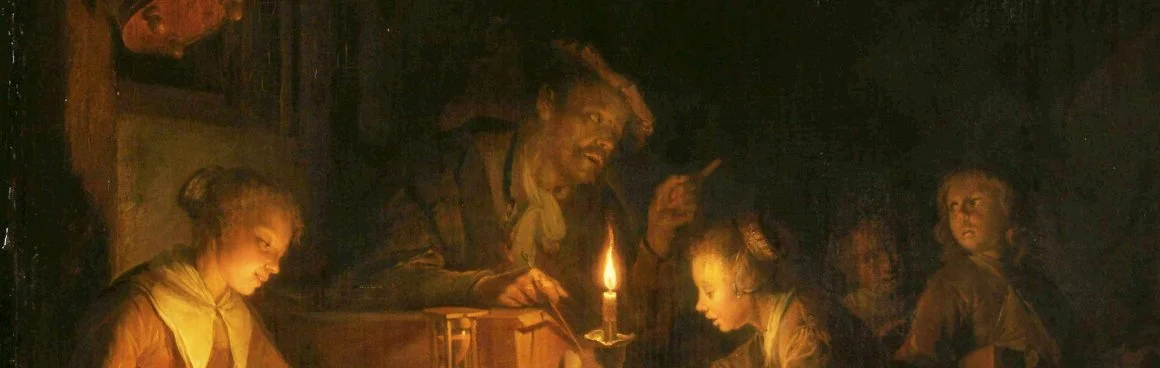
Fig. 38. The teacher as the realised form of learning: authority grounded in discipline and composure, presented as the outcome of education rather than origin.
The evidence suggests that this distinction carries deliberate meaning. The teacher’s authority is not grounded in origin but in discipline and learning — a principle the painting consistently supports. Read in relation to the children at the Folly table and the pupils around him, the logic becomes clearer. They are not fixed opposites, but figures at different points along the same developmental arc. The children embody learning in its earliest, most unstable phase; the pupils its progression; and the teacher its realised form — self-command and authority achieved through sustained practice. The painting proposes not a hierarchy of nature, but a sequence of becoming: any one of the children, through learning, might one day stand in his place.
This reading aligns with Dou’s own practice as a painter and teacher. Over two decades, he trained apprentices in the disciplined methods of fijnschilder painting in his Leiden studio. 5 The teacher’s composure may thus be understood as the visible form of that commitment. Dou reinforces the association visually: both the teacher and Dou himself, in his self-portraits of the mid-1660s, wear the same flat scholar’s cap [Fig. 38].
The effect is one of quiet naturalisation. The teacher’s presence is distinctive yet rendered unexceptional — a figure whose authority derives from what he has learned and mastered, and whose position affirms education as a potential open to all who submit to its discipline.
6.7 Reassessing Dou’s Legacy
The reassessment of Dou in modern scholarship closes a long critical circle. Nineteenth-century writers such as Fromentin and Thoré-Bürger admired his technical refinement but regarded it as lacking the expressive vitality of Rembrandt, casting his art as meticulous yet limited in scope. 6 7 The landmark exhibition Gerrit Dou, 1613–1675: Master Painter in the Age of Rembrandt (2000–2001), organised by Ronni Baer and edited by Arthur K. Wheelock Jr., sought to restore his stature — even as its title acknowledged how firmly Dou remained framed within Rembrandt’s orbit. 8 Wheelock nevertheless recognised that Dou’s meticulous finish reflects a broader intellectual and moral ideal, and that his works often operate not as simple depictions, but as constructed images that embody ideas. 9
The reunion of The Night School and Folly gives new force and clarity to arguments advanced by Eric Jan Sluijter: that the Leiden fijnschilders worked with intellectual autonomy, and that Dou’s microscopic precision functioned as a means of organising perception. 10 11 In the diptych, this principle is extended. Meaning emerges not from a single image, but from a structured relation — from sightlines, light, gesture, and sequence operating across two interdependent panels.
Seen in this light, The Night School reunited does not merely refine existing interpretations of Dou; it requires them to expand. Dou emerges not simply as a master of finish, but as a designer of complex pictorial relations — temporal, psychological, and ethical — capable of sustaining a multi-voiced argument across space and time.
The diptych also reframes our understanding of Dou’s studio. Rather than a hierarchy enforcing replication, it appears as a site of calibrated exchange. Folly is not evidence of imitation, but of a master allowing a pupil’s developing voice to animate the narrative within a governing structure. In this balance of control and independence lies the coherence of the work.
Taken together, these insights extend beyond Dou himself. If such a work could be conceived and realised within his practice, then the fijnschilder tradition cannot be confined to the stillness and emblematic clarity long associated with it. The implications are broader: for how the period is understood, and for the kinds of artistic intelligence it is recognised to have produced.
Such a reconsideration cannot stop with Dou alone. It leads directly to the second artist whose hand and imagination shaped the diptych — and to the question of authorship that its reunion makes unavoidable.
6.8 Dou and Schalcken
That second artist is Godfried Schalcken. Together, the two panels bring into relation distinct artistic languages: Dou’s structuring stillness and Schalcken’s livelier animation — closer in spirit to the wider Dutch genre tradition — within a single coherent design. Schalcken’s exuberance, seemingly at odds with Dou’s discipline, proves integral to the work: not an intrusion, but the necessary counterpoint within a structure conceived to sustain contrast.
If Dou may be understood as the author of the diptych’s ethical and compositional framework, Schalcken gives it its kinetic and psychological force. Where one ends and the other begins cannot be precisely determined; once the panels are reunited, the question of authorship becomes unavoidable: who is The Night School by?
The answer, I propose, is Dou and Schalcken — together.
If they are to be described separately, the Night School panel is by Dou, and Folly at the Night School by Schalcken, working under his direction. Yet such division risks obscuring the nature of the work itself. The diptych is not the sum of two paintings, but the outcome of a sustained pictorial and conceptual exchange between two minds at a formative moment in both careers.
Seen in this light, the night school is also more than a setting: it becomes a metaphor for the collaboration between master and apprentice, working side by side in Dou's candlelit studio. The teacher and assistant in the scene echo the painters themselves — Dou and Schalcken: one a master of renown, the other a precocious talent on the cusp of his career. Is the teacher's raised finger a gesture of admonishment — or of artistic direction? And the assistant: is he reacting in despair, or in delight at the disorder he has helped unleash? Such a reading should not be pressed, but the exchange is enriched by the thought of its possibility.
The visual and technical evidence — in gesture, physiognomy, and the handling of light — supports this dual attribution. Schalcken’s hand is evident in the animation and immediacy of Folly, while Dou’s governs the overarching design. The result is a composition of remarkable unity achieved through difference rather than stylistic uniformity. Narrative diptychs of this kind, realised through two distinct artistic voices, are, so far as is known, exceptionally rare.
To describe the work simply as “by Dou” is therefore to diminish what makes it singular. It is not an expression of solitary mastery, but a joint act of invention, in which a master’s structural intelligence and a pupil’s developing sensibility are brought into sustained relation. From that exchange emerged something genuinely new — not a variation within the fijnschilder tradition, but a form of pictorial thinking that neither artist would realise again independently.
6.9 A Lesson in Teaching and in Life
In moving between the two panels, the viewer retraces the very exchange that shaped the work. Our eyes perform what their hands once did: bridging discipline and invention until the diptych resolves into a unity that neither painter could have achieved alone. The work is therefore not simply a picture of a lesson, but an enacted one — a visual demonstration of what learning demands: patience, direction, risk, and the willingness to trust.
What, then, does Dou's partnership with Schalcken suggest about learning and artistic development? In The Night School, the master gives structural space to energies very different from his own highly disciplined fijnschilder manner. Rather than suppressing Schalcken’s exuberant naturalism, the diptych depends upon it. The younger painter is entrusted not merely with execution, but with the destabilising countervoice on which the work’s entire balance rests. Such a decision suggests an unusually confident and expansive conception of studio practice: one in which instruction did not end with imitation, but allowed room for emerging judgement, technical experimentation, and artistic independence. 12
Dou’s willingness to grant Schalcken meaningful agency within so intricate a design is therefore central to the work’s significance. The pupil’s contribution does not weaken the master’s conception but completes it. The master’s composure and the pupil’s exuberance do not cancel one another; they find their balance.
This is why the diptych reads, in the end, as a work of unusual human sympathy. Its subject is not vice and punishment, but the everyday effort to manage time, attention, and impulse — to bring discipline into relation with unruly vitality. The children are not types but individuals; not objects of censure, but figures in development. The disorder is not simply condemned, nor is the humour merely amusement. Instead, the scene reflects how learning actually happens: imperfectly, experimentally, in the friction between guidance and autonomy.
The Night School emerged from a world shaped by apprenticeship, repetition, correction, discipline, and gradual mastery — and yet, through the evident closeness of the relationship, conjured something new. Schalcken appears to have recognised this, and responded to Dou with an answering voice that is at once respectful and exploratory. Aside from his rare tribute, their exchange is not preserved in documents, but realised — visibly — across the two panels.
The Night School appears to preserve not only the result of artistic training, but the remarkable growth that could emerge from it. The refinement of method, the testing of structure, and the developing talents of a gifted pupil were deliberately allowed to co-exist within the work itself. Hofstede de Groot noted Schalcken’s developing mastery of candlelight at precisely this period, pointing to a moment of technical and artistic exchange. 13 The diptych can be understood as the product of that moment: a work shaped not only by learning, but by Dou’s decision to take his long enquiry into education into collaborative form — to reach beyond the conventional limits of painting, studio practice, and the work of the master himself to communicate the reality of teaching, in paint and in person.
6.10 Market Reality
What patrons expected from Dou was another matter. A market attuned to the prestige of his highly finished independent works would have been less receptive to an unusual diptych — let alone one of unequal dimensions, with one panel painted by an apprentice on a support that is not oak. While Dou's panel is executed on the finely prepared Baltic oak typical of high-end Dutch painting, the difference in wood alone would have signalled to a collector that the second panel was not a finished work for the market in the conventional sense.
The documented character of Johan de Bye's collection reinforces this point: the exhibition he assembled consisted entirely of works by Dou. 14 He acquired The Night School in keeping with that purpose. Whether Dou anticipated this outcome, or whether separation was the unplanned consequence of so single-minded a patron, cannot be determined with certainty. What is clear, if the dates are correct, is that the events of 1665 — the diptych's completion, Schalcken's departure from the studio, de Bye's acquisition, and the exhibition — converged in such a way that separation was highly likely. The master's panel was complete enough to stand alone; the diptych, dependent on its relation to a pupil's work, could not easily be sustained within such a market context.
If this reconstruction is correct, the separation may have been personally difficult. For Dou, The Night School was not simply another cabinet picture, but what appears to be the crowning achievement of his long engagement with learning, both as a painter and as a teacher. For the young Schalcken, participation in so significant a project, as the countervoice to his master, would have been an extraordinary honour and a profound sign of Dou's trust and recognition. It would have been natural for both men to feel deeply invested in The Night School.
Yet the very market that made such collaboration possible also made its survival precarious. Faced with the wishes of his most important patron, at the moment of Johan de Bye’s major exhibition devoted exclusively to his work, Dou may have felt unable to refuse parting with his panel, which de Bye likely saw as the latest — and one of the finest — jewels of his output. Schalcken’s engraved tribute to Dou gains particular poignancy in this light: not only as an act of gratitude, but as a record of artistic indebtedness to a collaboration whose singular creation may already have been disappearing from view. A public tribute of this kind from an apprentice to a master is most unusual. That Schalcken’s sense of debt was closely associated with The Night School would emerge again two decades later in a still more extraordinary tribute explored in §6.12.
What happened to Folly? Its enduring influence on Schalcken's later work suggests he retained it — but no documentary trace has yet come to light.
What was lost in that separation was not only the narrative coherence of the diptych, but a form of pictorial thinking that the established categories of Dutch Golden Age painting were not designed to accommodate: a secular diptych of unequal panels, painted by two hands, generating meaning through comparison rather than delivering it by statement. Whatever the precise sequence of events, Dou's sustained engagement with the theme of education — evident both in his long commitment to studio apprenticeship and in his paintings for a decade — suggests that The Night School represents a culminating statement, whose full resonance emerges only when the two panels are read together.
6.11 Schalcken Reconsidered
The rediscovery of Folly at the Night School prompts a major reassessment of Schalcken's development. Standard accounts present his mature candlelit manner as crystallising in the 1680s, shaped largely by market demand in The Hague, Amsterdam, and later London.¹⁵ While not incorrect, Folly demonstrates that the essential components of his later style — microscopic flame construction, dramatic chiaroscuro, expressive faces, choreographed gesture, and the organisation of a scene around the volatile light of a single candle — were already present at the outset of his career. What later patrons rewarded, Schalcken had first explored under Dou's supervision two decades earlier.
Equally significant is the question of time. Schalcken is often treated as a painter of static intimacy — poised candlelit moments and suspended reveries. Folly, however, reveals an artist alert to the unfolding of events, capable of compressing before, now, and after into a single pictorial instant. The sequential interplay of reactions — collapsing cards, rippling gestures, and shifting expressions — extends his temporal intelligence beyond the conventions of Dutch genre painting. In this respect, Folly anticipates narrative strategies that would not be more fully developed elsewhere until the following century. 16
In his later work, time is more often suspended than extended — moments crystallised rather than allowed to unfold. Yet traces of this earlier sensitivity persist in more concentrated forms, in paintings such as Judas Returning the Thirty Pieces of Silver, A Man Offering Gold and Coins to a Girl, The Parable of the Lost Piece of Silver, and The Parable of the Five Wise and Five Foolish Virgins. These works retain a sense of moral timing, but compress it into more self-contained episodes rather than extended sequences.
None, however, matches the breadth of temporal calibration found in Folly. That scope appears to have been shaped by the demands of a diptych conceived across two interdependent panels, under Dou’s direction and in deliberate search of counterpoint. It would take more than a century before comparable narrative compression re-emerges with similar clarity in Hogarth’s moral cycles. 17
Schalcken's gift with children also stands apart. The vitality, warmth, and psychological nuance of the figures in Folly have few contemporaneous parallels. Schalcken never returned to the subject on this scale — not because he lacked aptitude, but perhaps because the experiment belonged to Dou's studio, or because personal losses in later life made such subjects difficult. Whatever the reason, Folly preserves an exceptional instance of the talent he brought to depicting children.
What reappears across his career is the structuring discipline absorbed from Dou: candlelight organising the scene, the calibrated left-to-right sweep, and the use of gesture, eye-lines, and recurring motifs to structure dramatic emphasis — all rooted in the mental architecture first forged in the Night School project. Schalcken made this framework his own by enlivening it with instinctive warmth, expressive play, and finely judged dramatic timing. Even in his later works based on the Bible, the imprint of this formative collaboration remains visible.
Folly therefore reveals Schalcken not as a promising beginner, but as an artist who reached conceptual maturity remarkably early, and whose later career developed not by discovering expressive tools, but by refining ones he had already brought into being.
This pattern should not be read as arrested development, nor as a failure to sustain early promise. Artistic intelligence does not advance in a linear trajectory, and certain kinds of work depend on conditions that arise only briefly. The circumstances that shaped Folly — the discipline of Dou’s studio, the freedom to experiment outside market expectation, and a pedagogical project conceived across two panels — created a rare moment of concentrated invention. In the decades that followed, Schalcken’s talents were directed toward a different set of demands, as the expanding market of the 1670s and 1680s rewarded polish, recognisable effects, and repeatable success. What changed was not his capacity, but the environment in which it could be exercised.
Unlike many attributions, which rely on retrospective resemblance, Folly at the Night School functions as a foundational work: the formal, psychological, and technical principles visible here do not echo Schalcken’s later oeuvre so much as anticipate and clarify it.
That Schalcken recognised — and deeply valued — this formative inheritance becomes unmistakably clear in what follows.
6.12 Lost Silver as Tribute
The extraordinary thing about The Parable of the Lost Piece of Silver is how closely it echoes Folly at the Night School (see §4.7). Once seen side by side, the parallels are too deliberate to be accidental: the raised arms at the upper right; the small child at the lower right; the same intense foreground compression; the same choreography around a single candle; and Schalcken himself in semi-shadow, like the assistant in Folly, now wearing the scholar's cap associated with the teacher in The Night School and with Dou himself — worn, as in Schalcken's engraved tribute, the correct way round.
For these reasons, Lost Silver reads not as a biblical vignette in a historical setting — the figures and their dress are entirely contemporary — but as a mature re-expression of the compositional ideas Schalcken first shaped in Folly under Dou's supervision.
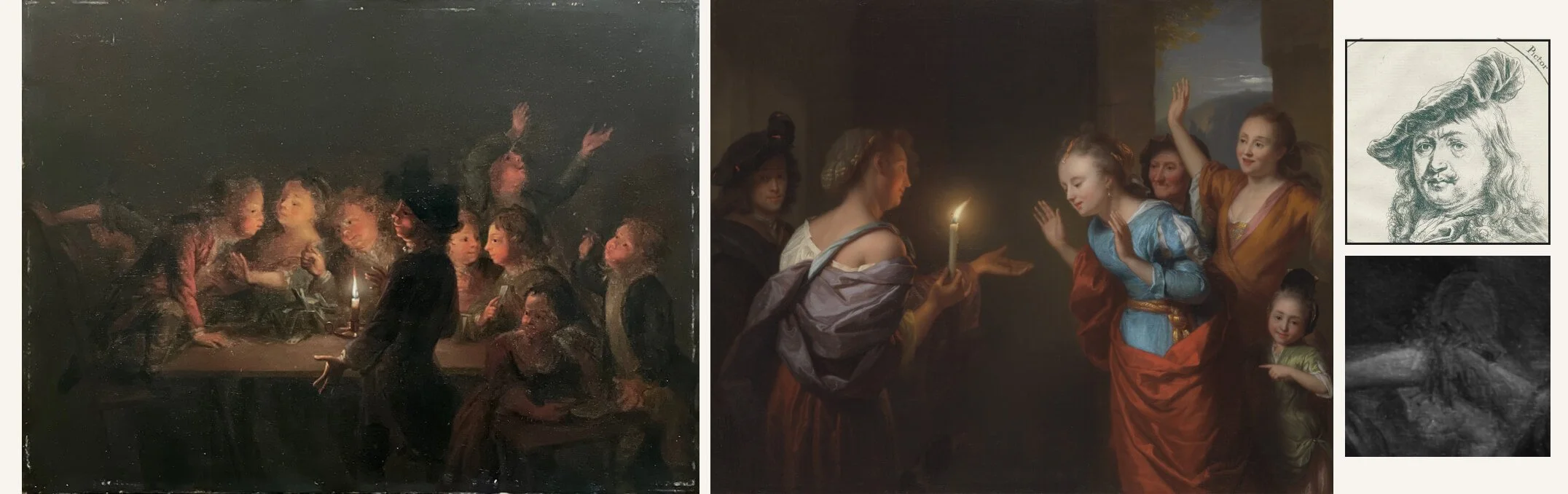
Fig. 39. Folly and Lost Silver, with matching scholar’s cap and bonnet, at near identical pitches, as those in the etched tribute to Dou and IRR underdrawing of Folly (not in the final painting).
Eighteenth-century viewers recognised this personal dimension even if the structural logic was not available to them. In the 1749 Kassel inventory the painting was listed among the portraits, with the accompanying description unequivocal: the figures were portraits of the painter himself and his family. The same identification appears in the Christie's sale catalogue of 1783 and the Paillet sale of 1786, both describing the figures as portraits of the painter and his family. 18 Whatever the literal accuracy of that claim, it was presented in each case not as conjecture but as received fact. That three independent eighteenth-century sources — German, English, and French — identify a personal presence in the work, and a familial framing of the scene, demonstrates that both were widely recognised long before modern scholarship set aside an autobiographical reading of the painting. 19
With Folly restored to view, those early intuitions finally make sense. The candle is the key. Constructed in the same distinctive multi-coloured layers as the flame in Folly, its meaning in Lost Silver is not singular but layered: it is the literal lamp of the parable; the light of learning that illumined The Night School; the candlelight artistry that was now bringing Schalcken success and recognition; and the warm domestic light that reaches toward those he provides for. In Lost Silver the flame leans distinctly toward the family group, carrying the narrative with it — a gesture that fuses these meanings into a single left-to-right arc of discovery, mastery, and fulfilment.
That directional sweep does not stop at the family. It turns back. The finely dressed child at the lower right — occupying precisely the same structural position as the small girl in Folly — performs a device central to Dou's compositional architecture: she looks out at the viewer and points across the action. It is the same directing gesture used by the teacher in The Night School to push the viewer beyond the immediate scene toward the panel beyond the frame. Here the child performs that function twice over: directing the viewer into the heart of the parable — toward the coin and the flame — but also beyond it, toward Schalcken's shadowed presence, and back to the origin of the idiom itself: the moment in Dou's studio when candlelight and a pointed finger first became engines of narrative.
The smallest detail of all supports this reading with particular force. The distinctive arched bonnet worn by the pointing child in Lost Silver closely matches the bonnet clearly discernible in the infrared underdrawing of Folly, on the girl pushing over a chair — a headpiece Dou most likely required Schalcken to remove from the final painting, reserving hat-wearing for the two principal figures of authority. [see Figs. 11 and 38] Its reappearance in Lost Silver, now given to the two figures signalling the reverse narrative, is unlikely to be accidental. No contemporary viewer could have known that bonnet existed; the echo operates on a purely personal level for Schalcken. It is precisely the kind of detail an artist restores years later from a formative experience — quietly, for himself alone.
Seen in this light, Lost Silver can be understood as Schalcken's retrospective tribute to the training that shaped him: a personal commemoration of what The Night School and Folly gave him — a structural discipline, a pictorial language, and a technical mastery that underpinned his later success. In the echoes of the candle, the pointing child, the directional sweep, and his own shadowed presence beneath the scholar's cap, Schalcken reactivates a compositional system whose origin lay in Dou's studio. Folly was born there; Lost Silver reflects it at a distance. The two paintings answer each other across two decades, preserving the memory of a conception once distributed across two panels. [Fig. 39]
Lost Silver confirms Folly as Schalcken's, just as compellingly as Folly explains the deeper meaning of Lost Silver.
6.13 An Enduring Enquiry
Seen across the full arc of Dou and Schalcken’s careers, the rediscovered diptych reveals an artistic continuity of unusual duration and coherence. From An Evening School through the Uffizi Night School, The Nursery triptych, Dou’s self-portraits of the mid-1660s, the reunited diptych, Schalcken’s engraved tribute, and finally Lost Silver, the same themes and evolving compositional ideas progress across almost three decades: learning, discipline, candlelight, behavioural exchange, and the belief in human potential.
Such sustained interconnectedness is rare in Dutch seventeenth-century painting. These works do not merely repeat motifs; they develop a shared pictorial enquiry through changing formats, subjects, and stages of life. What begins in Dou’s early schoolroom interiors as an exploration of education reaches its fullest expression in the reunited diptych by Dou and Schalcken, before returning years later in Schalcken’s Lost Silver as reflection: not now on children learning, but on what learning itself had made possible — artistic independence, expressive revelation, and the enduring memory of a formative collaboration.
The rediscovery of Folly restores the missing centre of that development. Once reunited, the diptych reveals itself not as an isolated experiment, but as the pivotal work around which this larger sequence coheres.
6.14 A Fine Mechanism
The more one studies the reunited diptych, the more it resembles one of the new Dutch pendulum clocks of the 1660s: immediately legible, yet driven by a hidden mechanism of balance, intention, and design. What first appears as a simple contrast between order and disorder gradually reveals itself, through sustained looking, as a tightly calibrated system of relations. Objects of light, time, learning and play activate the narrative. Gesture, physiognomy, movement, and contrasts in paint handling operate like counterweights — not to deliver a fixed moral conclusion, but to keep opposing forces in productive tension. Meaning emerges not through decoding symbols, but through relation, sequence, and the viewer’s own act of judgement — a structure whose clarity and timing remain strikingly modern.
Certain paintings of the Dutch Golden Age achieve a rare density of thought: works that must be read as much as looked at. Rembrandt’s The Night Watch transforms the group portrait into civic drama; Vermeer’s The Art of Painting turns the studio interior into a meditation on art itself. Dou and Schalcken’s The Night School belongs with them because it constructs a living model of learning. Their two voices convey this across two interdependent panels, not as allegory or moral, but as a human process unfolding through the escalating drama of unruly children unsettling a class.
The composition is as measured as the brushwork. One panel establishes order; the other places that order under pressure. The teacher takes corrective action; the assistant reacts as he loses control; the children move between concentration and impulse; the candle both illuminates and threatens collapse. Nothing is isolated. Every action generates another, every gesture redirects the eye, every face occupies a different point along the diptych’s developmental arc. The work does not merely depict education: it models how learning functions in time and across ages — how attention is formed, lost, recovered, and sustained through practice.
What makes this achievement exceptional is the way structure itself becomes expressive. Dou’s architectural stillness and Schalcken’s animated immediacy do not compete but counterbalance one another, allowing the diptych to think through difference rather than resolve it. The two painters function almost like opposing movements within the same mechanism: discipline and spontaneity held in equilibrium. The result is not a single pictorial statement, but a relational system whose meaning deepens the longer one studies its internal correspondences. Precise calibrations like the equal weighting of ten figures per panel, the recurring use of fives across the work — with the girl’s step across to disciplined reading swiftly mirrored by the collapsing house of cards — and the paired activities of reading, writing, card-playing, and bubble-blowing all form part of this finely ordered mechanism.
Within this structure, Schalcken achieves something particularly rare for the period: where Dou distils time in one panel — but for the just-turned hourglass — Schalcken compresses it in the other to show a single caught moment. The cards mid-collapse, bubble about to burst, reactive gestures, and threatened flame make the viewer reconstruct what has just happened and anticipate what will happen next. In this temporal daring, the diptych anticipates narrative strategies more familiar from Hogarth a century later — not through serial prints, but within the compressed space of one schoolroom distributed across two panels.
Seen from another angle, the diptych’s use of candlelight brings new fijnschilder precision to the flickering light of the candle. In so doing it anticipates, on an intimate scale, the later candlelit scenes of discovery painted by Joseph Wright of Derby. In both, light does not merely illuminate action; it reveals response — how perception generates thought and thought generates reaction.
Yet for all its structural sophistication, the diptych remains profoundly humane. Diligence and misjudgement are not fixed to age, gender, role, or authority; they circulate across the panels. Not all children behave foolishly; not all adults act wisely. The children are neither condemned nor idealised, but understood — learning imperfectly within the fragile rhythms of lived experience. The diptych sustains not certainty, but recognition: that the ideal of learning exists in continual tension with the instability of human behaviour; that education, like life itself, depends upon the continual negotiation between attention and distraction, impulse and discipline. Education may lift anyone to the position of command and respect embodied by the teacher.
In this, The Night School achieves something extraordinarily rare in seventeenth-century painting. Its greatness lies not simply in technical refinement or narrative ingenuity, but in the depth of relational and human understanding it compels the viewer to construct. What begins as a candlelit schoolroom gradually reveals itself as a mechanism for thinking — a work whose balance never settles completely, and whose meanings continue to generate thought long after one has looked away. The viewer’s role within this evolving mechanism of relation, comparison, and inference is explored further in Appendix 5: Made for Thought.
6.15 Completing the Picture
The Night School has long stood as one of Gerrit Dou's most admired works, yet the single panel has always presented a puzzling anomaly. The rediscovery of Folly at the Night School, as this dossier has shown, resolves that anomaly, revealing the painting as one half of an extraordinary dialogue — a connection I sensed immediately that autumn day in 2021, when I stood before The Night School and realised that the two pictures speak to one another.
Together, the two panels achieve something rare: they invite viewers into a story that continues to resonate. Their theme — the ideal of learning and the reality of human distraction — echoes across classrooms and centuries, from seventeenth-century Leiden to the present day.
Viewed in this light, the rediscovery is more than an art-historical event. It shows what The Night School was always meant to be: not only a human drama, alive with energy, humour, and relevance, but a work that engages the mind. Reuniting the diptych would restore it to its original form, not seen since the panels were separated in 1665. It is therefore not simply a matter of attribution or completion, but of deepening the impact of a major and celebrated work — for public engagement, interpretation, and the museum’s capacity to inspire.
Reunited, the work also presents an exceptional educational opportunity. Unusually for a seventeenth-century painting, it is about learning, and speaks directly to teachers and students today. Accessible on first encounter, the dialogue between the two panels opens onto deeper enquiry into how images teach: through design, technique, and the expression of human possibility. Few works align so closely with the educational mission of a national museum, or offer as much potential for meaningful engagement beyond its walls. This potential is explored in more detail in Appendix 4: Made for Learning.
To exhibit The Night School as it was originally designed is to allow the two panels to speak again. The richness of that exchange — between master and apprentice, diligence and disruption, youth and maturity, work and play — is one with which audiences of all ages can readily engage. Few paintings sustain such coherence across so many levels at once, or are the subject of such an unusual and compelling rediscovery.
6.16 Wider Perspectives
For more than a century, Dutch seventeenth-century painting has been narrated through a selective lineage of masters, with Rembrandt at the centre and others positioned in relation to him by scale, subject, or influence. Gerrit Dou has accordingly been framed as a meticulous miniaturist: a virtuoso of finish, admired yet marginal, a master in the age of Rembrandt who exemplifies refinement rather than innovation. That formula has endured because it suits the history that survived — not necessarily the history that was made. The rediscovery of The Night School diptych challenges this model, not by proposing a new hierarchy, but by revealing a form of artistic intelligence that the established narrative has not been designed to recognise.
The originality of The Night School diptych unsettles the model because it is not a variant of an existing form. It is a secular diptych of unequal panels, realised through two artistic voices, designed not to deliver a moral by statement but to generate meaning through comparison. Its narrative is temporal and behavioural, dialogic and contrapuntal: the work does not resolve within either image, but through their layered relation.
The diptych establishes a distinct mode of pictorial thinking in which meaning is produced relationally — across two images, over time, and through the viewer's act of judgement. It combines Dou's calibrated architecture of attention with Schalcken's kinetic psychology, modelling behaviour not as a fixed type but as human nature subject to lapse, correction, and consequence. Narrative, illumination, and gesture function not as embellishment, but as instruments of thought. In this sense, the work moves beyond the conventions of genre painting typically read as delivering a set moral message, anticipating later developments in expressive illumination, sequential narrative, and behavioural realism by exploring the conditions under which human action unfolds.
That this invention did not enter artistic tradition is not evidence of its weakness, but of its disappearance. The end of Dou and Schalcken's studio relationship meant that the specific conditions that gave rise to the experiment were not sustained; and once Dou's panel entered the market — acquired in 1665 by Johan de Bye — the structure that made the innovation legible passed from view.
The return of the diptych therefore does not merely revise a detail of connoisseurship; it restores a lost horizon of possibility, showing that seventeenth-century painting was capable of articulating forms of psychological and temporal complexity more familiar to much later developments — from Hogarth’s serial narratives and Goya’s behavioural dramas to forms of sequential visual thinking more familiar to cinema than early modern painting.
More broadly, it challenges the idea that artistic innovation is necessarily linear or cumulative. Discoveries depend on conditions: they can be made, fail to circulate, and reappear under different circumstances. Reunited, The Night School makes this visible — a small object with a large mind, and a reminder that art history is shaped not only by what endured, but by what might have endured had it remained in view.
Its achievement, moreover, is not only structural and cognitive but humanistic: it accords dignity, agency, and potential to its youngest figures, and presents learning as a universal capacity rather than a social inheritance — an outlook quietly radical in its time, and newly legible in the progression across the work.
There is, finally, a quiet correspondence between what the diptych depicts and what it enacts. Within the image, Dou accords full intellectual authority to a teacher whose dignity rests not on origin but on learning. Behind the image, he accords professional authority to a pupil whose standing rests not on status but on trust earned through discipline. One figure is visible; the other remains unseen — yet both are presented as products of education granted space to act.
Read together, these gestures reinforce one another. The diptych does not merely propose learning as a source of dignity; it demonstrates that belief through its very authorship. Dou gives authority to the teacher we see, and opportunity to the painter we do not, aligning the moral structure of the work with the ethics of its making.
In this sense, The Night School reunited can now find its place not as a footnote to the age of Rembrandt, but as one of the most intellectually distinctive and conceptually significant works of the Dutch Golden Age — a painting whose design, authorship, and psychological reach occupy a singular place within the period, and whose meaning remains strikingly contemporary.
The Night School excels in opening minds to the challenge and value of learning. In so doing, Dou and Schalcken do not present humanity as fallen or perfected, but as continually in the making — disciplined by time, disrupted by impulse, and renewed through effort, again and again. That process embraces everyone: from the unruly children at its outset to the more diligent pupils they may become; from the errant assistant learning his role to the teacher who sustains the class; and, behind the image itself, to Dou and Schalcken, master and pupil alike. That belief is the vision they frame in two unequal panels.
Footnotes to Section 6
The expression “black swan” derives from a Latin proverb meaning something impossible or non-existent (rara avis in terris nigroque simillima cygno — “a rare bird in the lands, and very like a black swan”). It was used in this sense until 1697, when Dutch explorers in Western Australia encountered black swans — transforming the phrase from a symbol of impossibility into one of unforeseen but consequential discovery, much like The Night School diptych itself. See Wikipedia, “Black swan theory,” summarising the original Latin source and its seventeenth-century Dutch reinterpretation.
C. Hofstede de Groot, A Catalogue Raisonné of the Works of the Most Eminent Dutch Painters of the Seventeenth Century, vol. IV (London, 1912), nos. 314-419.
Friso Lammertse, Dutch Genre Paintings of the 17th Century (Rotterdam: Museum Boijmans Van Beuningen, 1998), pp. 63–68 (The Quacksalver), 69–72 (A Young Woman at her Toilet).
Infrared photography undertaken by Gwen Tauber, RMA, August 2009, supplied by Rijksmuseum Conservation Department, correspondence with the author, 2026; https://www.rijksmuseum.nl/en/collection/object/The-Night-School--206d24dbca2f35d9d6a296bdb2e00193?tab=catalogue, Gwen Tauber notes, 2021, accessed April 2026.
Bakker, Piet. “Gerrit Dou” (2017). In The Leiden Collection Catalogue, 4th ed. Edited by Arthur K. Wheelock Jr. and Elizabeth Nogrady with Caroline Van Cauwenberge. New York, 2023–. https://theleidencollection.com/artists/gerrit-dou/ (accessed April 26, 2026).
Eugène Fromentin, Les Maîtres d’Autrefois : Belgique–Hollande (Paris, 1876), esp. pp. 209–214. Fromentin admired Dou’s technical finish but regarded his art as lacking emotional depth, valuing it more for its patience and refinement than for expressive power.
Théophile Thoré-Bürger, “Gérard Dow,” in Musées de Hollande, 2 vols. (Paris, 1858–60), vol. 2. Thoré-Bürger contrasts Dou’s meticulous finish with Rembrandt’s vitality, criticising what he saw as an overly refined and mannered art.
Mariët Westermann, “Back to Basics: Rembrandt and the Emergence of Modern Painting,” Perspective: la revue de l’INHA 4 (2011–12): 723–747, on the continuing dominance of Rembrandt’s reputation in shaping the interpretation of other Dutch masters.
Baer and Arthur K. Wheelock Jr., ed., Gerrit Dou, 1613–1675: Master Painter in the Age of Rembrandt (exh. cat., National Gallery of Art, Washington; Dulwich Picture Gallery, London; Mauritshuis, The Hague, 2000–2001), p. 33.
Otto Naumann, Frans van Mieris the Elder (1635–1681), 2 vols. (Doornspijk: Davaco, 1981), vol. 1, esp. pp. 13–24, on the intellectual ambition and artistic self-awareness of the Leiden fijnschilders and their engagement with issues of perception and pictorial control.
Eric Jan Sluijter, “The Leiden ‘Fijnschilders’ and the Question of Style,” in Gerrit Dou 1613–1675: Master Painter in the Age of Rembrandt (exh. cat., Washington / London, 2000), discussing Dou’s finish as a mode of perceptual and moral structuring rather than simple virtuosity.
The idea that discipline enables freedom lies at the core of Leiden’s civic and intellectual humanism, shaped by scholars such as Justus Lipsius, whose De Constantia (1584) redefined self-mastery as the route to liberty. The same ethos informed Leiden’s pedagogical codes and artistic training in the seventeenth century, where precision was a moral exercise — a principle Dou embodied in paint. See J. Lipsius, De Constantia (Leiden, 1584), I.iii–v; E.J. Sluijter, Seductions of Sight (Zwolle, 2000), 127–29; and P. Burke, The European Renaissance: Centres and Peripheries (Oxford, 1998), 91–95.
Cornelis Hofstede de Groot, A Catalogue Raisonné of the Works of the Most Eminent Dutch Painters of the Seventeenth Century Based on the Work of John Smith, trans. and ed. Edward G. Hawke, vol. 5 (London, 1908), 309: “From Dou, too, he gained his taste for painting scenes with the artificial light of candles… He acquired great facility in producing these works.” See also Arnold Houbraken, De Groote Schouburgh der Nederlantsche Konstschilders en Schilderessen, 3 vols. (Amsterdam, 1718–21), vol. 3, p. 166, praising Schalcken’s ability to render figures illuminated by candlelight.
Th. H. Lunsingh Scheurleer, C. Willemijn Fock, and A. J. van Dissel, Het Rapenburg: Geschiedenis van een Leidse gracht, vol. IIIb (Leiden, 1992), 486. Inventory of Johan de Bye collection, 1665.
Otto Naumann, Godefridus Schalcken (Doornspijk: Davaco, 1981), I: 20–25; Wayne Franits (ed.), Godfried Schalcken (Exh. cat., Dordrecht/Cologne, 1996), 39–45 — on the standard view that Schalcken’s distinctive candlelit manner crystallised only in the 1680s under changing market conditions.
Mariët Westermann, A Worldly Art: The Dutch Republic, 1585–1718 (New Haven and London: Yale, 1996), 159–163 — on the rarity of multi-phase temporal sequencing in mid-seventeenth-century Dutch genre painting.
Ronald Paulson, Hogarth (London: Lutterworth, 1971), 32–39 — on Hogarth’s later development of compressed moral narrative cycles, relevant for comparison with Schalcken’s early temporal experimentation in Folly.
Kassel, Gemäldegalerie inventory (1749), no. 154 (“Observe: the figures in this piece are portraits of the painter himself and his family”). Christie’s, London, A Catalogue of the Genuine and Entire Collection of Pictures of… Mr. Godfried Schalcken (27 February 1783), lot 38 (“portraits of the painter and his family”). Alexandre Joseph Paillet, Catalogue d’une collection de tableaux précieux (Paris, 25 March 1786), lot 46 (“portraits de l’auteur et de sa famille”). On the transmission of these traditions in early literature and sale catalogues, see Otto Naumann, Godefridus Schalcken, II, Appendix B.
Jansen, Guido. “Parable of the Lost Piece of Silver” (2017). In The Leiden Collection Catalogue, 4th ed., edited by Arthur K. Wheelock Jr. and Elizabeth Nogrady with Caroline Van Cauwenberge. New York, 2023–. The entry acknowledges the eighteenth-century tradition identifying the figures as portraits of the artist and his family, but favours a literal reading of the biblical parable. https://theleidencollection.com/artwork/parable-of-the-lost-piece-of-silver/ (accessed 3 December 2025).
7. PROVENANCE
7.1 The Night School
By Gerrit Dou, signed lower centre on the platform (ligated monogram GDov), by 1665.
The provenance of Dou’s panel of The Night School, now in the Rijksmuseum, is unusually well documented for a seventeenth-century Dutch cabinet painting, with ownership recorded continuously from 1665 to the present day. 1
[Provenance summarised from the Rijksmuseum collection record for The Night School.]
? Acquired from the artist by Johan de Bye (c.1625–1672), Leiden; his collection, Leiden, 11 September 1665, no. 8 (“1 kaers-avondtschool met veel personen”).
By descent to his niece Maria Knotter (1651–1701), Leiden.
By descent to her son Adriaen Wittert van der Aa (1672–1713), Leiden and Slot Cronenburgh, near Loenen.
Purchased from him for fl. 1,000 by Pieter de la Court van der Voort (1664–1739), Leiden, through the mediation of Carel de Moor, 1710.
Recorded in his probate inventory, Leiden, 1731.
Recorded again in his probate inventory, Leiden, 12 September 1739.
By descent to his son Allard de la Court van der Voort (1688–1755), and to his widow Catharina Backer (1689–1766); her sale, Leiden, 8 September 1766 sqq., no. 19.
Purchased by Mossel.
Purchased from him for fl. 4,900 by Gerrit van der Pot (1732–1807), Rotterdam, 1783.
His sale, Rotterdam, 6 June 1808, no. 28.
Purchased by Johannes Eck & Zoon for the museum.
Six van Hillegom collection.
Rijksmuseum, Amsterdam, since 1885.
The ownership of The Night School is thus continuously documented from 1665 onward.
The early date, when the work was newly created, is significant because it records the moment it entered the market as a single panel. In seventeenth-century Dutch practice, paintings by established masters usually circulated as individual works, while multi-panel formats were uncommon in this market, particularly in unconventional configurations. Related studies or companion pieces produced within a studio did not necessarily enter the market with them and might instead remain in the workshop or circulate independently. The documentary record of Dou’s panel in 1665 therefore reflects normal patterns of artistic production and collecting, and does not rule out the separate survival of a related work from the same studio environment.
That possibility is demonstrated by the paintings themselves: corresponding figure scale, reciprocal gestures and sight-lines, coordinated illumination, structural correspondences, and continuous narrative logic link The Night School and Folly at the Night School as components of a deliberately interrelated design.
7.2 Folly at the Night School
Probably executed by Godfried Schalcken in the studio of Gerrit Dou, Leiden, c.1665.
No continuous early ownership history for this panel is preserved. In seventeenth-century studio practice, companion works or related exercises did not necessarily enter the market alongside a master’s painting. Its provenance must therefore be reconstructed from surviving documentary traces, collecting history, and physical evidence.
A. Modern Rediscovery
The documented modern history of Folly at the Night School begins with its purchase by the Jubilee Gallery (Cirencester) at the Cotswold Auction Company, Cheltenham, UK, in September 2021, following consignment by a solicitor acting for a local deceased estate. It entered my possession on 14 November 2021, when I acquired it via eBay from the gallery. How the painting travelled from the Netherlands to Cheltenham over the course of three and a half centuries is not fully documented.
B. Collecting Context
A historically plausible explanation for the painting’s presence in the Cheltenham area lies in the existence of a major nineteenth-century Dutch cabinet collection there associated with the de Ferrières family.
Documented references confirm that paintings by Schalcken were present in the de Ferrières collection by the late eighteenth century. In 1783 The Parable of the Lost Piece of Silver was sold at Christie’s, London, as a work by Schalcken from the collection of Baron de Ferrières, and a second listing in 1786 (Paillet, Paris) repeated both attribution and provenance.
By the mid-nineteenth century the family had assembled a substantial collection of Dutch and Flemish fijnschilder paintings. Ernest-François-Auguste, 2nd Baron de Ferrières (1799–1864), formed this collection while resident in Brussels. On his death, more than one hundred paintings passed to his son Charles, 3rd Baron de Ferrières (1829–1908), who had settled in Cheltenham, having married Anne Sheepshanks in 1841. 2 By 1868 he was lending Dutch cabinet pictures to the Leeds Exhibition. 3 In 1898 he presented forty-three paintings to the town to found the Cheltenham Art Gallery, including works by Dou and Schalcken; many others had probably already passed into private hands in the years after his inheritance in 1864.
The existence of this collection in Cheltenham during the nineteenth century therefore provides a historically plausible context for the presence of a small Leiden cabinet painting in the area before its rediscovery.
C. Physical History of the Object
The panel survives in a nineteenth-century gilt frame constructed specifically for it and closely fitted to the support, indicating that it had already entered a collecting environment by that date. Its historicising character corresponds to framing practices frequently applied to seventeenth-century Dutch cabinet paintings during the nineteenth century. The frame also closely resembles the elaborate historicising gilt frames visible on Dutch cabinet paintings in archival photographs of the de Ferrières collection at Cheltenham, further aligning the panel with that collecting environment. [Fig. 40]
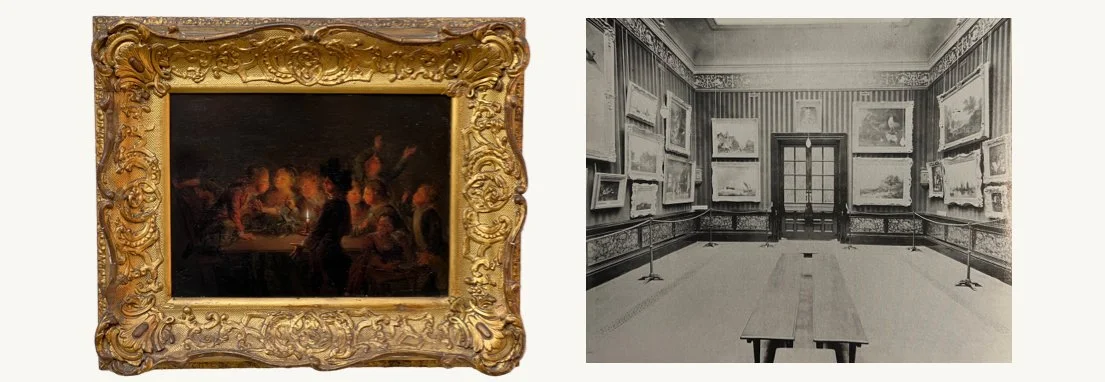
Fig. 40. How Folly’s nineteenth-century historicising gilt frame aligns with the framing style of the de Ferrières paintings at Cheltenham, as seen in this archival view of the original gallery.
An old painted collection number (“276?”, final digit uncertain) appears on the reverse. The first three digits are clearly legible, while the final mark is more loosely formed and slightly detached, suggesting a secondary identifier appended to an original catalogue number. [Fig. 42a] Such markings are characteristic of numbering systems used in substantial private collections and auction holdings of the eighteenth and nineteenth centuries, and indicate that the panel once formed part of a larger collection. The number falls within the range used by Hofstede de Groot for Schalcken’s candlelit scenes of children, where nearby entries include works of closely related subject — notably Children Blowing Bubbles by Candlelight (no. 278b), recorded in a sale at Cheltenham in 1859. The correspondence of subject matter and numerical range is suggestive of a plausible Schalcken provenance, while the Cheltenham record provides a nearby example of how a closely related candlelit scene by Schalcken circulated through nineteenth-century collections in the area. If this correspondence is correct, the number further indicates that the panel was at one time catalogued within a group of his candlelit scenes of children. 4
Apart from an aged varnish layer consistent with historic restoration practice, no structural alteration or later overpainting has been detected. The panel therefore appears to have survived for centuries without significant intervention, a condition typical of cabinet pictures long preserved in private collections.
D. Concluding Position
Taken together, the surviving documentary traces and collecting history provide a plausible context for the survival of Folly at the Night School, even though its earlier ownership history remains to be established. Once separated from its counterpart, the panel lacked both a visible signature and the contextual framework that would have secured it a stable attribution. It would therefore have presented itself simply as a small Dutch candlelit interior. In seventeenth- and eighteenth-century inventories, such works were commonly recorded by subject rather than authorship. Under those conditions, the panel’s absence from documented provenance chains is not anomalous but consistent with what is known of its likely historical trajectory.
Evidence of later cataloguing, however, suggests that it may subsequently have been classified by subject in a manner consistent with the nineteenth-century catalogue raisonné of Schalcken.
7.3 Comparative Technical Notes
The Night School (Gerrit Dou)
Panel, oak, 53.8 × 42 cm
Folly at the Night School (Godfried Schalcken)
Panel, wood species not identified, 22.5 × 30.6 cm
The historical plausibility outlined above can be tested against the material evidence of the paintings themselves. To clarify their relationship, the principal technical characteristics of each panel are set out in parallel below. The data derive from published technical examination of The Night School (Gwen Tauber, 2021) 1and of Folly at the Night School (Courtauld Institute, 2025). 5
A. Support
The Night School
Single oak plank, vertically grained, approx. 10mm thick; bevelled on all sides; top edge trimmed. Later L-shaped wooden strips attached at the lower sides. [Fig. 42] Dendrochronology indicates the youngest heartwood ring formed in 1618; the panel was probably usable by 1629 and likely used after 1635. 6
Folly at the Night School
Single plank (wood species not identified), tangentially cut, approx. 7mm thick, with no evidence of later thinning, cradling, or planing. The reverse is not bevelled and retains vertical tool marks. [Fig. 42]
The Courtauld examination notes a U-shaped grain pattern in the X-radiograph, consistent with tangential cutting of the board. Subsequent assessment by dendrochronologist Ian Tyers indicates that the panel is not oak and has insufficient ring structure for dendrochronological analysis. The tooling of the reverse is consistent with seventeenth-century panel preparation.
The non-oak support in Folly does not preclude its use within Dou’s studio. While Baltic oak was Dou’s usual support, he is known in at least one instance to have selected a different wood species. In The Quacksalver, the panel has been identified as a single piece of Cedrela odorata, a fine-grained wood native to Central America and Brazil. 7 Also known as Spanish cedar, such materials were likely repurposed from packing cases associated with Leiden’s textile and other trades to the Iberian Peninsula. 8 The presence of a non-oak support in Folly therefore falls within documented studio practice.
The difference in support from the Rijksmuseum panel does not affect the compositional and technical relationships discussed below.
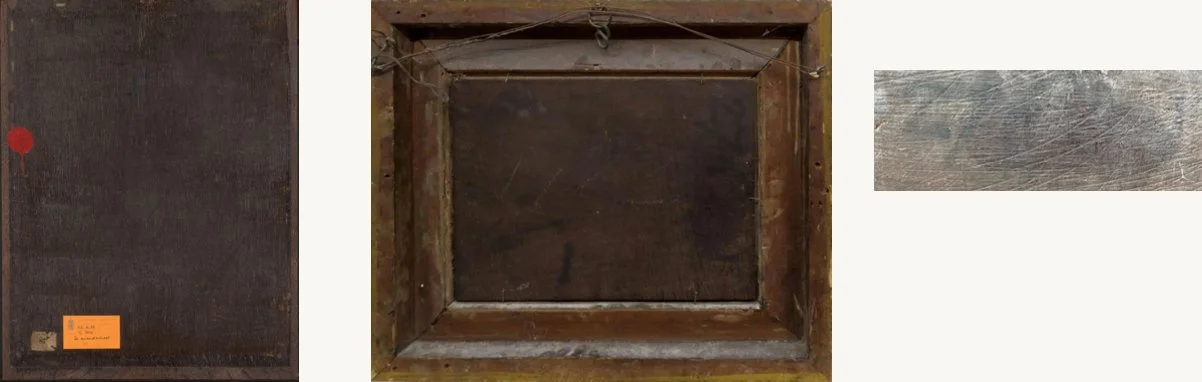
Fig. 401 Back of The Night School panel; Fig. 42. Back of the Folly frame and panel; and Fig. 42a. Folly panel turned and lightened to show an old collection number ‘276?’ (images not to scale).
B. Preparatory Layers
The Night School
Single translucent white ground extending to the edges of the support, composed of large opaque white pigment particles with a minute addition of earth pigment.
Folly at the Night School
Dense white preparatory ground penetrating the wood grain and forming a continuous luminous base layer visible in radiography and surface losses.
Comparative Observation
Both panels are prepared with continuous white grounds extending to the edges of the support, a feature consistent with Leiden cabinet-painting practice and compatible with documented preparation methods used in Gerrit Dou’s studio.
C. Underdrawing
The Night School
No underdrawing has been detected with the naked eye or infrared imaging. Technical examination published by Gwen Tauber confirms that infrared photography revealed compositional adjustments (including an earlier, longer position for the seated boy’s leg) but no underdrawing beneath the painted surface.
Infrared reflectography supplied by the Rijksmuseum (2026) confirms that no overpainted or abandoned figure exists in the shadowed area traditionally described as containing a “boy in the shadows.” 9 [Fig. 43]
Folly at the Night School
Underdrawing not clearly visible; infrared reflectography indicates that the composition was initially planned in a dry, carbon-based medium before being developed through successive adjustments in paint.
Comparative Observation
The infrared evidence for The Night School panel is significant in light of repeated references to such a figure in published descriptions beginning with the Van der Pot sale catalogue of 1808. It indicates that these descriptions reflect interpretative tradition rather than material revision.
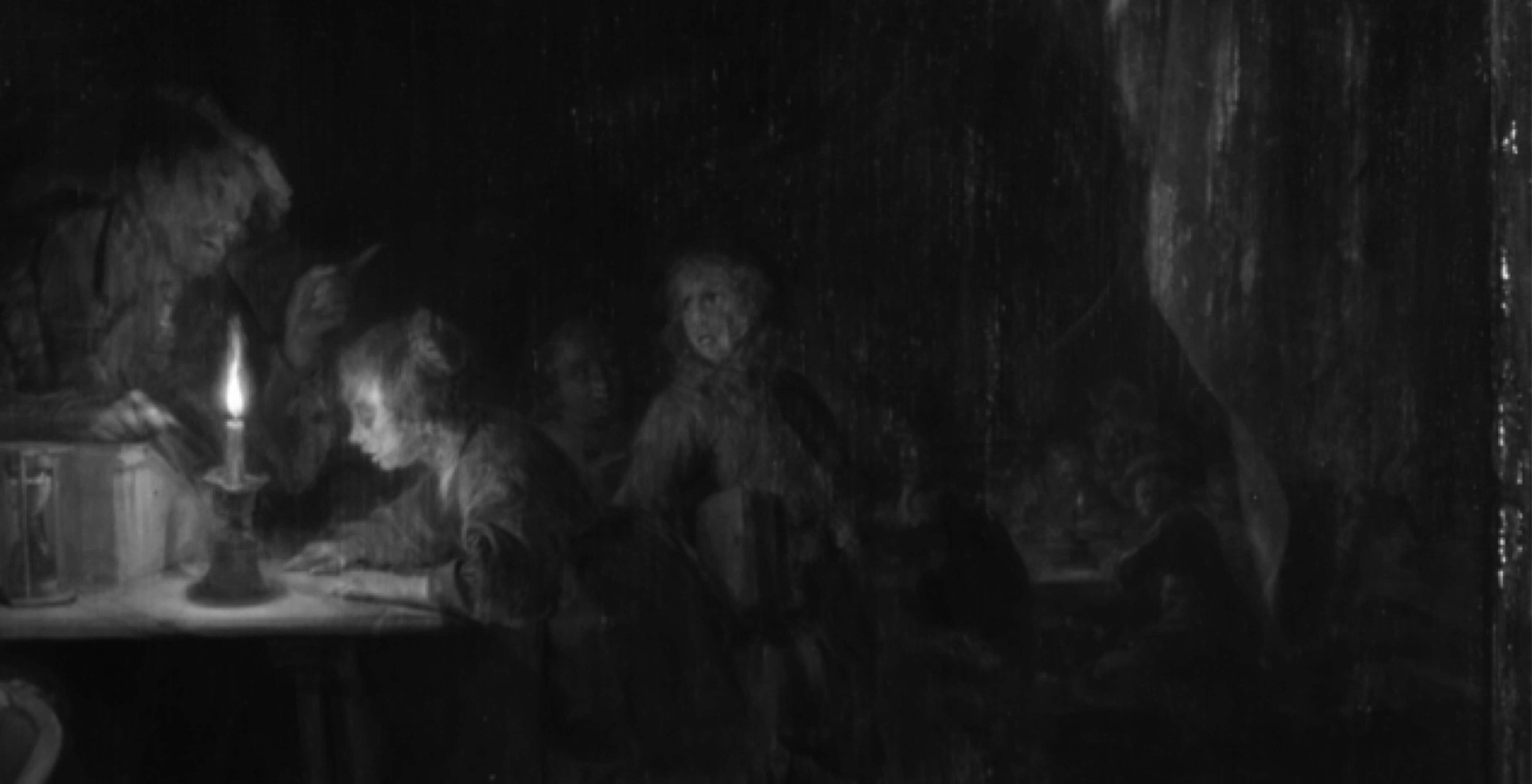
Fig. 43 Infrared reflectography detail of The Night School panel showing no evidence of a figure in the shadowed area traditionally described as containing a “boy.”
D. Paint Construction
The Night School
Composition built from back to front and from dark to light using reserves. The scene was first broadly underpainted in dark tones, visible in infrared examination. Illuminated passages were executed smoothly with carefully blended opaque paints.
Folly at the Night School
Paint applied in thin, layered stages. Radiography indicates a low-contrast structure consistent with relatively thin paint layers. The candle flame was constructed additively through successive colour applications over a luminous ground.
E. Compositional Revision
The Night School
Infrared examination reveals an early adjustment to the length of the seated boy’s leg in the foreground.
Folly at the Night School
Infrared reflectography reveals multiple pentimenti, including repositioned heads, altered gestures, redrawn hands, and compositional refinements to spacing and movement.
F. Surface and Later Intervention
The Night School
Later structural additions present in the form of attached support strips.
Folly at the Night School
No structural alterations detected. The varnish contains dispersed carbon-black particles indicating a later toning treatment.
G. Summary Observation
Both paintings share structural characteristics typical of mid-seventeenth-century Leiden cabinet panels, including single-plank supports and continuous white preparatory grounds. Within this shared technical framework, differences in paint handling and revision density indicate distinct working procedures.
Footnotes to Section 7
Rijksmuseum, The Night School, collection record (entry and provenance by Gerbrand Korevaar, 2026; technical notes by Gwen Tauber, 2021, accessed 25 February 2026, https://www.rijksmuseum.nl/en/collection/object/The-Night-School--206d24dbca2f35d9d6a296bdb2e00193
Christopher Wright, Catalogue of the Foreign Paintings from the de Ferrieres Collection and Other Sources (Cheltenham Art Gallery and Museums, 1980). p.10 recounts ‘well over a hundred’ paintings inherited by the 3rd Baron; useful for comparing frame types and tracing possible context for Folly.
Illustrated Catalogue of the Art Treasures Exhibition (Leeds, 1868), which records Baron de Ferrières’s loans. Helps place works from the Brussels/Cheltenham connection in the wider mid-nineteenth-century exhibition culture.
John Smith, A Catalogue Raisonné of the Works of the Most Eminent Dutch, Flemish and French Painters (London, 1829–42); and Cornelis Hofstede de Groot, A Catalogue Raisonné of the Works of the Most Eminent Dutch Painters of the Seventeenth Century, trans. Edward G. Hawke, 10 vols. (London: Macmillan, 1907–28), vol. V (1913), pp. 388–391, nos. 272–283, listing Schalcken’s candlelit scenes of children. Nearby entries include A Girl with a Lighted Candle and a Boy (277), in which a boy attempts to blow out a flame, and a scene of children melting wax by candlelight (276) — motifs closely aligned with the unstable flame, childish experimentation, and transient effects central to Folly itself. Children Blowing Bubbles by Candlelight (278b) is recorded in a sale at Cheltenham in 1859.
Courtauld Institute of Art, Conservation Department, Technical Examination Report on “Folly at the Night School” 3rd September 2024 (Appendix 1 to this dossier). Key evidence for the painting’s material integrity.
Prof. Dr. Peter Klein, Report on the dendrochronological analysis of the panel “Night School” (G. Dou, inv. no. A 87), Universität Hamburg, 12 December 2010. SK-A-87_20101212_Dendro
Friso Lammertse, Dutch Genre Paintings of the Seventeenth Century (Rotterdam: Museum Boijmans Van Beuningen, 1998), p. 67, noting the use of the tropical hardwood Cedrela odorata as the support for Gerrit Dou’s The Quack.
Wayne Franits, Dutch Seventeenth-Century Genre Painting: Its Stylistic and Thematic Evolution (New Haven: Yale University Press, 2004), on the development of Leiden’s textile trade.
Infrared photography undertaken by Gwen Tauber, RMA, August 2009, supplied by Rijksmuseum Conservation Department, correspondence with the author, 2026.
8. POSTSCRIPT
When I first began writing, I imagined this dossier might run to a few thousand words. Instead, it grew steadily as the research unfolded. The reason was simple: each question answered seemed to open another, and the relationship between the two panels proved richer and more structurally coherent the more closely it was examined.
I believe this reflects three things. First, that the proposition of a conceived diptych and Schalcken’s early authorship is well founded. Second, that the reunited paintings reveal an exceptional richness of relation. The written sources from Dou’s lifetime may be sparse, but the works themselves are remarkably articulate — constructions in which visual decisions, narrative timing, behaviour, and contrast all carry interpretive weight. Third, that the The Night School occupies a pivotal place in the careers of both artists.
I am acutely aware how fortunate I have been to uncover Folly, and to be the first person in centuries to explore the part it plays in The Night School. The process has been enthralling, but it also carried a strong sense of stewardship: not simply to argue for an attribution, but to help bring the painting back into public view with a coherent and accountable understanding of what the pairing does — how it operates conceptually, structurally, and pedagogically when the two panels are read together. That responsibility explains both the scale of this document and its attempt to think beyond attribution toward consequence.
What I have tried to assemble here is not a closed argument, but a foundation: a framework of evidence and comparison intended to be tested, questioned, and refined. The dossier and its arguments will only benefit from critical engagement by others. The later appendices step back from attribution to consider what the reunited diptych might make possible in a museum and broader educational context, where The Night School and Folly function not only as a rare master–pupil dialogue, but as an unusually lucid teaching object — one that reflects on learning, judgement, time, and human potential in ways that remain legible to modern viewers.
On the evidence assembled here, my hope is that this dossier, together with thenightschool.org, might become a shared scholarly resource — provisional, open, and subject to revision. The aim is not to preserve a single voice, but to provide The Night School reunited with a living intellectual home that supports research, education, and public understanding. Such a framework is needed, for the evidence suggests that since its creation more than 360 years ago, the two works have never been seen together: they appear to have been separated when de Bye acquired the Dou panel for his exhibition of 1665. The diptych therefore requires time — time for its implications to be tested, its educational force to be experienced, and its place within the history of art to be understood with the depth it warrants.
Ultimately, the reunion of the two panels is what matters most, so that they may speak again in the contrapuntal way Dou appears to have intended. If this document has helped clarify what is at stake in that reunion — artistically, historically, and curatorially — then it will have achieved its purpose.
APPENDIX 1
The Process of Discovery
In November 2021 a small candlelit genre painting on eBay drew my attention. The listing described it as “eighteenth– or nineteenth-century Dutch school,” yet to me it appeared earlier in date and of high quality, despite the poorly lit photographs.
By coincidence, I was travelling to Amsterdam that weekend to visit my son at university. So I decided to visit the seventeenth-century galleries at the Rijksmuseum to see if there was anything like it. Remarkably, the very first painting I stopped in front of was Gerrit Dou’s The Night School. In that instant, I had the uncanny sense that the two works spoke to one another. As I took this in and looked across at the gallery caption, I realised that its explanation did not match what I could see: there was a structural anomaly in The Night School that the description glossed over.
I took a quick photo so I could view The Night School on the museum’s website back at the hotel and compare it with the painting I had seen online. [Fig. 44] When I did, the connection was clear. A few days later I bid in the eBay auction and secured the painting. [Fig. 45] That moment — of recognition and of a question that would not resolve itself — was the start of a four-year investigation.
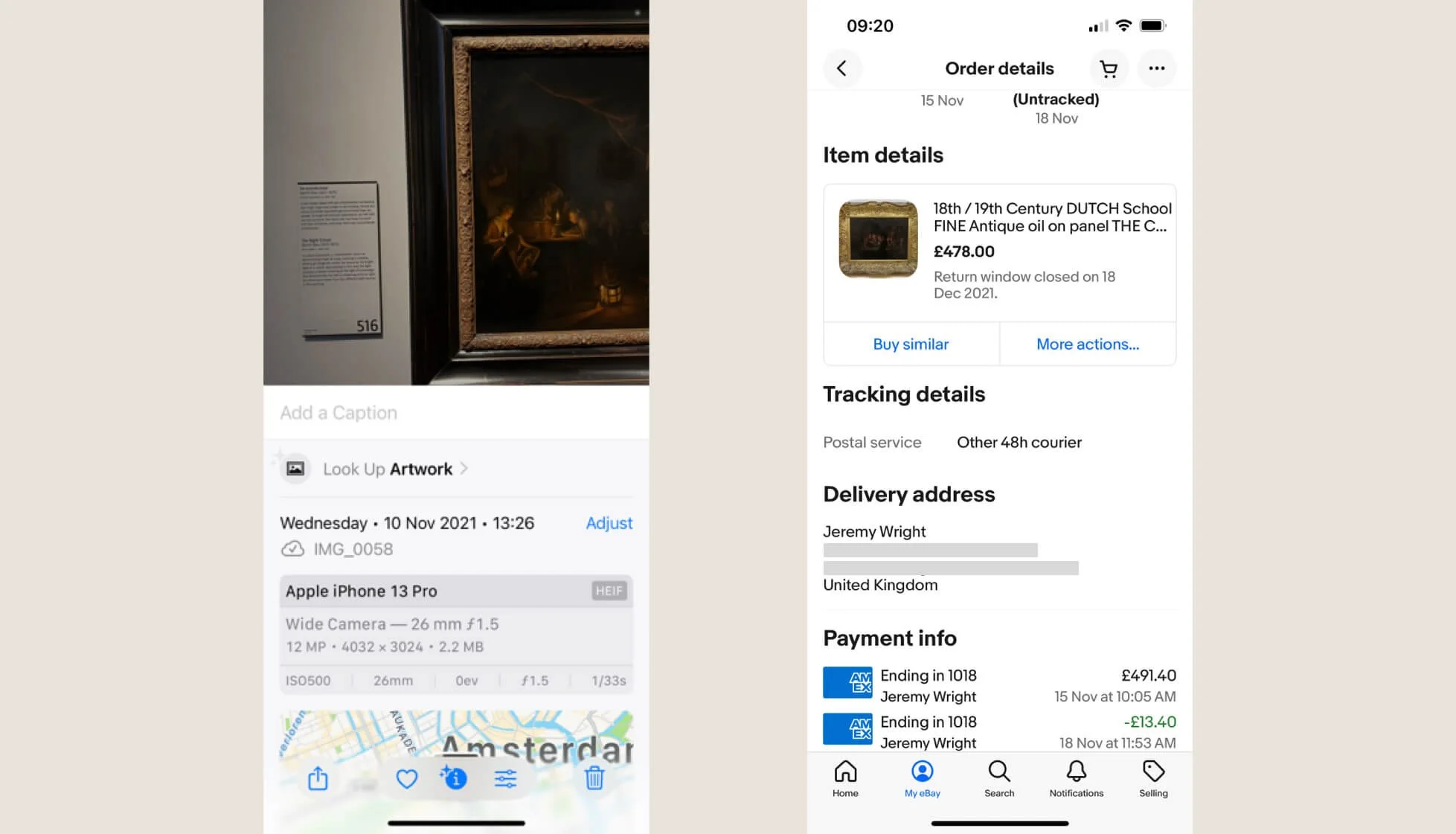
Fig. 44. (Left) The moment of discovery - a quick photo to compare later that evening; and Fig. 45. The eBay purchase made a few days later. Delivery costs were refunded when I chose to collect the painting in person.
What began at that point was not a case to prove but a set of questions to answer. Early observations were not just of similarity but of difference. Both scenes appeared to depict the same candlelit schoolroom, and the teacher and his assistant seemed connected by their gestures and gaze across the divide. The figures were to the same scale, yet the panels were different sizes and formats, one portrait and the other landscape. The paint handling was distinctly different. Was this the work of another hand — and perhaps a later one? One detail remained harder to reconcile. If the Rijksmuseum panel was a single painting, why did the admonishing gesture of its main figure point toward empty space? The gallery description suggested that he was addressing a boy in the shadows, but there was not one to be seen.
For some time the problem that puzzled me most was finding an artist who painted children with such human vitality. Time and again I returned to that elusive search. Eventually another possibility occurred to me, which helped me approach the problem from a different angle: what if the narrative, lighting, and structural connections were so strong that the painting had to have been made at the same time, in the same studio, as Dou’s panel? That possibility opened up a new explanation for the absence of comparable later works. The content of the diptych was largely driven by Dou and, once working independently, the painter of Folly was just as likely to have been drawn to other subjects.
This question unlocked how I looked at the work more broadly, and rapidly the hallmarks of Dou's meticulous engineering began to fall into place: the ratio of the panels, the balance of the figures, the numerical structure and symbolism, the triple lock, and the logic of the lighting. The more these elements accumulated, the harder it became to see Folly as an independent invention. Instead, it appeared increasingly as part of a larger conception carefully structured by Dou. As the evidence accumulated, I realised independent technical examination was required, and so submitted the panel to the Courtauld Institute of Art in London.
Infrared imaging revealed pentimenti within the composition, confirming that the scene was developed through the process of painting rather than copied from an existing design. Microscopic study of the paint surface also revealed an exceptionally refined handling of the candle flame, visibly distinct from Dou’s and characteristic of just one of his apprentices. Together with the identification of a dense white preparation layer consistent with Dou’s studio practice, these observations provided important technical evidence about the panel’s origin and authorship.
A further confirmation of Schalcken’s hand came during a visit to the National Gallery in London to study A Man Offering Gold and Coins to a Girl. Seeing the painting in person confirmed that the flame possessed the same chromatic range as that in Folly. What had seemed uncertain in the museum’s reproduction was unmistakable before the painting itself.
So if this was a classroom scene, what did it teach? The counterpoint of diligence and folly looked straightforward at first but became more subtle the closer I looked. An early attempt to summarise the moral I expected in The Night School reduced the scene to a familiar lesson: that children must learn there is a time for work and a time for play. Although plausible given the evident narrative, this explanation proved unsatisfactory. It imposed a tidy conclusion on a painting that seemed deliberately resistant to closure. The pupils are not simply disciplined or disorderly, but variously attentive, distracted, curious, and absorbed in the candlelit drama. What could be taken as a straightforward moral scene gradually revealed itself as something more complex — a composition built around a living tension rather than a single lesson.
Yet the attempt was not entirely misguided. The elements that had first suggested that simple moral — the just-turned hourglass, the admonishing teacher, the collapsing house of cards, energised children, and the threatened candlelight — all pointed persistently toward a deeper theme. Taken together, they suggested that the two paintings were structured not only spatially but temporally. Rather than delivering a fixed moral about work and play, the diptych appeared to explore the wise and unwise use of time itself, both in the lesson and in the broader rhythm of life, revealing a more sophisticated perception of human behaviour and human potential.
During this period another work by Schalcken, The Parable of the Lost Piece of Silver, also came to my attention and proved unexpectedly relevant. I had already discussed it in the dossier as evidence of Schalcken’s later career development after absorbing the lessons of The Night School. But I then realised that the connection was stronger — a conclusion supported by primary documentation from eighteenth-century sales records. The subject and composition of Lost Silver read as an autobiographical tribute in paint to the man and the training that shaped him — a personal commemoration of what The Night School and Folly gave him: a structural discipline, an expressive language, and the candlelight motif that eventually defined his career.
Late in the investigation, after I had shared an early draft of the dossier with the Rijksmuseum, an earlier version of the composition, now in the Uffizi in Florence, came to light in an update the museum itself made to its catalogue entry for The Night School. This smaller panel revealed how Dou had first formulated the theme before reworking it into the larger and more directional composition now in Amsterdam. Seen in that light, the changes Dou introduced in the later painting — the hourglass, the standing teacher, the opened curtain, and the strengthened directional structure — appear less like refinements to a single picture than deliberate adjustments to a design intended to connect with its counterpart beyond the frame. This additional evidence unambiguously reinforced the interpretation already established. The gesture that had once seemed to address empty space now read as part of that larger design.
As the observations accumulated, another layer of organisation gradually became apparent. The figures themselves seemed to participate in the diptych's argument. What initially appeared to be differences of style and temperament between the two panels increasingly revealed a developmental structure, an impression strengthened by the changes Dou made to the human types between the Uffizi version and his later panel. The figures were not merely descriptive but integral to the diptych's meaning, extending from the raw vitality of the children to the composure of the studying pupils and ultimately the authority embodied by the teacher above the candle. This observation eventually became Physiognomy as Argument (§5.10).
The final stage of the research involved stepping back from individual discoveries and asking how they related to one another and formed a coherent whole. The answer gradually emerged in what became A Fine Mechanism (§6.14), for which the pendulum clock provided an unexpectedly apt analogy. What at first reads as a simple counterpoint between two scenes, on closer looking reveals a finely calibrated mechanism whose deeper meaning emerges from the delicate balance between human vitality and human endeavour across the two panels. Inevitably, perhaps, the project grew from a case for reunion and attribution to an attempt to fully comprehend what Dou and Schalcken created between them, and the significance of The Night School in their careers and, more broadly, within Dutch seventeenth-century art.
What has been most unusual about this process, and particular to the circumstances of the work, is that I was exploring new ground through close observation of how the panels related to one another. There is no previous research on the diptych to draw on, which makes the paintings themselves the fundamental evidence. Yet their pivotal position in Dou's enduring enquiry into learning, and in Schalcken's emerging career, meant that a remarkable arc of related works and tributes also became primary evidence, illuminating both the formation of the diptych in the mind of one artist and its influence on the other thereafter. The ground was not merely unexplored; it turned out to be unexpectedly extensive.
What began as a moment of curiosity before a dark candlelit painting on eBay became a sustained effort to understand how two works might once have formed a single conception in 1665. As the investigation progressed, it became apparent that insights do not always emerge in a logical or predictable order. When looking for one thing, something unexpectedly useful or corrective in another area would appear. Questions that remained unresolved for long periods could suddenly clarify once the right perspective was found. The process proved both demanding and absorbing, and one conclusion became increasingly clear: in Dou’s work, everything serves a purpose. The more closely one looks — and the longer one spends with his exquisite pictorial engineering — the more it rewards. This dossier presents the results of that investigation and the evidence that has emerged from it.
APPENDIX 2
Courtauld Technical Report
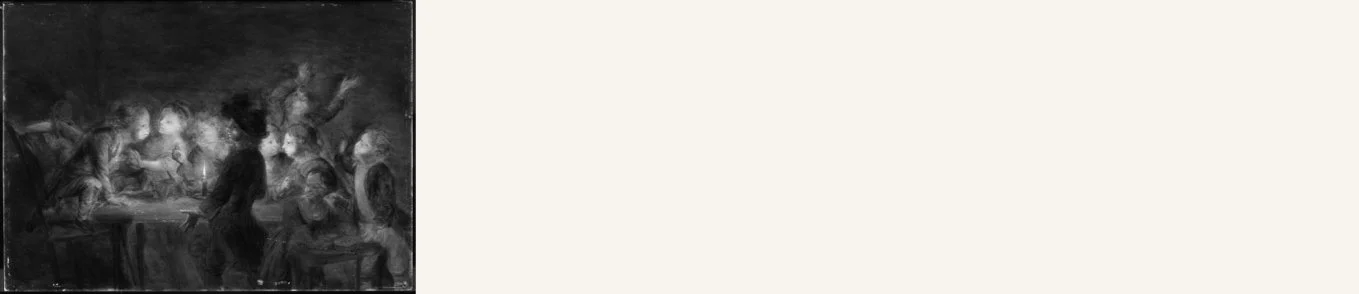
Download the Courtauld technical examination of Folly at the Night School (PDF)
Reproduced in full, with personal address details redacted.
APPENDIX 3
The Rijksmuseum Description
The current Rijksmuseum description of The Night School reads:
Light and dark, virtue and vice are juxtaposed here. Bathed in bright candlelight, a girl earnestly recites her lesson, while in the shadows the schoolmaster admonishes a boy. In the foreground, a second pupil, candle in hand, helps another with his schoolwork. The candlelight here symbolizes reason. 1
This interpretation is understandable when Dou's painting is perceived as a standalone work. The composition appears to juxtapose diligence and misbehaviour within a single interior, and the direction of the teacher's raised finger naturally invites viewers to seek the object of his admonition somewhere within the frame.
Yet the description encounters a difficulty. The boy whom the teacher is said to admonish is not visible in the painting. The explanation therefore supplies a narrative relationship that cannot be directly observed.
The reunion of Folly at the Night School with The Night School offers a different solution. Read together, the teacher's gaze and gesture correspond not to an unseen figure within his own panel, but to the assistant positioned opposite him in the companion scene. The rebuke operates across the divide between the two paintings, linking action and response in a way that becomes visible only when the diptych is restored.
The companion panel also reorients the meaning of other elements within Dou's composition. Rather than presenting a simple opposition of virtue and vice within a single room, the diptych contrasts two different uses of time, attention, and human potential. The candlelight likewise acquires a broader significance. Rather than symbolising reason in the abstract, it becomes the shared emblem of learning itself — steady and protected in The Night School, yet vulnerable and threatened in Folly. Meaning emerges not from either image alone, but through their relation.
This difficulty is not unique to the Rijksmuseum description. Earlier commentators likewise struggled to account the direction of the teacher's gesture. 2 Such recurring attempts suggest that viewers repeatedly sensed a narrative incompleteness within the separated panel and sought ways to resolve it.
Seen in relation to its companion, however, these ambiguities become more intelligible. What had long seemed unresolved within a single painting can be understood as part of a larger design operating across the reunited diptych.
Footnotes to Appendix 3
Rijksmuseum, Amsterdam, object record for Gerrit Dou, The Night School (SK-A-87), online description (English and Dutch), https://www.rijksmuseum.nl/en/collection/object/The-Night-School--206d24dbca2f35d9d6a296bdb2e00193, accessed 28th May 2026.
Théophile Thoré-Bürger, Musées de la Hollande et de la Belgique, vol. 2 (Paris: Gide et J. Baudry, 1858–60), 99–100. Catalogus van een Uitmuntend Kabinet van Schilderijen (Rotterdam: J. van Baalen, 1808), lot 28 (sale of Gerrit van der Pot’s collection). Catalogue d’une riche collection de tableaux… (Rotterdam, 1808), pp. 14–15, no. 28. TTwo earlier descriptions of The Night School that appear to supply figures or actions in an effort to account for the object of the teacher's admonishing gesture.
APPENDIX 4
Made for Learning
This appendix explains why Dou and Schalcken’s The Night School is uniquely suited to support forms of learning that depend on interpretation, judgement, and sustained looking.
A. Where the Value Lies
The reunited Night School is more than an attribution story. It becomes one of the most versatile artworks through which to explore the creative process in the Dutch Golden Age — a single diptych capable of opening discussion of technique, narrative, studio practice, morality, the psychology of learning, and even questions of identity and universal human potential. Few works lend themselves so naturally to both school teaching and university-level study.
The educational value of the reunited diptych rests on six distinctive strengths:
1. Immediate Readability, Deep Interpretability
Students grasp the scene at once — diligence and distraction, order and mischief — yet its symbolism, geometry, and pedagogical meaning reveal themselves only through sustained looking, comparison, and judgement.
2. A Gateway into the Art of the Golden Age
The diptych becomes a single case study through which to explore:
seventeenth-century genre painting, from Dou to Steen
the life of an artist, from apprentice to master
Calvinist pedagogy and emblematic symbolism
narrative structure and pictorial time
the social history of education
Leiden studio practice and master–pupil pedagogy
technical art history (infrared reflectography, pentimenti, glazes, white grounds, magnification)
Few artworks open so many threads through a single visual conception.
3. A Uniquely Relatable Modern Theme
Students of all ages respond instinctively to the rhythm of work and play, the fragility of attention, the pressures on teachers, and the fact that learning is always bounded by time — time that must be structured, protected, and renewed.
Another dimension with exceptional educational potential is Dou’s portrayal of the teacher. His complexion and features distinguish him from the pupils around him, yet he is depicted with complete naturalness: calm, authoritative, and fully integrated into the moral centre of the scene.
For modern teaching, this becomes a powerful site of discussion: not representation as spectacle, but representation as dignity — the quiet proposition that learning, responsibility, and leadership are universal capacities, regardless of background or origin.
4. A Compelling Narrative of Rediscovery
The painting’s journey — separated in the 1660s, miscatalogued, found on eBay, technically analysed, reattributed, and reunited — captures the thrill that serious discoveries are still possible. It provides a vivid teaching case for:
connoisseurship
provenance
research method
attribution politics and ethics
critical reassessment
5. A Rare Model for Teaching Studio Practice
The diptych is one of the clearest surviving examples of collaborative pedagogy in a seventeenth-century workshop. It can be set in the context of more usual studio practice:
how Dou trained his pupils
how the Night School composition developed from earlier designs
how he gave Schalcken the freedom of the counter-voice
how Schalcken infused Dou’s structure with expressive energy
6. Exceptional Potential for Public and School Engagement
With themes of learning, storytelling, human behaviour, and attention, the reunited paintings are ideally suited to:
school visits
narrative-led interpretation
curriculum-linked workshops
interactive exploration of light, time, and learning
A model assignment: Dou’s briefing to Schalcken
One exercise captures the teaching power of the diptych particularly well:
“In The Night School, how might Gerrit Dou have briefed the young Godfried Schalcken to paint the counterpart scene? In 250–500 words, reconstruct their exchange using the paintings — and the research evidence — as your guide.”
This single question integrates visual analysis, historical reasoning, empathy, and narrative intelligence. The diptych becomes not just an object to study but a dialogue to enter.
B. Why The Night School is So Good for Teaching
A single painting can show us what an artist made. A diptych made by two minds shows us how they thought.
In this case, that thinking is organised around a single challenge: how to counterpoint the wise and unwise use of time. Dou and Schalcken’s distinct talents are not blended but deliberately distributed across the two panels in response to that question.
Most artworks are sealed boxes: they reveal the product, but they hide the process and the relationships that shaped it. Even brilliant single-author masterpieces — a Vermeer, a Rembrandt — give us the result, not the conversation that produced it. Dou and Schalcken’s The Night School is different in four decisive ways:
1. It Externalises a Private Exchange
Most master–pupil interactions leave little trace. Dou’s corrections, Schalcken’s experiments, the verbal instructions, the moments of hesitation — these normally vanish. Here, uniquely, the dialogue is the artwork:
Dou sets the premise, structure, geometry, light, and ethical frame.
Schalcken answers with motion, warmth, volatility, and lived observation.
Each painting completes the other’s sentence.
You aren’t just analysing composition — you’re analysing a conversation.
2. It Allows Psychological Inference Without Speculation
Because the exchange is staged in paint, it becomes possible — even necessary — to read intentions:
What did Dou worry about? (Discipline, structure, form.)
What did he trust Schalcken to add? (Animation, instability, lived detail.)
What did Schalcken admire in his master? (Moral clarity, compositional control.)
What did he want to show he could do differently? (Fire, gesture, moment, irreverent vitality.)
Normally, we can only reach such insights by triangulation — comparing dates, influences, pupils, and letters. Here, the works themselves reveal personality, temperament, and core artistic values. We read the parallels in paint.
3. It Makes the Students of Today Inhabit the Studio of 1665
The Night School reunited doesn’t just show two scenes — it re-enacts a workshop dynamic. To understand it properly, you have to assess:
Dou’s mind as he constructs meaning through architecture
Schalcken’s mind as he animates that meaning through lived experience
how their intentions rub, reinforce, contradict, and complete one another
the “why”, not just the “what”
That act of moving between two minds is pedagogically priceless. Single works cannot offer this, because they contain no articulated exchange of intention to react to. It can almost be read as a cognitive X-ray of a seventeenth-century studio.
4. It Can Open Minds to the Merits of Apprenticeships, Then and Now
The reunited diptych also offers a rare way to think about apprenticeship as learning grounded in practice rather than theory:
The Night School presents apprenticeship at a mature stage, where the pupil is trusted not to replicate what the master already does well, but to extend it into new territory.
Schalcken’s contribution shows how discipline, once absorbed, becomes a platform for difference: youthful energy, psychological range, temporal animation, and risk-taking within a guiding structure.
The diptych invites discussion of learning through immersion in real work, where experimentation is permitted, responsibility is real, and outcomes matter.
Schalcken’s later career — and his explicit tribute in Lost Silver to what he learned through this formative experience — provides a rare historical example of apprenticeship translating into long-term professional and economic success.
For modern audiences, the work offers a relevant lens through which to discuss mentoring, post-school learning, and the conditions under which talent is allowed to flourish — questions that remain pressing today.
C. Learning with AI, Thinking Beyond It
The rise of AI poses a fundamental challenge to education: how do we teach students to think, not simply retrieve information? Copying, summarising, and fact-collecting — once staples of art-historical training — can now be performed by machines. What AI cannot replicate is the slower interpretive work of making meaning: comparison, inference, ambiguity, and judgement.
This is precisely where The Night School reunited becomes invaluable.
The diptych demands forms of thinking that resist automation:
close looking — gesture, light, and chains of cause and effect
comparative reasoning — reading two panels as a single structure
temporal inference — before, during, and after within one moment
perspective-taking — understanding both Dou’s structure and Schalcken’s response
interpretive judgement — arguing intention rather than retrieving fact
dialogue — testing ideas collaboratively rather than harvesting answers
contextual analysis — situating the paintings within the art of their time
A single essay or dissertation question can capture this difference:
“How does The Night School lead the mind of the viewer?”
This cannot be answered by retrieval or summary. The diptych requires sustained looking and supports many possible answers, all of which must be argued within the structure of the work.
A second question follows naturally:
“How does The Night School manage time?”
This invites students to consider duration, interruption, renewal, and attention — how time is structured, measured, mishandled, and recovered across the two panels.
Even an apparently minor detail of playful appeal can open productive discussion. For example:
“How do hats carry meaning in the work of Dou and Schalcken?”
When the diptych is viewed beside Dou’s self-portraits, Schalcken’s tribute engraving, and The Parable of the Lost Piece of Silver, headwear emerges as a subtle yet distinctive marker of role, identity, and artistic inheritance.
In this way the diptych functions not simply as content but as method: a training ground for the kinds of thinking that remain distinctly human. Students may use AI to gather context, but the interpretive core — reading structure, gesture, and intention — must be done through looking, discussion, and judgement.
The study of The Night School therefore does not merely survive the age of AI — it strengthens the very capacities that machines cannot replace: seeing, interpreting, and understanding.
D. A Painting for Every Generation
In a textbook, lecture slide, or online archive, the physical size of a painting is irrelevant. Rembrandt’s Night Watch and Dou and Schalcken’s The Night School occupy the same space on a page or screen. [Fig. 46] What matters in teaching is what a work can do in the mind: how effectively it engages, extends, and enriches thought.
Painted just 23 years apart, the two works ask radically different things of the viewer:
The Night Watch is majestic, dense, historical, and culturally distant — a civic drama rooted in costume, symbolism, and a world that students must first learn to decipher.
The Night School, by contrast, feels immediately accessible: a schoolroom in which children test the patience of their teacher and the boundaries of attention. The situation needs no explanation; its drama is instantly recognisable.
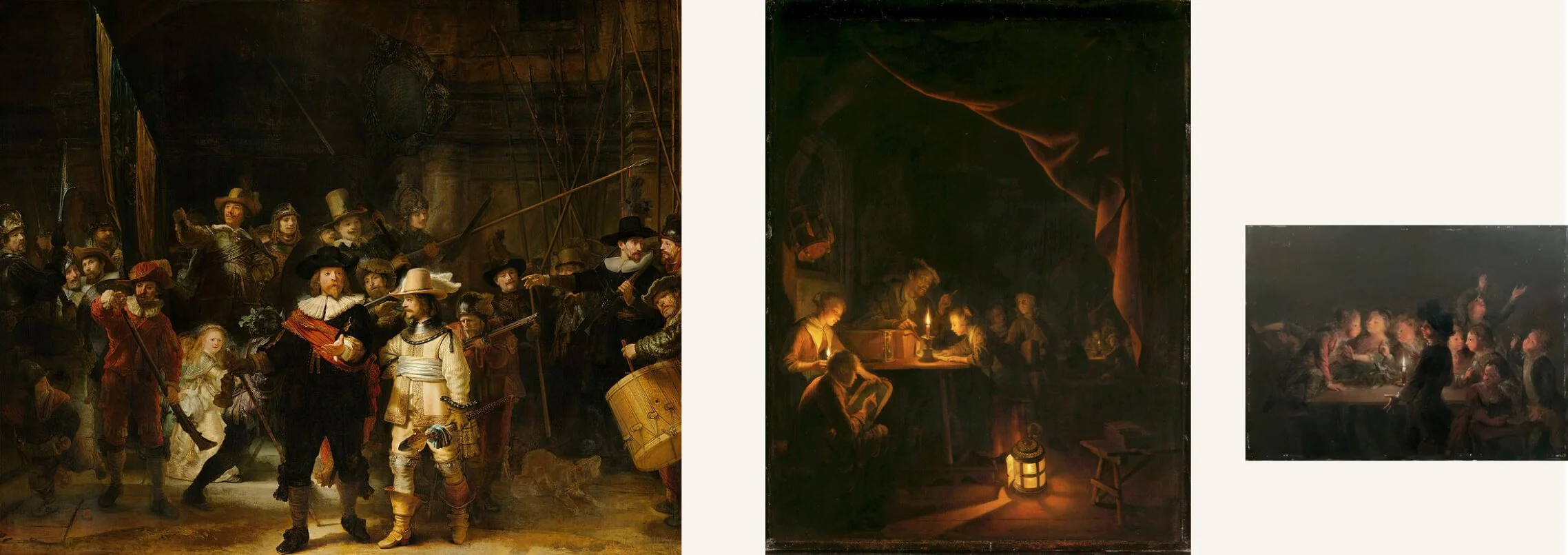
Fig. 46. The Night Watch, 1642, and The Night School diptych, c.1665.
Equal in scale and detail on the page; radically different in what they ask of the mind.
One requires cultural decoding; the other can simply be read, for what it shows.
The longer one looks, the more its structure rewards thought. Every gesture, object, and sightline serves a purpose. Nothing is merely ornamental; everything contributes to meaning. The work becomes not simply a picture to observe but a structure to explore — a painting that teaches by requiring the viewer’s active participation.
This is what makes The Night School so powerful as a tool for teaching and learning. Its clarity invites entry; its structure rewards thought. Help a student discover that, and their interest in art can last a lifetime.
Every teacher who encounters The Night School will also recognise something of their own experience. Dou’s teacher stands in quiet authority, steady in the face of distraction — a reminder that teaching everywhere rests on the same enduring labour: guiding learning while managing the human noise that surrounds it.
Teachers across cultures will want to use this work not only for its interpretive richness, but because it understands their role — and treats it with dignity across the centuries.
Invitation
This appendix is not a fully worked programme but a deliberate opening. It shows how The Night School can sit at the centre of a future educational ecosystem — scholarly, museum-based, and school-based — built around a single reunited masterpiece whose theme is learning itself.
Appendix 5
Made for Thought
A Masterclass in Contrapuntal Painting
Most paintings present a view. Dou and Schalcken’s The Night School invites you to think between two views. One schoolroom, two scenes: not alternative vantage points, but counterpoint visions within a single candlelit world. The viewer is invited to register the difference between diligence and folly, order and lapse, behaviour and consequence, and the hand of one artist and of another — and to recognise that meaning arises not from either view alone, but from the tension between them.
This interplay does not simply describe behaviour; it invites the viewer into a cognitive process. In The Night School, attention is held, directed, and sustained. In Folly, attention unravels — not wickedly, but curiously, impulsively, with the fragile exuberance of youth. Seen in tandem, the paintings understand learning not as a fixed state but as a lived movement: an oscillation between concentration and interruption, discipline and mischief, and between time well used and time lost — as unpredictable as it is human. What emerges is not a moral verdict but a recognisable pattern of behaviour: children behave like this, and the work of education lies not in suppressing such energies, but in steering them, renewing them, and making room for the messy, hopeful work of growth.
The more you engage, the more it opens up
To perceive the diptych in this way is to realise that it is less a record of events than a model for thought. The two panels create a visual simulation of cognitive movement — from focus to distraction, from disruption to recovery — enacted in real time, in real space, across co-present images. The drama is not confined to what we see, but extends to what we infer: what has just happened, what will soon happen, and how a compromised equilibrium might be restored. The paintings place the viewer in a position that resembles the teacher’s: surveying, interpreting, anticipating — and hoping for improvement.
What makes this all the more remarkable is that the dialogue unfolds on two levels simultaneously: within the depicted scene, and between the artists who made it. The compositional composure of The Night School bears the imprint of Gerrit Dou’s architectural discipline; the kinetic energy of Folly bears the signature of Godfried Schalcken’s emerging temperament. The diptych therefore becomes, in part, a conversation enacted in paint — a master setting structure and expectation, a pupil answering with motion, warmth, and lived observation. The paintings are not mirror opposites, but interlocking expressions of two minds testing and extending one another. To reflect on the two views is therefore to think not only about classroom dynamics, but about artistic ones: how authority is exercised, how independence emerges, and how difference, rather than sameness, can generate coherence.
Seen at its most ambitious, The Night School reunited models thought on three intertwined levels: within the children who enact a cycle of concentration and disruption; between the scenes whose differences establish meaning; and between the painters whose temperaments shape those differences. It is a work made through acts of thought that asks the viewer to engage in kind — not by decoding a fixed message, but by inhabiting a shifting posture of relation, comparison, and inference. The reward lies not in resolution, but in sustained attentiveness. The deeper the engagement, the more it opens up.
HOW THE NIGHT SCHOOL REWARDS LOOKING AND THINKING
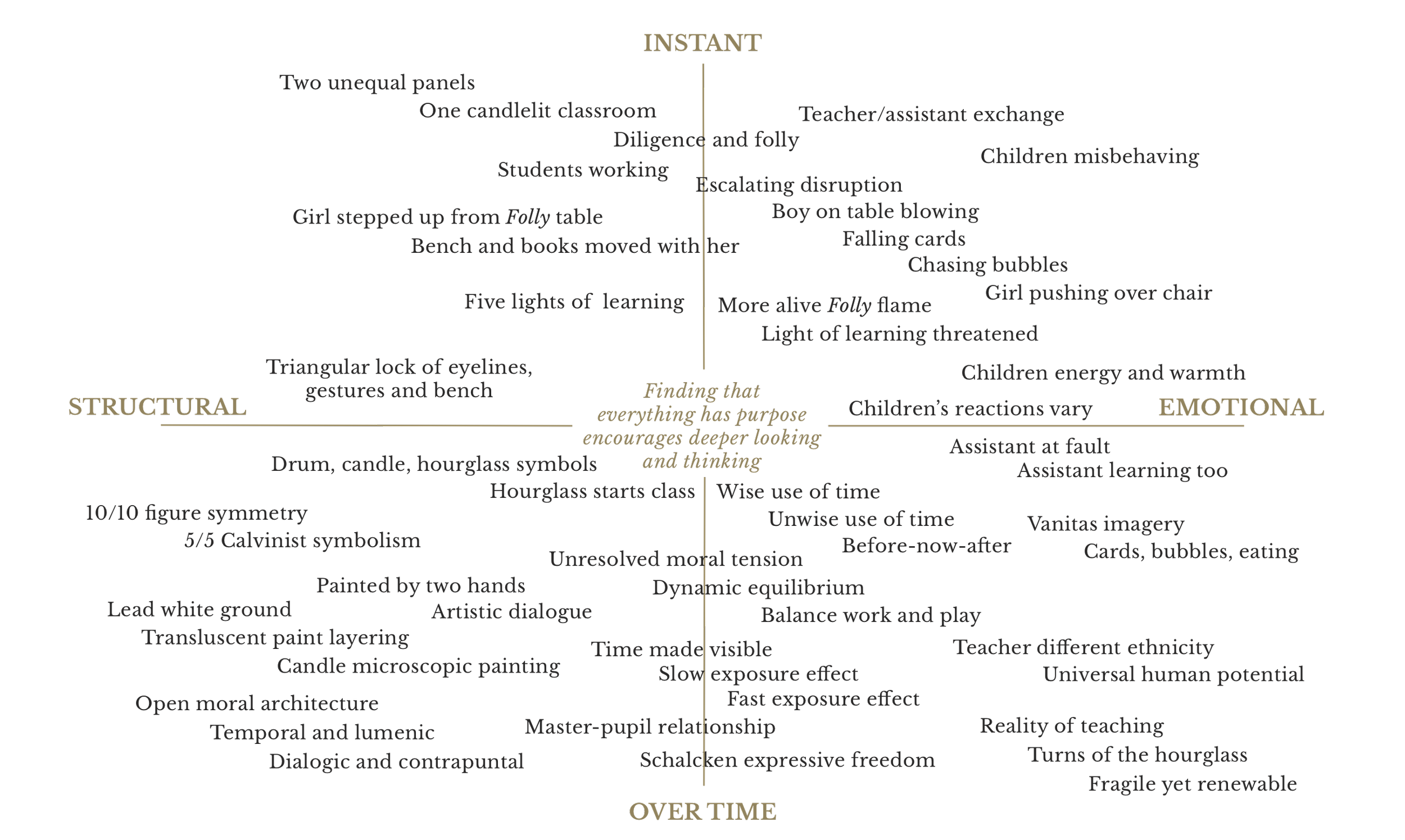
A humane statement about growth
If many canonical paintings have become famous because they show beauty, power, or mythic drama, Dou and Schalcken’s The Night School is compelling for a different reason: it imagines how people change. Its focus is not on appearance but on capacity — not what someone is, but what they may become through practice, attention, and labour. The diptych constructs a world in which dignity is neither inherited nor guaranteed, but arises through work, patience, and collective effort. The most ordinary setting — a dark room, restless children, an inexperienced assistant — becomes a theatre of human possibility, in which education is not merely the transmission of knowledge, but the shaping of character and the management of volatility.
This gives the work an unusually broad ethical and emotional range. The Mona Lisa may provoke fascination, and The Birth of Venus mythic wonder, but The Night School offers something more intimate and more demanding: a vision of how people grow, falter, and begin again. It does not represent heroism, serenity, or idealised form, but fragile, earnest effort — the kind of work most of us undertake every day, often without applause, and often with mixed results. In its own quiet way, it is a profoundly hopeful painting — not because it promises success, but because it reveals the conditions of growth and allows for renewal.
A cognitive engine, not a static image
What makes the diptych so inexhaustible is not simply that it contains complexity, but that it refuses to close complexity down. It does not resolve the tensions it establishes: diligence never wholly defeats distraction; authority never wholly stabilises the environment; order never fully suppresses disorder. The work leaves its energies in motion, accepting that these counterforces are not failures to be vanquished, but conditions to be managed — in life as much as in art. Resolve them too neatly, and the picture ends; sustain them, and it continues to think.
That quality — the refusal of closure — is perhaps the most contemporary aspect of The Night School reunited. Long before psychology, pedagogy, or narrative theory had names for these dynamics, Dou and Schalcken built them into a visual form that demands reflection rather than recognition, participation rather than consumption. The painting is not satisfied with being looked at; it requires being thought with. And because the viewer must continually negotiate the relationships it establishes — between children, between scenes, between painters — the work never exhausts itself. Each engagement generates a new configuration of insight.
An enduring relevance
This, ultimately, is the source of its universal relevance. For despite its period costumes and candlelit surfaces, it articulates something profoundly modern: that human potential is not a stable state, but a renewable practice; that learning is communal and vulnerable; that attention is effortful; that improvement is cyclical; and that dignity arises not from perfection but from perseverance. The painting links the condition of being human with the work of becoming human — not through sentiment, but through structure.
Some artworks are admired, some are loved. This one engages the mind so effectively that you learn to admire and love it. Its greatness lies not in surface wonder, but in the work it does on perception, behaviour, and belief — and in the faith it places in human potential, fragile yet renewable, every time we begin again. The more one thinks about it, the more it rewards. What The Night School gives back does not reside in the paint alone, but in the work it sets in motion in the mind.
Appendix 6
Some Thoughts on Display
When it comes to display, the analogy with one of the new Dutch pendulum clocks of the 1660s might be equally helpful. The diptych, while immediately readable, is driven by a hidden mechanism of balance, intention, and design — not to deliver a single answer, but to keep opposing forces in calibrated tension. What appears simple at first glance becomes, with closer looking, a system of relationships whose counterbalances stimulate thought rather than closure. If The Night School and Folly are to be reunited, a display that helps visitors engage with this inner working is not an embellishment but an essential part of bringing the paintings fully to life.
These are small, dark, exquisite cabinet pictures, made for close, attentive looking. Viewed quietly in a domestic setting — as Dou intended — they reward slow, concentrated nearness. But the reunited diptych is no longer a private pleasure-piece. The rediscovery, the master–apprentice dialogue, the technical revelations, and the educational potential described in Appendix 3 will inevitably draw far more attention than their modest scale was designed to bear.
A conventional gallery hanging, however respectful, cannot easily reconcile these realities. Stand too close, and one blocks the view for others; stand too far, and the candlelit detail dissolves. Try to read both panels at once while someone is examining the brushwork, and even two people will struggle — let alone a larger group. The very rhythm of looking the diptych requires — near, mid, far — is at odds with the experience of a crowded gallery.
There is also a practical consequence of this kind of engagement: it slows visitors down. The diptych rewards time — looking back and forth, testing interpretations, and registering differences — and visitors who sense that depth will naturally want to stay with it longer. In a busy gallery, that intensity of attention becomes a bottleneck. What draws people in is precisely what conventional display struggles to accommodate.
If nothing more were at stake, this would simply be a curatorial nuisance. But here, the way the diptych is seen determines the way it is understood. The painterly dialogue between Dou and Schalcken depends on comparison; the rediscovery depends on sequence; the technical evidence depends on magnification. The paintings do not just need to be displayed — they need to be opened for learning, and ideally in a way that evokes the seventeenth-century world in which they were conceived.
This is why the idea of a dedicated Night School Studio feels less like an option than an inevitability. It offers a simple, natural solution to a real problem: how to honour the intimacy of two small candlelit paintings while enabling the deep, layered understanding that their reunion makes possible.
A. What the Rediscovery Demands
The rediscovery shifts the diptych from a self-contained jewel to a work whose interest now radiates outward: discovery, technique, narrative, pedagogy, process, recognition. Visitors will not simply look; they will want to understand not just what they are seeing, but how it came to be — and why it matters.
Why The Night School once seemed complete.
How a pendant vanished for centuries and resurfaced.
What changes when the two panels are seen together.
How Dou constructed the composition.
How Schalcken energised it.
What lies beneath the surface.
What IRR reveals and why pentimenti matter.
These are questions with visual answers — and they cannot be conveyed through wall text alone. They rely on the ability to show sequence, comparison, and magnification, and to do so without breaking the quiet historical atmosphere the paintings themselves invite.
In a standard gallery, such interpretation is awkward: printed panels distract; enlarged stills force visitors away from the paintings; and the originals must visually compete with the very material designed to explain them. A more sympathetic approach is needed — one that lets the diptych’s story unfold in the same room as its candlelit stillness, without intruding on it.
B. The Night School Studio — A Setting that Deepens Understanding
The diptych is, at its core, a preserved teaching moment — Dou setting the premise, Schalcken extending it. It is therefore natural to imagine a display that gently evokes the environment in which this exchange occurred: Dou’s studio on the Galgewater in Leiden, a compact room of wooden walls, controlled light, and quiet discipline.
This need not be a reconstruction — only an evocation. The aim is not to build a theatrical set, but to create a scholarly viewing room whose tone reflects the world from which the paintings emerged. Oak panelling, soft shadow, and an atmosphere of enclosed concentration would be enough.
A few recognisable objects from the paintings themselves — the plain benches, the small table, the heavy curtain, the polished floor lantern with its reflector — can serve as subtle points of orientation. These are not props in the theatrical sense but historically grounded studio objects, used repeatedly in Dou’s paintings and likely present in the workspace where the two panels were made. Their presence signals authenticity: quiet markers that visitors will recognise when they spot them within the images.

Fig. 47. The original works framed and hung much as they might have been in Dou’s studio, to give an authentic period feel
In such a room — clearly identified to visitors as The Night School Studio — the paintings would remain the still centre of gravity: two small panels hung on warm wooden walls in their black ripple frames, lit with a gentle candlelit warmth, with enough breathing space around them to allow as much near–mid–far looking as their modest size will allow. In a large space devoted solely to them, this will only heighten their aura. [Fig. 47]
To preserve this atmosphere, any interpretation must appear only when required — and vanish entirely when not.
C. Illuminated Panels: Interpretation without Intrusion
A sensitive way to provide interpretation without disturbing the stillness of the room is through two enlarged, frameless illuminated panels on the opposite wall, matching the shape and proportion of the paintings themselves. [Fig. 47]
When inactive, each panel would display the same oak panelling as the room, becoming visually indistinguishable from the wall; no frame, no equipment, nothing modern. When activated, they would quietly illuminate, allowing images to appear as though emerging from the panelling itself.
This keeps almost the entire wall surface as genuine timber, preserves the seventeenth-century tone, and avoids any impression that technology is competing with the art. The paintings retain their candlelit authenticity; the illuminated panels belong wholly to interpretation, never to the objects themselves.
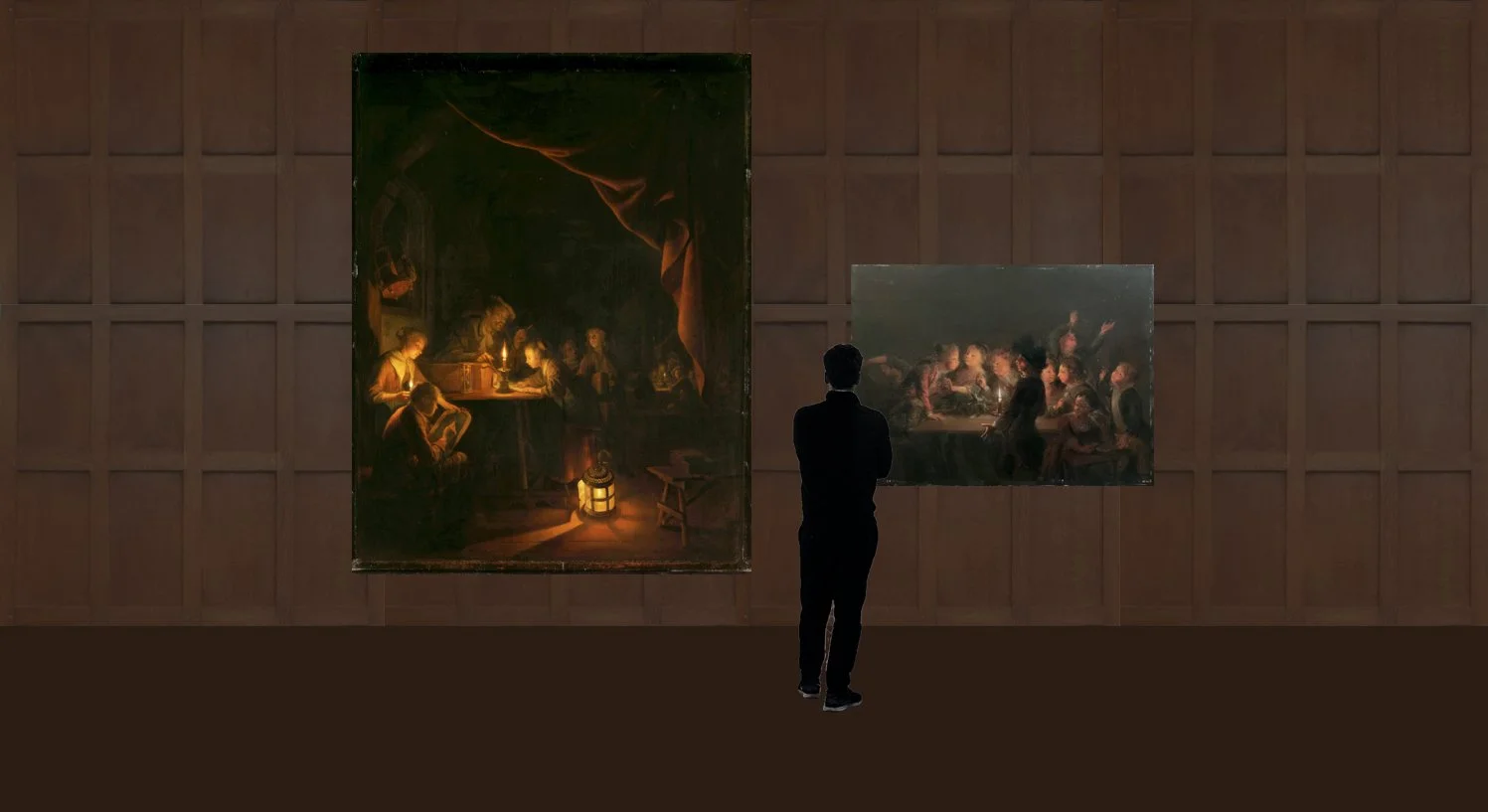
Fig. 48. Interpretation without intrusion. When activated, enlarged illuminated panels allow gestures, expressions, and candlelight to be read at scale by many viewers, while the originals remain untouched, quiet, and complete in themselves.
At a scale that lends the figures a near life-size presence, the panels allow gestures, expressions, and candlelight to be read by groups without crowding. They can reveal, at the touch of a button or on a scheduled cycle:
• the rediscovery sequence — from The Night School alone to the reunited diptych
• the revelations beneath the surface → IRR → white-ground underlayer
• the contrast between Dou’s and Schalcken’s candle flames at magnification
• symbolic imagery: drum, hourglass, cards, bubble, shown at scale
• structural overlays, alignments, and the compositional “locks”
• Dou’s wider educational experiments
• the Lost Silver tribute
• thematic prompts for schools and families
The beauty of the system is its unlimited flexibility. The panels can be used with or without sound, movement, or voiceover; they can support quiet study, group discussion, or guided teaching. Like Dou himself, the museum can experiment — finding what works best for different audiences.
And when not needed, the room returns seamlessly to oak, shadow, and the quiet presence of two candlelit paintings.

Fig. 49. The Night School panel (left) image SK-A-87 downloaded from the Rijksmuseum;
(right) lightened for reading clarity within dossier.
Technical Note on Image Clarity and Adjustment
Both The Night School and Folly are small panels showing candlelit interiors that have darkened over time. No seventeenth-century painting survives at its original luminosity, and Dou’s panel appears to show the progressive mellowing and dulling of aged varnish. Schalcken's is further affected by nineteenth-century intervention: the Courtauld conservation team observed that later restorers added black to its varnish, deepening shadows and suppressing highlights.
To allow the relationships, gestures, and symbolic architecture of the diptych to be read clearly within this dossier, images of The Night School are shown in a judiciously lightened version; presented here alongside the unadjusted image as downloaded from the Rijksmuseum website. [Fig. 49]
The Courtauld report adopts the same approach for Folly, reproducing both the unadjusted surface and a 'normal light' version to reveal underlying detail. The image of Folly at the Night School reproduced throughout this dossier is based on a photograph taken by the author in 2021 and has been very slightly lightened for clarity only, without any chromatic alteration. Original camera metadata is retained.
If the panels are reunited for display, sensitive cleaning will help restore their original clarity and balance as a pair, though the extent of improvement remains to be seen. In a museum setting, even conserved surfaces on this cabinet-sized diptych will remain difficult for larger groups to read simultaneously. This is why large interactive screens — calibrated to convey what the artists themselves assumed would be clear — are not a luxury but a necessity. They allow the originals to remain themselves: small, candlelit, and authentic, while their meaning becomes fully accessible.
D. A Display that Lets the Diptych Teach Again
Together, the intimate studio-like room and the flexible illuminated panels allow the reunited diptych to be experienced as both object and dialogue: seen as it is, in its candlelit stillness, and understood as it works, in its sequencing, correction, animation, and rediscovery.
This arrangement gives scholars, students, teachers, and families a way to explore the diptych at their own pace, by minimising crowding, frustration and visual noise. Most importantly, it allows the master–apprentice dialogue at the heart of the paintings to be felt — a rare opportunity that no standard gallery arrangement could match.
In this sense, the Night School Studio becomes a deeply sympathetic and engaging environment: a scholarly gallery that reflects the diptych’s origins and quietly allows its lessons to emerge. It is the most natural and respectful way to bring the paintings’ full depth to the public — and, in doing so, to give The Night School the impact of scale that its density of detail and thought fully sustains, even if its physical format is small.
It would offer the kind of rewarding encounter that those who hear about or study The Night School will naturally wish to experience for themselves.
If this dossier has shown anything, it is that Dou’s panel was only half the idea. Reunited with its counterpart and displayed in this way, The Night School can once again do what it was made to do: invite learning, delight, and reward sustained looking. Such an opportunity to reshape the understanding of a Dutch national treasure — and to share that discovery with the world — is vanishingly rare.
BIBLIOGRAPHY
Primary Sources
Catalogue de la collection de tableaux … de feu Monsieur Gerrit van der Pot. Rotterdam, 1808.
Catalogue des Tableaux de la célèbre collection de M. Adrian Braamcamp. Amsterdam, 1771.
Catalogue des Tableaux de la collection de M. J. J. de Bruyn. The Hague, 1798.
Catalogue des Tableaux, Dessins et Estampes de feu M. Gerrit van der Pot. Rotterdam, 1808.
Catalogus van een Uitmuntend Kabinet van Schilderijen. Rotterdam: J. van Baalen, 1808.
Catalogus van eene uitmuntende verzameling schilderijen nagelaten door wijlen den heere Adriaan van der Pot, te Rotterdam. Rotterdam, 1808.
Catalogus van schilderijen nagelaten door den heer Pieter de la Court van der Voort. Rotterdam: P. van Dijk, 8 September 1766.
della Porta, Giambattista. De humana physiognomia. Naples: Joseph Cacchium, 1586.
Dou, Gerrit. Death inventory. Stadsarchief Leiden, Notarial Archives, 1675.
Hofstede de Groot, Cornelis. A Catalogue Raisonné of the Works of the Most Eminent Dutch Painters of the Seventeenth Century. Vol. 4. London, 1912.
Hofstede de Groot, Cornelis. A Catalogue Raisonné of the Works of the Most Eminent Dutch Painters of the Seventeenth Century. Vol. 5. London, 1908.
Houbraken, Arnold. De Groote Schouburgh der Nederlantsche Konstschilders en Schilderessen. 3 vols. Amsterdam, 1718–1721.
Immerzeel, J. Jr. De Levens en Werken der Hollandsche en Vlaamsche Kunstschilders. Amsterdam, 1842.
Lipsius, Justus. De Constantia. Leiden, 1584.
Schalcken, Godfried. Portrait of Gerrit Dou. Engraving, 1665.
Thoré-Bürger, Théophile. Musées de la Hollande. Vol. 2. Paris: A. Morel, 1858.
van der Willigen, E. Les Artistes de Harlem. Haarlem, 1870.
Secondary Sources
Baer and Arthur K. Wheelock Jr., ed., Gerrit Dou 1613–1675: Master Painter in the Age of Rembrandt. Exhibition catalogue. Washington/London/The Hague, 2000-2001.
Burke, Peter. The European Renaissance: Centres and Peripheries. Oxford: Blackwell, 1998.
Chapman, H. Perry. Art and Reform in the Early Dutch Republic. Cambridge University Press, 2012.
de Jongh, Eddy. Tot Lering en Vermaak: Meaning and Genre in Dutch Seventeenth-Century Painting. Amsterdam, 1976.
de Winkel, Marieke. Fashion and Fancy: Dress and Meaning in Rembrandt’s Paintings. Amsterdam University Press, 2006.
Emmens, J. A. Rembrandt en de Regels van de Kunst. Amsterdam, 1968.
Emmens, J. A. “Gerrit Dou’s ‘Nursery’ and the Problem of Genre Painting.” Nederlands Kunsthistorisch Jaarboek 11 (1960).
Franits, Wayne. Dutch Seventeenth-Century Genre Painting: Its Stylistic and Thematic Evolution. New Haven: Yale University Press, 2004.
Wayne Franits, Godefridus Schalcken: A Late 17th Century Painter in Pursuit of Fame and Fortune. London: Lund Humphries, 2023.
Fromentin, Eugène. Les Maîtres d’Autrefois: Belgique–Hollande. Paris, 1876.
Giltaij, Jeroen. Catalogue entries in Godfried Schalcken. Dordrecht, 1996.
Groen, Karin. “Grounds in the Paintings of Gerrit Dou.” In Shop Talk: Studies in Technical Art History. Amsterdam, 1995.
Hendrikman, L. Godefridus Schalcken: A Dutch Painter in Late Seventeenth-Century London. Leiden/Boston: Brill, 2016.
Jansen, Guido “Godfried Schalcken.” In Dictionary of Art. London: Macmillan, 1996.
Paulson, Ronald. Hogarth. London: Lutterworth, 1971.
Schama, Simon. The Embarrassment of Riches: An Interpretation of Dutch Culture in the Golden Age. New York: Knopf, 1987.
Sluijter, Eric Jan. Rembrandt’s Rivals: History Painting in Leiden 1620–1640. Amsterdam University Press, 2015.
Sluijter, Eric Jan. Seductions of Sight: The Studio and the Conventions of Painting in the Seventeenth Century. Zwolle: Waanders, 2000.
Sluijter, Eric Jan. Seductions of Sight: Painterly Themes in Seventeenth-Century Dutch Art. Zwolle: Waanders, 2000.
Sluijter, Eric Jan. Seductions of Sight: Painter and Viewer in the Age of Rembrandt. Zwolle: Waanders, 2000.
Sluijter, Eric Jan. “Gerrit Dou and the Perception of Detail.” In Seductions of Sight: Studies in Dutch Art of the Golden Age, 105–129. Zwolle: Waanders, 2000.
Thoré-Bürger, Théophile. “Gérard Dow.” In Musées de Hollande, vol. 2 (1858–60).
van der Veen, Guido J. J., and Arthur K. Wheelock Jr., eds. Jan Steen: Painter and Storyteller. Exhibition catalogue. Washington/Amsterdam, 2016.
Westermann, Mariët. A Worldly Art: The Dutch Republic, 1585–1718. New Haven and London: Yale University Press, 1996.
Westermann, Mariët. “Back to Basics: Rembrandt and the Emergence of Modern Connoisseurship.” Perspective: Actualités de la recherche en histoire de l’art (2011).
Wheelock, Arthur K. Jr. The Leiden Fijnschilders from Dou to Slothouwer. Washington: National Gallery of Art, 1988.
Wright, Christopher. Catalogue of the Foreign Paintings from the de Ferrières Collection and Other Sources. Cheltenham: Cheltenham Art Gallery and Museums, 1980.
Digital/Technical Sources
Christie’s, London. Catalogue of the Genuine and Entire Collection of Pictures of Mr. Godfried Schalcken. Sale, 27 February 1783, lot 38.
Daly, Nathan; Amato, Silvia; and Burnstock, Aviva. Report of a Technical Examination of CIA3062 (Folly at the Night School). Courtauld Institute of Art, Conservation Department, 3 September 2025. Unpublished technical report.
Kassel Gemäldegalerie, Inventory (1749), no. 154.
Mauritshuis. Catalogue entry for Gerrit Dou, The Young Mother (1658).
National Gallery, London. Catalogue entry for Godfried Schalcken, An Old Woman Scouring a Pot (NG846).
National Gallery of Art, Washington. Biographical entry for Godfried Schalcken (1643–1706).
Paillet, Alexandre Joseph. Catalogue d’une collection de tableaux précieux. Paris, 25 March 1786, lot 46.
PubHist database. Entry for Gerrit Dou, The Night School.
Rijksmuseum, Amsterdam. Gerrit Dou, The Night School. Oil on panel. Current catalogue no. SK-C-150 (formerly SK-A-87). Rijksmuseum collection, online catalogue.
Rijksmuseum. Catalogue entry for Jan Steen, The Feast of St Nicholas.
Rijksmuseum. “Stories” page on Gerrit Dou.
Royal Collection Trust. Catalogue entry for Godfried Schalcken, The Game of Lady, Come into the Garden (RCIN 405343).
The Leiden Collection. Catalogue entry for Godfried Schalcken, The Parable of the Lost Piece of Silver.
The Leiden Collection. Technical report on Godfried Schalcken, Self-Portrait by Candlelight.
Wallace Collection. Catalogue entry for Caspar Netscher, A Lady Teaching a Child to Read (1664).
Wikipedia. “Black Swan Theory” (conceptual reference)
Digital facsimile of Catalogus van een Uitmuntend Kabinet van Schilderijen (Rotterdam, 1808).
Digital facsimile of Catalogue d’une riche collection de tableaux… (Rotterdam, 1808).